
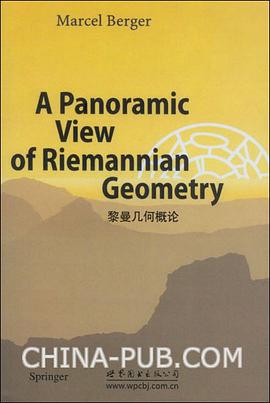

具体描述
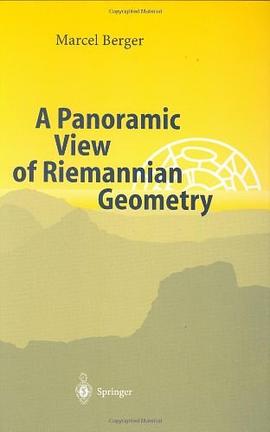
《黎曼几何概论》中着手本领域比较熟悉的话题,并且尽快过渡到最新科研成果。这些结果并没有给出详细的证明,但一些的重要的结果仍然描述的十分详细生动,使得读者对该领域有详细深刻的理解。然而,黎曼流形作为一个很小的科目,概念的建立需要一个过程,前三章侧重于通过常规的方法引入各种概念和黎曼几何的工具,紧接着详细讲述Gauss和Riemann。
作者简介
目录信息
1 euclidean geometry
1.1 preliminaries
1.2 distance geometry
1.2.1 a basic formula
1.2.2 the length of a path
1.2.3 the first variation formula and application to billiards
1.3 plane curves
1.3.1 length
1.3.2 curvature
1.4 global theory of closed plane curves
1.4.1 "obvious" truths about curves which are hard to prove
1.4.2 the four vertex theorem
1.4.3 convexity with respect to arc length
1.4.4 umlaufsatz with corners
1.4.5 heat shrinking of plane curves
1.4.6 arnol'd's revolution in plane curve theory
1.5 the isoperimetric inequality for curves
1.6 the geometry of surfaces before and after gaul}
1.6.1 inner geometry: a first attempt
.1.6.2 looking for shortest curves: geodesics
1.6.3 the second fundamental form and principal curvatures
1.6.4 the meaning of the sign of k
1.6.5 global surface geometry
1.6.6 minimal surfaces
1.6.7 the hartman-nirenberg theorem for inner flat surfaces
1.6.8 the isoperimetric inequality in e3 a la gromov
1.6.8.1 notes
1.7 generic surfaces
1.8 heat and wave analysis in e2
1.8.1 planar physics
1.8.1.1 bibliographical note
1.8.2 why the eigenvalue problem?
1.8.3 minimax
1.8.4 shape of a drum
1.8.4.1 a few direct problems
1.8.4.2 the faber-krahn inequality
1.8.4.3 inverse problems
1.8.5 heat
1.8.5.1 eigenfunctions
1.8.6 relations between the two spectra
1.9 heat and waves in e3, ed and on the sphere
1.9.1 euclidean spaces
1.9.2 spheres
1.9.3 billiards in higher dimensions
1.9.4 the wave equation versus the heat equation
2 transition
3 surfaces from gaufi to today
3.1 gau6
3.1.1 theorema egregium
3.1.1.1 the first proof of ganβ's theorema egregium; the concept of ds2
3.1.1.2 second proof of the theorema egregium.
3.1.2 the gang-bonnet formula and the rodrigues-gauiβ map
3.1.3 parallel transport
3.1.4 inner geometry
3.2 alexandrov's theorems
3.2.1 angle corrections of legendre and gauβ in geodesy
3.3 cut loci
3.4 global surface theory
3.4.1 bending surfaces
3.4.1.1 bending polyhedra
3.4.1.2 bending and wrinkling with little smoothness
3.4.2 mean curvature rigidity of the sphere
3.4.3 negatively curved surfaces
3.4.4 the willmore conjecture
3.4.5 the global gautβ-bonnet theorem for surfaces
3.4.6 the hopf index formula
4 riemann's blueprints
4.1 smooth manifolds
4.1.1 introduction
4.1.2 the need for abstract manifolds
4.1.3 examples
4.1.3.1 submanifolds
4.1.3.2 products
4.1.3.3 lie groups
4.1.3.4 homogeneous spaces
4.1.3.5 orassmannians over various algebras
4.1.3.6 gluing
4.1.4 the classification of manifolds
4.1.4.1 surfaces
4.1.4.2 higher dimensions
4.1.4.3 embedding manifolds in euclidean space
4.2 calculus on manifolds
4.2.1 tangent spaces and the tangent bundle
4.2.2 differential forms and exterior calculus
4.3 examples of riemann's definition
4.3.1 riemann's definition
4.3.2 hyperbolic geometry
4.3.3 products, coverings and quotients
4.3.3.1 products
4.3.3.2 coverings
4.3.4 homogeneous spaces
4.3.5 symmetric spaces
4.3.5.1 classification
4.3.5.2 rank
4.3.6 riemannian submersions
4.3.7 gluing and surgery
4.3.7.1 gluing of hyperbolic surfaces
4.3.7.2 higher dimensional gluing
4.3.8 classical mechanics
4.4 the riemann curvature tensor
4.4.1 discovery and definition
4.4.2 the sectional curvature
4.4.3 standard examples
4.4.3.1 constant sectional curvature
4.4.3.2 projective spaces kpn
4.4.3.3 products
4.4.3.4 homogeneous spaces
4.4.3.5 hypersurfaces in euclidean space
4.5 a naive question: does the curvature determine the metric?
4.5.1 surfaces
4.5.2 any dimension
4.6 abstract riemannian manifolds
4.6.1 isometrically embedding surfaces in e3
4.6.2 local isometric embedding of surfaces in ms
4.6.3 isometric embedding in higher dimensions
5 a one page panorama
6 metric geometry and curvature
6.1 first metric properties
6.1.1 local properties
6.1.2 hopf-rinow and de rham theorems
6.1.2.1 products
6.1.3 convexity and small balls
6.1.4 totally geodesic submanifolds
6.1.5 center of mass
6.1.6 examples of geodesics
6.1.7 transition
6.2 first technical tools
6.3 second technical tools
6.3.1 exponential map
6.3.1.1 rank
6.3.2 space forms
6.3.3 nonpositive curvature
6.4 triangle comparison theorems
6.4.1 bounded sectional curvature
6.4.2 ricci lower bound
6.4.3 philosophy behind these bounds
6.5 injectivity, convexity radius and cut locus
6.5.1 definition of cut points and injectivity radius
6.5.2 klingenberg and cheeger theorems
6.5.3 convexity radius
6.5.4 cut locus
6.5.5 blaschke manifolds
6.6 geometric hierarchy
6.6.1 the geometric hierarchy
6.6.1.1 space forms
6.6.1.2 rank 1 symmetric spaces
6.6.1.3 measure isotropy
6.6.1.4 symmetric spaces
6.6.1.5 homogeneous spaces
6.6.2 constant sectional curvature
6.6.2.1 negatively curved space forms in three and higher dimensions
6.6.2.2 mostow rigidity
6.6.2.3 classification of arithmetic and nonarithmetic negatively curved space forms
6.6.2.4 volumes of negatively curved space forms
6.6.3 rank 1 symmetric spaces
6.6.4 higher rank symmetric spaces
6.6.4.1 superrigidity
6.6.5 homogeneous spaces
7 volumes and inequalities on volumes of cycles
7.1 curvature inequalities
7.1.1 bounds on volume elements and first applications.
7.1.1.1 the canonical measure
7.1.1.2 volumes of standard spaces
7.1.1.3 the isoperimetric inequality for spheres
7.1.1.4 sectional curvature upper bounds
7.1.1.5 ricci curvature lower bounds
7.1.2 isoperimetric profile
7.1.2.1 definition and examples
7.1.2.2 the gromov-berard-besson-gallot bound.
7.1.2.3 nonpositive curvature on noncompaet manifolds
7.2 curvature free inequalities on volumes of cycles
7.2.1 curves in surfaces
7.2.1.1 loewner, pu and blatter-bavard theorems
7.2.1.2 higher genus surfaces
7.2.1.3 the sphere
7.2.1.4 homolngical systoles
7.2.2 inequalities for curves
7.2.2.1 the problem, and standard manifolds
7.2.2.2 filling volume and filling radius
7.2.2.3 gromov's theorem and sketch of the proof
7.2.3 higher dimensional systoles:systolic freedom almost everywhere
7.2.4 embolic inequalities
7.2.4.1 introduction
7.2.4.2 the unit tangent bundle
7.2.4.3 the core of the proof
7.2.4.4 croke's three results
7.2.4.5 infinite injectivity radius
7.2.4.6 using embolic inequalities
8 transition: the next two chapters
8.1 spectral geometry and geodesic dynamics
8.2 why are riemannian manifolds so important?
8.3 positive versus negative curvature
9 spectrum of the laplacian
9.1 history
9.2 motivation
9.3 setting up
9.3.1 xdefinition
9.3.2 the hodge star
9.3.3 facts
9.3.4 heat, wave and schrodinger equations
9.4 minimax
9.4.1 the principle
9.4.2 an application
9.5 some extreme examples
9.5.1 square tori, alias several variable fourier series
9.5.2 other flat tori
9.5.3 spheres
9.5.4 kpn
9.5.5 other space forms
9.6 current questions
9.6.1 direct questions about the spectrum
9.6.2 direct problems about the eigenfunctions
9.6.3 inverse problems on the spectrum
9.7 first tools: the heat kernel and heat equation
9.7.1 the main result
9.7.2 great hopes
9.7.3 the heat kernel and ricci curvature
9.8 the wave equation: the gaps
9.9 the wave equation: spectrum & geodesic flow
9.10 the first eigenvalue
9.10.1 λ1 and ricci curvature
9.10.2 cheeger's constant
9.10.3 λ1 and volume; surfaces and multiplicity
9.10.4 kahder manifolds
9.11 results on eigenfunctions
9.11.1 distribution of the eigenfunctions
9.11.2 volume of the nodal hypersurfaces
9.11.3 distribution of the nodal hypersurfaces
9.12 inverse problems
9.12.1 the nature of the image
9.12.2 inverse problems: nonuniqueneas
9.12.3 inverse problems: finiteness, compactness
9.12.4 uniqueness and rigidity results
9.12.4.1 vigneras surfaces
9.13 special cases
9.13.1 riemann surfaces
9.13.2 space forms
9.13.2.1 scars
9.14 the spectrum of exterior differential forms
10 geodesic dynamics
10.1 introduction
10.2 some well understood examples
10.2.1 surfaces of revolution
10.2.1.1 zou surfaces
10.2.1.2 weinstein surfaces
10.2.2 ellipsoids and morse theory
10.2.3 flat and other tori: influence of the fundamental group
10.2.3.1 flat tori
10.2.3.2 manifolds which are not simply connected
10.2.3.3 tori, not flat
10.2.4 space forms
10.2.4.1 space form surfaces
10.2.4.2 higher dimensional space forms
10.3 geodesics joining two points
10.3.1 birkhoff's proof for the sphere
10.3.2 morse theory
10.3.3 discoveries of morse and serre
10.3.4 computing with entropy
10.3.5 rational homology and gromov's work
10.4 periodic geodesics
10.4.1 the difficulties
10.4.2 general results
10.4.2.1 gromoll and meyer
10.4.2.2 results for the generic ("bumpy") case.
10.4.3 surfaces
10.4.3.1 the lusternik-schnirelmann theorem
10.4.3.2 the bangert-franks-hingston results
10.5 the geodesic flow
10.5.1 review of ergodic theory of dynamical systems
10.5.1.1 ergodicity and mixing
10.5.1.2 notions of entropy
10.6 negative curvature
10.6.1 distribution of geodesics
10.6.2 distribution of periodic geodesics
10.7 nonpositive curvature
10.8 entropies on various space forms
10.8.1 liouville entropy
10.9 from osserman to lohkamp
10.10 manifolds all of whose geodesics are closed
10.10.1 definitions and caution
10.10.2 bott and samelson theorems
10.10.3 the structure on a given sa and ki~
10.11 inverse problems: conjngacy of geodesic flows
11 best metrics
11.1 introduction and a possible approach
11.1.1 an approach
11.2 purely geometric functionals
11.2.1 systolic inequalities
11.2.2 counting periodic geodesics
11.2.3 the embolic constant
11.2.4 diameter and injectivity
11.3 least curved
11.3.1 definitions
11.3.1.1 inf
· · · · · · (收起)
读后感
我当然没有读完这本书,所以这不是一篇书评。事实上,我是今天才买到这本书的。 离开学术的日子,偶尔去书店时,还依然会条件反射般先跑到原版数学书的货架前,翻一翻新出的旧书(没错,事实正是如此)。若在从前,可能还会YY一下若是能啃下来这一本,内功修为又可以增长几何...
评分我当然没有读完这本书,所以这不是一篇书评。事实上,我是今天才买到这本书的。 离开学术的日子,偶尔去书店时,还依然会条件反射般先跑到原版数学书的货架前,翻一翻新出的旧书(没错,事实正是如此)。若在从前,可能还会YY一下若是能啃下来这一本,内功修为又可以增长几何...
评分我当然没有读完这本书,所以这不是一篇书评。事实上,我是今天才买到这本书的。 离开学术的日子,偶尔去书店时,还依然会条件反射般先跑到原版数学书的货架前,翻一翻新出的旧书(没错,事实正是如此)。若在从前,可能还会YY一下若是能啃下来这一本,内功修为又可以增长几何...
评分我当然没有读完这本书,所以这不是一篇书评。事实上,我是今天才买到这本书的。 离开学术的日子,偶尔去书店时,还依然会条件反射般先跑到原版数学书的货架前,翻一翻新出的旧书(没错,事实正是如此)。若在从前,可能还会YY一下若是能啃下来这一本,内功修为又可以增长几何...
评分我当然没有读完这本书,所以这不是一篇书评。事实上,我是今天才买到这本书的。 离开学术的日子,偶尔去书店时,还依然会条件反射般先跑到原版数学书的货架前,翻一翻新出的旧书(没错,事实正是如此)。若在从前,可能还会YY一下若是能啃下来这一本,内功修为又可以增长几何...
用户评价
这本书的封面设计非常有品味,那种深沉的蓝色调搭配简约的字体,一看就知道这是一本严肃的学术著作,而不是那种轻飘飘的入门读物。我最初被它吸引,是因为我对数学的某些抽象概念一直抱有浓厚的兴趣,尤其是那些涉及到空间结构和拓扑特性的理论。拿到手里的时候,感觉分量十足,那种沉甸甸的感觉让人对内容的深度充满了期待。我翻开扉页,看到作者的简介,确实是该领域内的权威人物,这更增加了我对这本书的信心。我期望它能为我揭开那些隐藏在复杂公式背后的几何直觉,让我能够真正“看”到那些高维空间是如何运作的。我不是科班出身,所以对这类书籍的阅读体验要求较高,它既需要有严谨的逻辑推导,又不能让初学者感到完全的不知所措,希望这本书能在两者之间找到一个完美的平衡点。
评分这本书的排版堪称教科书级别的典范,字体大小适中,行距宽松,使得在长时间阅读后眼睛的疲劳感也相对较轻。最让我赞赏的是,插图和图表的质量非常高,它们不仅仅是作为公式的辅助说明,更是理解抽象概念的关键桥梁。许多涉及微分形式和曲率张量的描述,如果没有那些清晰的几何图示,我恐怕会陷入无尽的符号迷宫中。作者似乎非常理解读者在学习这些高深理论时会遇到的困难点,总能在关键的转折处加入详尽的几何直觉铺垫,而不是直接跳跃到纯粹的代数操作。这对我这样试图从几何图像去理解代数结构的学习者来说,简直是雪中送炭。我特别喜欢它对经典微分几何概念的引入方式,那种循序渐进的感觉,让人觉得复杂的理论体系并非遥不可及。
评分说实话,这本书的难度曲线相当陡峭,它绝不是一本可以轻松“翻阅”的书籍。我花了大量时间去消化其中的每一个定理和证明的细节。有些章节的证明过程极其精巧,需要读者具备扎实的微积分和线性代数基础,才能跟上作者的思维步伐。我发现自己经常需要停下来,拿起草稿纸,自己重新推导一遍,以确保完全理解了每一步逻辑的必然性。虽然过程有些煎熬,但每当攻克一个难点,那种豁然开朗的成就感是无与伦比的。这本书的价值恰恰在于其对严谨性的坚持,它没有为了迎合大众而简化核心内容,而是忠实地呈现了该领域最本质的数学结构。对于想要深入研究,甚至未来准备从事相关领域研究的人来说,这无疑是一部不可或缺的“案头工具书”。
评分这本书的章节安排极具匠心,特别是关于流形和张量分析的引入部分,设计得非常巧妙。作者首先从欧几里得空间中的曲线和曲面入手,用最直观的方式建立了局部坐标系和第一基本形式的概念,然后水到渠成地过渡到了抽象的黎曼流形。这种“由具体到抽象”的教学策略,有效地降低了读者面对高维抽象概念时的心理门槛。我特别欣赏它对“测地线”的阐述,通过对惯性运动的几何解释,让原本复杂的变分问题变得清晰可感。总而言之,这本书成功地搭建了一座坚实的桥梁,连接了直观的几何想象与严谨的现代数学语言,为读者开启了一扇通往深奥空间理论的大门,读完后感觉整个认知地图都被拓展了。
评分从图书馆借阅的这本厚重的书,散发出一种独特的、混合了纸张和油墨的学术气息。我注意到书中似乎收录了许多历史上重要的里程碑式的思想片段,不仅仅是现代的框架。作者在回顾理论发展脉络时,展现了一种深厚的历史洞察力,这使得整个学习过程不仅仅是知识的灌输,更像是一场数学思想的朝圣之旅。例如,他对一些早期微分几何学家如何面对“非欧几里得”空间挑战的描述,充满了人文关怀和智力上的敬意。这让我感受到,数学并非是冰冷无情的逻辑堆砌,而是一系列人类伟大智慧探索的结晶。这种兼顾理论深度与历史纵深的叙事方式,极大地提升了阅读体验,让我对纯粹的数学美学有了更深层次的体会。
评分在文轩网下的单,刚拿到书,大失所望,印刷质量很差,纸张有点发霉,而且闻起来一股味道。。。与我在新街口新华书店看到的那个版本完全不能比。感觉是盗印的,Fuck
评分在文轩网下的单,刚拿到书,大失所望,印刷质量很差,纸张有点发霉,而且闻起来一股味道。。。与我在新街口新华书店看到的那个版本完全不能比。感觉是盗印的,Fuck
评分在文轩网下的单,刚拿到书,大失所望,印刷质量很差,纸张有点发霉,而且闻起来一股味道。。。与我在新街口新华书店看到的那个版本完全不能比。感觉是盗印的,Fuck
评分数学还有很多问题,
评分在文轩网下的单,刚拿到书,大失所望,印刷质量很差,纸张有点发霉,而且闻起来一股味道。。。与我在新街口新华书店看到的那个版本完全不能比。感觉是盗印的,Fuck
相关图书











本站所有内容均为互联网搜索引擎提供的公开搜索信息,本站不存储任何数据与内容,任何内容与数据均与本站无关,如有需要请联系相关搜索引擎包括但不限于百度,google,bing,sogou 等
© 2026 book.quotespace.org All Rights Reserved. 小美书屋 版权所有