
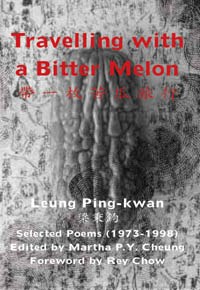

具体描述
"It is fitting that Travelling With A Bitter Melon, the most comprehensive collection of Leung Ping-kwan's poetry, should come at a tim e when Hong Kong is experiencing an upsurge of interest in home-grown writing. Fitting, because this bilingual volume will serve to remind those striving to forge Hong Kong's English-language voice that the city's most gifted poet has been writing and publishing in Chinese for more than a quarter of a century, and has built up an invaluable body of work over that time. This book is a must for anyone who takes Hong Kong writing seriously.
"The complicated subject of Hong Kong identity dominates. Leung focuses deliberately on the ordinary: a teacup, a tree, a deserted tram depot, a bitter melon. They are our shared images and they are treated tenderly.
"A thread of disciplined intelligence runs through Leung's work, lending these mundane images a singular power. The first poem in the volume, 'Tea,' reveals the poet's trademark preoccupation with food as a metaphor. In this poem, 'Jasmine petals gather/or disperse in patterns', a reminder of dear friends: 'Kept apart by so many trivialities/we have no moment of silence/to sit and sip together'.
"The lines are redolent of classical Chinese poetry, a key interest ?Leung is professor of Chinese at Lingnan University in Tuen Mun.
"Leung's language is crisp, searching and unsentimental without simplifying his subject matter. In 'Fragments Of A Northern Song Dynasty Fish-shaped Pot,' the poet wonders from where in China it came, and concludes: 'The fragments say: Please carefully study our grain/Don't read us into/Your history.' Hong Kong is on the periphery, offering alternative solutions to what it means to be Chinese in the modern world.
"Later, in 'Images Of Hong Kong,' the narrator searches for a postcard to send a friend. Yet he finds mostly 'Exotica for a faraway audience...Entangled with what others have said/Why is it so hard to tell our own stories?'
"The poems offer a chronological journey froth the relative stability of the 1970s through the growing insecurities of the 1980s as the Joint Declaration on Hong Kong's future was signed.
"This collection also shows Leung's proclivity for food as a metaphor of cultural identity, something pointed out in Rey Chow's excellent introductory essay.
"In 'Mussels In Brussels,' the poet muses: 'All say mussels have no identity problems/Perhaps...after all, here in Brussels/we still eat Canadian mussels'. Yet the poem's final conclusion argues for a sense of origin: 'Chinese mussels strayed from home/thousands of miles away, still taste of/the ponds and lakes that bred them.'
"There is a cinematic quality to much of Leung's work, which one of his translators, Gordon Osing, has attributed to the elisions in the lines. This isn't a coincidence ?Leung is interested in film, and film is the art form that has done the most to articulate the modern Hong Kong sensibility and win it an international audience. The films of John Woo or Wong Kar-wai are examples of this.
"If poetry is an overlooked art these days, then Hong Kong poetry falls into a doubly ignored category, being poetry from a city in which few people are interested in the written word.
"Yet readers will find a vividness and veracity of historical, cultural and emotional detail which, rooted in the Hong Kong experience, should put to rest any doubts about the city's place as a literary hub."
Didi Kirsten Tatlow
South China Morning Post
作者简介
目录信息
Foreword:An Ethics of Consumption / by Rey Chow 9
Introduction / by Martha P.Y. Cheung 19
蟬鳴 CICADA CHIRPS
茶 Tea 38
半途 Halfway 40
雷聲與蟬鳴 Thunder and the Chirping of Cicadas 44
剝海膽 Opening Sea Urchins 48
浮藻 Seaweed 52
冬日船艙 Boat Cabin in Winter 58
盆栽 Potted Plants 62
萬葉植物園遇雪 Snow in the Myriad Leaves Botanical Garden 70
初春二題 Early Spring I & II 72
舊城 OLD CITIES
拆建中的摩囉街 Demolition on Cat Street 80
寒夜,電車廠 Freezing Night,Tram Depot 84
笆掌圍斜巷 The Steep Alley at A. Agostinho 88
避雨南灣小咖啡店 Sheltering from Rain in a Coffee Shop in Praia Grande 90
大三笆牌坊 St. Paul's Ruins 94
關閘 Barrier Gate 98
舊城 Dreary City 102
鐘乳岩 Stalactites 104
湖 The Lake 108
故宮 Imperial Palace 112
西洋畫素描班 Academy of Fine Arts, Beijing 114
北京早晨 Morning, Beijing 116
游詩 JOURNEYS
待魚 Waiting for Fish 120
一個尋常的雨天 An Ordinary Rainy Day 128
除夕 New Year's Eve 132
聽John Cage 音樂會回來的路上 After John Cage 138
太陽昇起的頌詩 Ode to the Sun Rising 146
用左手的女人 The Left-handed Woman 150
修理屋背的頌詩 Ode to Roof Repair 154
在紐約街頭看落葉 Watching Falling leaves on a New York Street 160
蓮葉 LOTUS LEAVES
連葉 Leaf Contact 166
冕葉 Leaf Crown 170
戀葉 Leaf Enchantment 174
憐葉 Leaf Pity 178
漣葉 Leaf Ripples 180
牆後 BEYOND THE WALLS
靜物 Still-life 184
大地上的居所 A Shelter on Earth 188
牆倒了又生出一扇牆 A Wall Crumbles and Another Wall Comes up 192
華沙軍事博物館 Warsaw Military Museum 194
一所波蘭餐館 A Restaurant in Poland 196
奧斯維兹集中營舊址 The Remains at Auschwitz 198
克拉科夫歷史博物館 Kraków History Museum 202
雨後的歐洲 Europe after the Rain 204
威廉大帝的破教堂 The Dilapidated Kaiser Wilhelm Memorial Church 206
萊頓的現代中國詩會 Conference on Modern Chinese Poetry at Lyden 210
食事地誌 FOODSCAPE
鴛鴦 Tea-coffee 216
洋蔥 Onion 218
除夕盆菜 Pun Choi on New Year's Eve 220
蘇豪的早餐 Breakfast in Soho 226
柏林的啤酒 Beer in Berlin 228
青蠔與文化身份 Mussels in Brussels 232
鹹蝦醬 Salted Shrimp Paste 236
菜乾湯 Soup with Dried Chinese Cabbage 240
茄子 Eggplants 244
二人壽司 Sushi for Two 248
球鞋 Sneakers 250
試酒 Wine Tasting 256
在峰景酒店 At Bela Vista 260
帶一枚苦瓜旅行 Travelling with a Bitter Melon 266
博物館 MUSEUM PIECES
周鼎 Cauldron 274
陶俑 Clay Figures 278
銅鏡 Bronze Mirror 282
羅汉 Arhats 286
刺繡 Embroidery 290
北宋魚形壼殘件 Fragments of a Northern Song Dynasty Fish-shaped Pot 296
汉拓 Han Dynasty Rubbing 300
重畫地圖 RE-MAPPING
雀仔街 Bird Street 306
大角咀填海區 Reclamation Land in Tai Kok Tsui 310
虎豹別墅 Tiger Balm Garden 314
老殖民地建築 An Old Colonial Building 316
形象香港 Images of Hong Kong 320
香港歷史明信片 Postcards of Old Hong Kong 324
看李家昇黃楚喬照片冊有感 Leafing through Wingo and Holly's Photo Albums 328
蔡孑民先生墓前 At the Grave of Mr Cai Jiemin 332
我的六零年代 The 1960s for me 338
重畫地圖 Re-mapping 346
Acknowledgements 352
· · · · · · (收起)
读后感
评分
评分
评分
评分
用户评价
从语言的音乐性和节奏感来看,这本书无疑达到了一个极高的水准。作者的句子结构充满了变奏,长句的蜿蜒曲折与短句的干脆利落交替出现,形成了一种阅读上的旋律感。阅读起来,仿佛是听到了一部由大提琴和短笛合奏的室内乐,时而低沉婉转,时而轻快跳跃。我甚至会忍不住大声朗读某些句子,去体会那种音韵上的美感,仿佛文字本身就具有了某种物质性的震动。而且,作者在运用重复和回环的修辞手法上,也显示出大师级的掌控力。某些关键的意象或短语会在不同章节中以不同的面貌重新出现,每一次的重现都带着累积的意味和新的光芒,极大地增强了文本的整体性和张力。这种对语言节奏的精妙运用,使得这本书的文学价值得到了质的提升,让阅读体验变成了一种纯粹的审美享受。
评分这本书的叙事方式简直是独树一帜,充满了那种让人猝不及防的幽默感和对生活细致入微的观察。作者似乎拥有一种魔力,能把最寻常的日常场景描绘得活灵活现,让人忍不住会心一笑。比如,书中关于机场安检那一段的描写,那种焦虑和无奈被刻画得淋漓尽致,我甚至能清晰地感受到那种队伍排成长龙时的焦躁,以及被要求脱掉鞋子的尴尬,读起来简直像是在看一出精彩的默剧。而且,作者的文字功底极其扎实,遣词造句都带着一种老派的优雅,但又时不时地跳出一些极其现代、接地气的比喻,这种古典与现代的碰撞,让阅读体验妙不可言。这本书的节奏把握得非常好,时而平缓如溪水潺潺,时而又像一阵疾风骤雨,让人肾上腺素飙升。我特别喜欢作者处理人物内心挣扎的方式,那些看似微不足道的纠结,被放大后竟然展现出了极具共鸣的人性光辉与脆弱。总而言之,这是一本让人读完后,会对身边的一切都多看两眼的奇妙作品,它不仅仅是记录了“旅行”,更像是记录了一种“存在”的状态。
评分这部作品的结构布局,我必须得说,简直是文学形式上的一个大胆实验。它摒弃了传统小说的线性叙事,而是采用了碎片化、多层次的拼贴手法。你得随时准备好大脑进入“快速切换”模式,因为下一秒,场景可能就从某个异国街头的喧嚣瞬间跳跃到了作者对某个哲学命题的沉思。这种阅读过程,与其说是被动接受信息,不如说是在主动参与一次解谜。每一个章节都像是一块精心打磨的宝石,单独看已足够璀璨,但只有将它们按照作者巧妙设置的暗线串联起来,才能看到那幅完整的、令人震撼的图景。我花了相当长的时间去梳理这些线索,那种“啊哈!”的顿悟时刻,简直是阅读的极致享受。它挑战了我们对“故事”的固有认知,迫使读者走出舒适区,去重新审视文本与意义之间的关系。对于那些厌倦了千篇一律情节设置的读者来说,这本书绝对是一剂强心针,它让你感受到文字的力量可以多么肆意和不受拘束。
评分让我印象深刻的是作者所营造的氛围,那是一种混合着怀旧、疏离感和淡淡忧伤的独特基调。书中的每一个场景似乎都蒙上了一层薄雾,即便描绘的是阳光明媚的正午,你也能从中捕捉到一丝不易察觉的寂寥。这种情绪的渗透力极强,仿佛作者不是在用文字描述,而是在用嗅觉和触觉进行创作。我特别欣赏他对“地方感”的捕捉,他描绘的那些城市、街道、甚至是一间小小的咖啡馆,都仿佛拥有了自己的呼吸和历史,它们不再是单纯的背景板,而是成为了推动情节、影响角色命运的无形角色。读到某些段落时,我甚至能闻到雨后泥土的气息,感受到那种清晨街道上特有的冷冽空气。这种高超的感官唤醒能力,是许多作品望尘莫及的。它让你觉得,你不仅仅是在阅读一个故事,更像是被邀请进入了一个充满诗意和沉思的梦境之中,久久不愿醒来。
评分这本书所探讨的主题深度,远超出了其表面上似乎轻快的叙事风格所能暗示的范畴。它不动声色地触及了诸如身份认同的流动性、现代人与环境的隔阂,以及时间在个体生命中的意义等宏大议题。然而,作者处理这些深刻话题的方式极其高明,他从不进行说教式的阐述,而是将哲理巧妙地融入到一次次的偶然相遇和细微的观察之中。你会发现,在一次看似随意的交谈背后,隐藏着对存在意义的深刻反思。最精彩的是,作者似乎能精准地捕捉到我们每一个普通人在面对生活转折点时的那种犹豫和自我怀疑,并将这种复杂的情绪进行艺术提纯。这种“以小见大”的叙事哲学,使得原本高冷的哲学思考变得触手可及,具有极强的现实意义。对于那些喜欢在阅读中进行自我对话和思想碰撞的读者来说,这本书简直是一座宝藏。
评分 评分 评分 评分 评分相关图书







本站所有内容均为互联网搜索引擎提供的公开搜索信息,本站不存储任何数据与内容,任何内容与数据均与本站无关,如有需要请联系相关搜索引擎包括但不限于百度,google,bing,sogou 等
© 2026 book.quotespace.org All Rights Reserved. 小美书屋 版权所有