
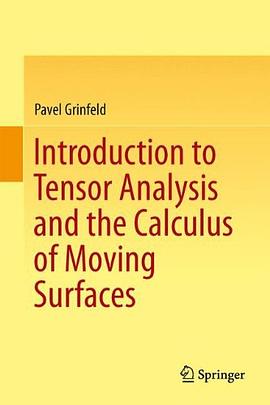
Introduction to Tensor Analysis and the Calculus of Moving Surfaces pdf epub mobi txt 电子书 下载 2026
- 微分几何
- Math
- 数学
- 张量
- MathDifferentialGeometry
- 张量分析
- 微分几何
- 移动曲面
- 微积分
- 数学
- 物理
- 工程
- 高等数学
- 经典教材
- 几何学

具体描述
This textbook is distinguished from other texts on the subject by the depth of the presentation and the discussion of the calculus of moving surfaces, which is an extension of tensor calculus to deforming manifolds.
Designed for advanced undergraduate and graduate students, this text invites its audience to take a fresh look at previously learned material through the prism of tensor calculus. Once the framework is mastered, the student is introduced to new material which includes differential geometry on manifolds, shape optimization, boundary perturbation and dynamic fluid film equations.
The language of tensors, originally championed by Einstein, is as fundamental as the languages of calculus and linear algebra and is one that every technical scientist ought to speak. The tensor technique, invented at the turn of the 20th century, is now considered classical. Yet, as the author shows, it remains remarkably vital and relevant. The author’s skilled lecturing capabilities are evident by the inclusion of insightful examples and a plethora of exercises. A great deal of material is devoted to the geometric fundamentals, the mechanics of change of variables, the proper use of the tensor notation and the discussion of the interplay between algebra and geometry. The early chapters have many words and few equations. The definition of a tensor comes only in Chapter 6 – when the reader is ready for it. While this text maintains a consistent level of rigor, it takes great care to avoid formalizing the subject.
The last part of the textbook is devoted to the Calculus of Moving Surfaces. It is the first textbook exposition of this important technique and is one of the gems of this text. A number of exciting applications of the calculus are presented including shape optimization, boundary perturbation of boundary value problems and dynamic fluid film equations developed by the author in recent years. Furthermore, the moving surfaces framework is used to offer new derivations of classical results such as the geodesic equation and the celebrated Gauss-Bonnet theorem.
作者简介
Pavel Grinfeld is currently a professor of mathematics at Drexel University, teaching courses in linear algebra, tensor analysis, numerical computation, and financial mathematics. Drexel is interested in recording Grinfeld's lectures on tensor calculus and his course is becoming increasingly popular. Visit Professor Grinfeld's series of lectures on tensor calculus on YouTube's playlist: http://bit.ly/1lc2JiY http://bit.ly/1lc2JiY
Also view the author's Forum/Errata/Solution Manual (Coming soon): http://bit.ly/1nerfEf
The author has published in a number of journals including 'Journal of Geometry and Symmetry in Physics' and 'Numerical Functional Analysis and Optimization'. Grinfeld received his PhD from MIT under Gilbert Strang.
目录信息
读后感
评分
评分
评分
评分
用户评价
这本书的封面设计着实引人注目,那种深邃的蓝色背景配上烫金的标题,立刻给人一种严谨、学术的冲击力。我第一次翻开它的时候,内心是既期待又有些忐忑的,毕竟“张量分析”和“运动曲面微积分”这两个词汇本身就预示着一段不平凡的阅读旅程。虽然我还没有深入到核心的数学推导部分,但光是阅读前言和目录,就能感受到作者在知识体系构建上的匠心独运。作者显然花费了大量精力去梳理不同数学分支间的内在联系,试图搭建一座从经典微积分到更高维几何学之间的坚实桥梁。尤其是对引言部分的叙述,那种层层递进的逻辑铺陈,让人感觉到数学的严密美感,仿佛在欣赏一座精心雕琢的艺术品,每一个符号、每一个定义都恰到好处,既不失严谨性,又尽可能地降低了初学者的入门门槛。这种对知识结构清晰的把握,预示着本书在后续章节中,对复杂概念的讲解也会是条理分明、循序渐进的。我非常好奇作者是如何处理那些抽象的、需要高度空间想象力的几何概念的。
评分这本书的排版和字体选择,简直是教科书制作的典范。清晰的页边距,适中的行距,以及那套沉稳的衬线字体,使得长时间的阅读也不会让人感到视觉疲劳。这一点对于阅读这种高度依赖精确符号和复杂公式的学科书籍来说至关重要。我注意到作者在引入新的数学符号或定义时,总会用加粗或者斜体进行特别强调,这极大地帮助了快速定位关键信息,尤其是在回顾和查阅时,效率倍增。而且,书中的插图——尽管我还没看到特别复杂的动力学图示——但那些基础的坐标系变换和向量场的示意图,都处理得非常干净利落,没有多余的干扰元素,完全服务于数学概念的阐释。这种对细节的关注,体现了出版方和作者对读者体验的尊重,让原本枯燥的公式学习过程,增添了一份可读性。我甚至觉得,这本书的装帧质量已经达到了可以作为工具书长期保存的水平,它的物理形态本身就在无声地传递着专业和可靠。
评分从目录的结构来看,本书似乎并未急于跳入爱因斯坦场方程或者广义相对论中的那些高阶应用,而是选择了一条更为扎实的基础路线。我注意到它花了相当大的篇幅来建立欧几里得空间中曲线和曲面的微分几何基础,这无疑是一个明智的策略。很多引入张量分析的教材往往会因为过早地引入伪黎曼流形的概念而让读者迷失方向。然而,本书似乎更倾向于先让读者在熟悉的环境中,体会张量作为一种描述物理量独立于坐标系变换的本质属性。这种“由浅入深,扎根基础”的教学思路,对于那些有扎实微积分背景,但对张量概念尚感陌生的工程师或物理学生来说,无疑是更友好的。我特别期待看到作者是如何将传统的偏微分与协变导数联系起来的,那里往往是理解张量分析精髓的关键所在。
评分这本书的语言风格,初读下来,给人一种沉稳而又略带英式幽默的学者气息。它不像某些标准教科书那样,只是冷冰冰地陈述定理和证明,而是夹杂着一些对数学思想背景的探讨。比如,在解释为什么需要引入度规张量时,作者不仅仅是给出了公式,还简要回顾了欧几里得距离概念的局限性,将数学工具的诞生置于解决实际问题的历史脉络中。这种“讲故事”的方式,极大地激发了我继续探索下去的好奇心。它让读者感觉到,这些复杂的数学结构不是凭空出现的,而是人类智慧为了更精确地描述世界而不得不发展出来的工具。这种人文关怀与硬核数学的结合,使得本书的阅读体验更加立体和丰富,让人愿意花时间去品味其中的深意,而不是仅仅为了应试而匆匆浏览。
评分我注意到,这本书似乎非常注重概念之间的辨析和类比,这在处理“运动曲面”这类涉及时间演化的几何概念时尤其重要。例如,在介绍物质导数和物质导数在流体动力学中的应用时,作者似乎采用了多角度的解释,通过不同的积分形式和微分算子来展现同一物理过程在不同数学框架下的表达。这种对比和交叉验证的学习方法,非常有助于巩固那些容易混淆的抽象概念。如果后续章节能保持这种严谨的对比风格,那么对于那些希望将张量分析应用于流体力学、弹性力学或电磁场理论中的读者来说,这本书的价值将不仅仅停留在理论介绍层面,而是一本实用的、指导性的参考书。它仿佛在对读者说:看,同样的运动规律,在不同的数学语言下是如何精确而优雅地被捕捉到的。
评分 评分 评分 评分 评分相关图书









本站所有内容均为互联网搜索引擎提供的公开搜索信息,本站不存储任何数据与内容,任何内容与数据均与本站无关,如有需要请联系相关搜索引擎包括但不限于百度,google,bing,sogou 等
© 2026 book.quotespace.org All Rights Reserved. 小美书屋 版权所有