
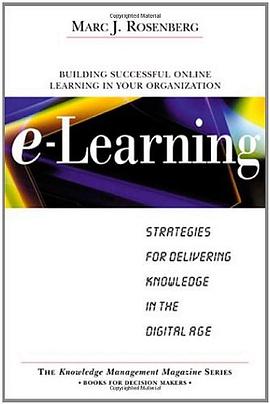

具体描述
This is the first strategy book on developing organization-wide, online learning. Learn what companies like AT&T, Cisco Systems, Dell Computer, IBM, Lucent Technologies, Merrill Lynch, Prudential, and U S West and others have accomplished with e-learning. It isn't just the promise of impressive technology that is driving people to e-learning. Businesses need to get rapidly changing information to large numbers of people faster than ever. They need to lower the overall costs of creating a workforce that performs faster and better than the competition, and they need to do this around the clock. It's no longer a question of whether organizations will one day implement online learning, but whether they will do it well.Most organizations that need to train their employees are experimenting with some form of Web-delivered learning. But most organizations have focused on the technological challenges, buying the right software, getting enough bandwidth allocated for Web-based training, designing courseware, etc. These are important first steps but the larger strategic issues remain unsolved: how to make e-learning part of the daily work culture, and fully implement its power. "E-Learning" is the first book in this exciting new field that addresses not just the technological challenges of Web-based training and knowledge management, but how to develop a comprehensive organization-wide learning strategy. Author Marc Rosenberg discusses the technological issues but more importantly, assesses the dramatic strategic, organizational, and political issues involved in the process of making e-learning a reality.Written for professionals responsible for leading the revolution in workplace learning, "E-Learning" takes a broad, strategic perspective on corporate learning. This wake-up call for executives everywhere discusses: requirements for building a viable e-learning strategy; how e-learning will change the nature of training organizations; knowledge management; and, other new forms of e-learning. "E-Learning" explains the basic principles of a comprehensive Web-based learning strategy - how to link your organization's Web sites, Web-based training, courseware, and all the other components of online learning.With an underlying focus on the "why" - and not just the "how" - Rosenberg provides a roadmap for growing and sustaining an e-learning culture that's based on twenty years of observations, best (and worst) practices, and conversations with leaders in the learning technology fields. Divided into three parts, "E-Learning" offers an essential balance between building great e-learning (design and technology issues) and implementing it (acceptance and support issues). Within each chapter, examples illustrate many key components of an effective e-learning framework. Unlike other technology-focused guides to Web-based training, "E-Learning" is the first book that tackles the overarching strategic issues - problems facing any organization experimenting with the tremendous promise of Web-based learning and knowledge management."The biggest growth in the Internet, and the area that will prove to be one of the biggest agents of change, will be in e-learning." - John Chambers, CEO, Cisco Systems. 'Marc Rosenberg is one of the key thinkers in the ever-changing world of learning and technology. This book offers a pragmatic and powerful set of resources for any organization walking the sometimes slippery e-learning pathway' - Elliott Masie, President, The MASIE Center. 'If there is any reason to fear e-learning, it's that we will fail to understand why we are doing it. This book combines the right amount of reflection on why with a heavy dose of sound advice about how to. It has a lot in common with it's subject. It's just what we need, just in time' - John W. Cone, Vice President, Dell Learning, Dell Computer Corporation.'Marc Rosenberg has nailed it. He surfaces the issues, realistically describes alternatives and operationalizes what a true e-learning strategy is. Good cases. Good ideas. Good writing. You need this book!' - Gloria Gery, Consultant in Performance Support and Learning. 'Dr. Rosenberg's vision, coupled with the useful advice peppered throughout his book, will guide corporate leaders of learning as we strive to harness the power of e-learning for the benefit of our people and our businesses. I intend to share the book widely with my business colleagues and professional associates' - Pat Kelly, Vice President, People Development, AT&T Wireless Services.
作者简介
目录信息
读后感
评分
评分
评分
评分
用户评价
相关图书
















本站所有内容均为互联网搜索引擎提供的公开搜索信息,本站不存储任何数据与内容,任何内容与数据均与本站无关,如有需要请联系相关搜索引擎包括但不限于百度,google,bing,sogou 等
© 2026 book.quotespace.org All Rights Reserved. 小美书屋 版权所有