
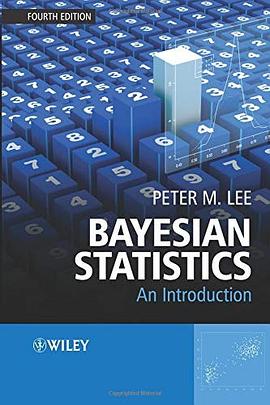
Bayesian Statistics pdf epub mobi txt 电子书 下载 2026
- statistics
- Bayes统计
- Bayes
- 贝叶斯统计学
- 统计
- 2012
- 贝叶斯统计
- 统计学
- 概率论
- 机器学习
- 数据分析
- 模型选择
- 推断统计
- 蒙特卡洛方法
- 贝叶斯网络
- 统计建模

具体描述
Bayesian Statistics is the school of thought that combines prior beliefs with the likelihood of a hypothesis to arrive at posterior beliefs. The first edition of Peter Lee's book appeared in 1989, but the subject has moved ever onwards, with increasing emphasis on Monte Carlo based techniques. This new fourth edition looks at recent techniques such as variational methods, Bayesian importance sampling, approximate Bayesian computation and Reversible Jump Markov Chain Monte Carlo (RJMCMC), providing a concise account of the way in which the Bayesian approach to statistics develops as well as how it contrasts with the conventional approach. The theory is built up step by step, and important notions such as sufficiency are brought out of a discussion of the salient features of specific examples. This edition: Includes expanded coverage of Gibbs sampling, including more numerical examples and treatments of OpenBUGS, R2WinBUGS and R2OpenBUGS. Presents significant new material on recent techniques such as Bayesian importance sampling, variational Bayes, Approximate Bayesian Computation (ABC) and Reversible Jump Markov Chain Monte Carlo (RJMCMC). Provides extensive examples throughout the book to complement the theory presented. Accompanied by a supporting website featuring new material and solutions. More and more students are realizing that they need to learn Bayesian statistics to meet their academic and professional goals. This book is best suited for use as a main text in courses on Bayesian statistics for third and fourth year undergraduates and postgraduate students.
作者简介
目录信息
Preface to the First Edition xxi
1 Preliminaries 1
1.1 Probability and Bayes’ Theorem 1
1.2 Examples on Bayes’ Theorem 9
1.3 Random variables 12
1.4 Several random variables 17
1.5 Means and variances 23
1.6 Exercises on Chapter 1 31
2 Bayesian inference for the normal distribution 36
2.1 Nature of Bayesian inference 36
2.2 Normal prior and likelihood 40
2.3 Several normal observations with a normal prior 44
2.4 Dominant likelihoods 48
2.5 Locally uniform priors 50
2.6 Highest density regions 54
2.7 Normal variance 55
2.8 HDRs for the normal variance 59
2.9 The role of sufficiency 60
2.10 Conjugate prior distributions 67
2.11 The exponential family 71
2.12 Normal mean and variance both unknown 73
2.13 Conjugate joint prior for the normal distribution 78
2.14 Exercises on Chapter 2 82
3 Some other common distributions 85
3.1 The binomial distribution 85
3.2 Reference prior for the binomial likelihood 92
3.3 Jeffreys’ rule 96
3.4 The Poisson distribution 102
3.5 The uniform distribution 106
3.6 Reference prior for the uniform distribution 110
3.6.1 Lower limit of the interval fixed 110
3.7 The tramcar problem 113
3.8 The first digit problem; invariant priors 114
3.9 The circular normal distribution 117
3.10 Approximations based on the likelihood 122
3.11 Reference posterior distributions 128
3.12 Exercises on Chapter 3 134
4 Hypothesis testing 138
4.1 Hypothesis testing 138
4.2 One-sided hypothesis tests 143
4.3 Lindley’s method 145
4.4 Point (or sharp) null hypotheses with prior information 146
4.5 Point null hypotheses for the normal distribution 150
4.6 The Doogian philosophy 157
4.7 Exercises on Chapter 4 158
5 Two-sample problems 162
5.1 Two-sample problems – both variances unknown 162
5.2 Variances unknown but equal 165
5.3 Variances unknown and unequal (Behrens–Fisher problem) 168
5.4 The Behrens–Fisher controversy 171
5.5 Inferences concerning a variance ratio 173
5.6 Comparison of two proportions; the 2 × 2 table 176
5.7 Exercises on Chapter 5 179
6 Correlation, regression and the analysis of variance 182
6.1 Theory of the correlation coefficient 182
6.2 Examples on the use of the correlation coefficient 189
6.3 Regression and the bivariate normal model 190
6.4 Conjugate prior for the bivariate regression model 197
6.5 Comparison of several means – the one way model 200
6.6 The two way layout 209
6.7 The general linear model 212
6.8 Exercises on Chapter 6 217
7 Other topics 221
7.1 The likelihood principle 221
7.2 The stopping rule principle 226
7.3 Informative stopping rules 229
7.4 The likelihood principle and reference priors 232
7.5 Bayesian decision theory 234
7.6 Bayes linear methods 240
7.7 Decision theory and hypothesis testing 243
7.8 Empirical Bayes methods 245
7.9 Exercises on Chapter 7 247
8 Hierarchical models 253
8.1 The idea of a hierarchical model 253
8.2 The hierarchical normal model 258
8.3 The baseball example 262
8.4 The Stein estimator 264
8.5 Bayesian analysis for an unknown overall mean 268
8.6 The general linear model revisited 272
8.7 Exercises on Chapter 8 277
9 The Gibbs sampler and other numerical methods 281
9.1 Introduction to numerical methods 281
9.2 The EM algorithm 283
9.3 Data augmentation by Monte Carlo 291
9.4 The Gibbs sampler 294
9.5 Rejection sampling 311
9.6 The Metropolis–Hastings algorithm 317
9.7 Introduction to WinBUGS and OpenBUGS 323
9.8 Generalized linear models 332
9.9 Exercises on Chapter 9 335
10 Some approximate methods 340
10.1 Bayesian importance sampling 340
10.2 Variational Bayesian methods: simple case 345
10.3 Variational Bayesian methods: general case 353
10.4 ABC: Approximate Bayesian Computation 356
10.5 Reversible jump Markov chain Monte Carlo 367
10.6 Exercises on Chapter 10 369
Appendix A Common statistical distributions 373
A.1 Normal distribution 374
A.2 Chi-squared distribution 375
A.3 Normal approximation to chi-squared 376
A.4 Gamma distribution 376
A.5 Inverse chi-squared distribution 377
A.6 Inverse chi distribution 378
A.7 Log chi-squared distribution 379
A.8 Student’s t distribution 380
A.9 Normal/chi-squared distribution 381
A.10 Beta distribution 382
A.11 Binomial distribution 383
A.12 Poisson distribution 384
A.13 Negative binomial distribution 385
A.14 Hypergeometric distribution 386
A.15 Uniform distribution 387
A.16 Pareto distribution 388
A.17 Circular normal distribution 389
A.18 Behrens’ distribution 391
A.19 Snedecor’s F distribution 393
A.20 Fisher’s z distribution 393
A.21 Cauchy distribution 394
A.22 The probability that one beta variable is greater than another 395
A.23 Bivariate normal distribution 395
A.24 Multivariate normal distribution 396
A.25 Distribution of the correlation coefficient 397
Appendix B Tables 399
B.1 Percentage points of the Behrens–Fisher distribution 399
B.2 Highest density regions for the chi-squared distribution 402
B.3 HDRs for the inverse chi-squared distribution 404
B.4 Chi-squared corresponding to HDRs for log chi-squared 406
B.5 Values of F corresponding to HDRs for log F 408
Appendix C R programs 430
Appendix D Further reading 436
D.1 Robustness 436
D.2 Nonparametric methods 436
D.3 Multivariate estimation 436
D.4 Time series and forecasting 437
D.5 Sequential methods 437
D.6 Numerical methods 437
D.7 Bayesian networks 437
D.8 General reading 438
References 439
Index 455
· · · · · · (收起)
读后感
评分
评分
评分
评分
用户评价
总体而言,这本书带来的价值远超乎我最初对一本专业统计学教材的期待。它不仅仅是教授“如何做”贝叶斯统计,更重要的是教会了读者“为何要”用贝叶斯的方式去思考问题。这种思维模式的转变,才是最宝贵的收获。书中关于**层次结构模型**的讲解部分,简直是教科书级别的示范。作者通过一个复杂的纵向数据分析案例,层层剥茧地展示了如何构建一个包含多层随机效应的复杂模型,并优雅地处理了参数估计和模型比较的问题。他着重强调了,在贝叶斯框架下,模型的不确定性是如何被自然地纳入到整体推断过程中的,这一点是很多传统频率派方法难以做到的。这种对不确定性的全面拥抱,让我重新审视了自己过去处理复杂数据集的方式。合上书本时,我感到自己不仅掌握了一套先进的分析技术,更重要的是,我获得了一种看待数据、量化知识和应对不确定性的全新、更加成熟的视角。这是一本真正能够提升研究者核心竞争力的著作。
评分让我印象深刻的还有作者在讨论贝叶斯哲学立场时的那种**审慎而开放的态度**。统计学的核心争议之一,便是关于“客观性”的定义,而贝叶斯方法天然地与主观信息的引入相关联。有些教材会极力美化贝叶斯方法的“优越性”,仿佛它能解决所有问题。但这本书显然避免了这种倾向。作者花了相当的篇幅来讨论“选择先验”的敏感性问题,并提供了多种量化评估这种敏感度的方法。他坦诚地指出,在数据量稀疏或信息不足的情况下,先验的选择对结果的影响会非常显著,并建议读者应将模型的稳健性检验作为结论发布前不可或缺的一步。这种对方法论局限性的深刻洞察和坦诚披露,体现了作者深厚的学术素养和对读者负责的态度。这使得我对书中所传授的知识更加信服,因为它不是被包装得完美无瑕的“真理”,而是经过充分检验和反思的、具有边界条件的强大工具。
评分这本书的叙事节奏把握得非常到位,绝不是那种让人昏昏欲睡的学术著作。它有一种内在的张力,仿佛在不断地向读者发起挑战,但挑战的方式又是充满鼓励性的。我特别留意了作者在章节过渡时的处理。他很少使用突兀的章节跳跃,而是通过**主题的螺旋上升**来构建知识体系。比如,在前面对简单线性模型的贝叶斯处理完成后,作者会巧妙地引入正则化的概念,将其自然地转化为岭回归和Lasso回归的贝叶斯版本,而不是像其他教材那样,将正则化单独作为一个章节来处理,显得生硬。这种流畅的知识过渡,让读者可以清晰地看到,今天学习的新工具,是如何建立在昨天掌握的基础之上的。这种结构设计极大地增强了阅读的连贯性和内在逻辑性,使得学习过程不再是零散知识点的堆砌,而是一次完整的知识构建之旅。对于那些希望系统性学习而非碎片化学习的读者来说,这种编排的精妙之处是无法替代的。
评分这本关于贝叶斯统计学的书,说实话,在打开之前,我心里是有点忐忑的。毕竟“贝叶斯”这个词本身就带着一种高深的学术气息,总让人联想到复杂的数学公式和晦涩的理论推导。我本身的研究方向更偏向于应用,对纯理论的钻研一直不是我的强项。然而,一旦翻开书页,我立刻发现我的担忧是多余的。作者的叙述方式极其平易近人,他似乎深谙如何将那些抽象的概念用生活中最贴近的例子来阐释。比如,在讲解先验分布和后验分布的概念时,作者并没有直接抛出那些复杂的积分和概率密度函数,而是用一个经典的“医生诊断”的场景来引入。他详细地描述了基于以往经验(先验)如何修正新病人的检查结果(似然),最终得出更可靠的判断(后验)。这种循序渐进的讲解方式,极大地降低了学习的门槛。书中大量穿插的图表和案例分析,也起到了画龙点睛的作用。那些原本只存在于脑海中的概率云图,通过清晰的视觉呈现变得触手可及。我尤其欣赏作者在处理不同模型选择时的坦诚态度,他没有声称某一种方法是“绝对最优”的,而是引导读者去理解在不同情境下,贝叶斯方法的优势和局限性,这才是真正的科学精神所在。这本书更像是一位经验丰富的导师,在你迷茫时,轻声为你指引方向,而不是一个冷冰冰的公式手册。
评分阅读体验上,这本书给我带来的震撼是结构性和方法论层面的。我过去接触的一些统计学著作,往往将方法论的讲解和实际操作割裂开来。读者学完理论,还得自己去摸索如何将其落地,这个过程常常伴随着挫败感。但这本书的编排逻辑是**内嵌式学习**的典范。每一个重要概念的提出,都紧密地跟着相应的编程实现思路(虽然书中可能不会提供完整的代码块,但其算法描述的清晰度足以让人直接转化为代码)。特别是关于马尔可夫链蒙特卡洛(MCMC)方法的介绍部分,我之前一直觉得这是贝叶斯统计的“珠穆朗玛峰”,难以逾越。作者没有回避其复杂性,而是将其拆解成一系列可操作的步骤,并着重强调了收敛诊断的重要性。他甚至细致地讨论了不同的采样器(如Metropolis-Hastings和Gibbs Sampling)在效率和适用性上的权衡。这种对**实践细节的尊重**,使得这本书不仅仅停留在纸面上的理论探讨,而是一本真正能够指导研究人员和数据分析师进行实际建模的实用工具书。读完这部分,我感觉自己对复杂模型的构建和评估有了一种前所未有的掌控感。
评分 评分 评分 评分 评分相关图书










本站所有内容均为互联网搜索引擎提供的公开搜索信息,本站不存储任何数据与内容,任何内容与数据均与本站无关,如有需要请联系相关搜索引擎包括但不限于百度,google,bing,sogou 等
© 2026 book.quotespace.org All Rights Reserved. 小美书屋 版权所有