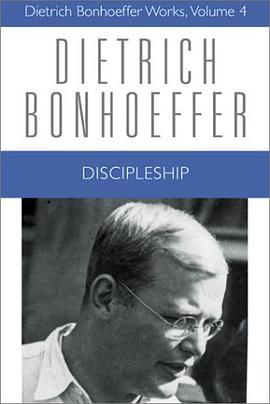
具体描述
With that sharp warning to his own church, which was engaged in bitter conflict with the official nazified state church, Dietrich Bonhoeffer began his book Discipleship (formerly entitled The Cost of Discipleship). Originally published in 1937, it soon became a classic exposition of what it means to follow Christ in a modern world beset by a dangerous and criminal government. At its center stands an interpretation of the Sermon on the Mount: what Jesus demanded of his followers--and how the life of discipleship is to be continued in all ages of the post-resurrection church.
Every call of Jesus is a call to death, Bonhoeffer wrote.
His own life ended in martyrdom on April 9, 1945.
Freshly translated from the German critical edition, Discipleship provides a more accurate rendering of the text and extensive aids and commentary to clarify the meaning, context, and reception of this work and its attempt to resist the Nazi ideology then infecting German Christian churches.
A Glimpse into the Vast Landscape of Bonhoeffer's Thought: Beyond the Fourth Volume Dietrich Bonhoeffer’s intellectual and theological legacy is a sprawling, intricate tapestry woven from profound scriptural engagement, radical ethical commitment, and intense philosophical reflection, particularly during his confrontation with the Nazi regime. While Discipleship (Volume 4 of the Dietrich Bonhoeffer Works) stands as a cornerstone text—a powerful articulation of the cost of discipleship and the nature of Christian community—it represents only one facet of his monumental contribution. To truly appreciate the breadth of his work, one must look beyond this singular volume and delve into the currents that shaped his theology across his other writings. The scope of Bonhoeffer’s work encompasses formative early writings, critical analyses of Christology and ecclesiology, deeply personal prison correspondence, and complex philosophical explorations of faith in a secularizing world. Examining these other volumes illuminates the foundational theological architecture that underpins the ethical urgency found in Discipleship. I. The Formative Years and Foundational Theology Before the searing clarity of Discipleship, Bonhoeffer’s early works laid the groundwork for his mature thought, often rooted in intense biblical exegesis and engagement with prevailing theological trends. The Cost of Grace: Act and Being (Volume 1): This early Habilitation thesis, written while Bonhoeffer was still in his early twenties, reveals a young theologian grappling with fundamental metaphysical and theological distinctions, particularly contrasting the concept of "act" (the concrete reality of faith and revelation) with "being" (the abstract essence of theological concept). This text establishes his commitment to understanding theology not as abstract system-building, but as a dynamic engagement with the reality of God’s self-disclosure. It is here we see the initial seeds of his later insistence that theology must be grounded in the concrete event of Christ, rather than detached speculation—a principle vital to understanding the demanding nature of discipleship. The Early Sermons and Lectures: Collections spanning his early academic career showcase an emerging voice deeply concerned with the nature of the Church. His lectures on Dogmatics and Ecclesiology reveal a persistent focus on the tangible reality of the Church as the concrete presence of Christ in the world. This early commitment to the ecclesia—the gathered body—provides the necessary context for the communal demands detailed in Discipleship. The question is not merely how an individual follows Christ, but where that following takes place: within the fellowship formed by and for Christ. II. Christology and the Radical Nature of the Church Bonhoeffer’s mature thought, particularly in the period leading up to his arrest, is defined by a robust Christology that views Christ as the mediator of reality itself. The Centrality of Christ: Christology (Volume 3): This volume, comprising lectures delivered during the Nazi era, demonstrates Bonhoeffer’s unwavering focus on Jesus Christ as the center of all reality—historical, theological, and personal. Unlike liberal theology, which often reduced Christ to a moral exemplar, Bonhoeffer insists on Christ as the Lord of history and the very ground upon which the Church stands. This absolute claim on Christ is what gives weight to the subsequent call to discipleship. If Christ is not Lord of everything, then the stringent demands for obedience described in Discipleship lose their footing. This text provides the cosmic and historical anchor for the ethical summons. The Nature of the Church: Sanctorum Communio (Volume 2): This earlier work, focusing on the nature of the Christian community, demonstrates that Bonhoeffer viewed the Church not as an optional social structure, but as the manifestation of Christ’s continuing presence. He rigorously analyzes the relationship between the human community and the divine reality that structures it. The specific duties and responsibilities toward one's brethren—the core subject matter of the "Community" sections in Discipleship—are fully elucidated here through systematic ecclesiological principles. The call to costly commitment is intrinsically bound up with living within this "saints’ communion." III. The Prison Letters and the Secular World The writings from prison mark a profound shift, moving Bonhoeffer away from systematic formation toward existential reflection on faith in a world that increasingly appears "godless." Faith in the World: Letters and Papers from Prison (Volume 8): While the ethical demands in Discipleship are immediate and communal, the late-career reflections found in the prison letters pivot toward a challenging interpretation of mature faith. Here, Bonhoeffer confronts the notion of the "world come of age," where traditional religious language no longer serves as an adequate bridge to God. The call to discipleship, which in Volume 4 involved active, visible allegiance, transforms into a demand for suffering and "religionless Christianity." The prison writings ask how one follows Christ when the traditional scaffolding of faith has been dismantled by modernity. This represents the ultimate test of the very discipleship he described years earlier: maintaining costly grace when the world no longer validates the cost. Ethics Under Duress: Ethics (Volume 6): This unfinished work, compiled from lectures and prison notes, directly addresses the difficulty of living a righteous life within a world corrupted by political evil. While Discipleship offers an idealized vision of obedience within the fellowship, Ethics grapples with the ambiguity of action when all available paths seem compromised. It explores the tension between divine command and the responsibility owed to one’s neighbor and earthly mandates. This volume expands the scope of discipleship from inward commitment and communal living into complex political and ethical decision-making under duress. IV. Theological Anthropology and the Struggle for Meaning Further volumes provide necessary background on Bonhoeffer’s understanding of the human being in relation to God—the necessary precondition for understanding discipleship itself. The Unity of Good and Evil (Volume 5): This collection of early writings and reflections on morality delves into the complexities of human choice and responsibility before God. It maps out the theological anthropology that informs his view of the fallen state, making the necessity of radical conversion and costly following (as argued in Discipleship) comprehensible. It details the fractured state of humanity that requires the radical reconstitution offered by Christ. In summary, to grasp the full weight of the call found in Discipleship, one must see it not in isolation, but as the intersection of Bonhoeffer’s rigorous Christology (Christology), his deep commitment to the nature of the Church (Sanctorum Communio), his early philosophical explorations of reality (Act and Being), and his later, agonizing contemplation of faith in a secularized, suffering world (Letters and Papers from Prison). Discipleship is the ethical blueprint; the surrounding volumes are the theological, historical, and existential framework that validates its uncompromising demands.