
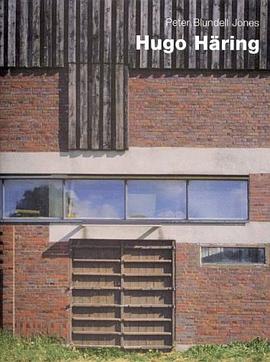

具体描述
Although he has hitherto remained somewhat overlooked, Hugo Haring was a key figure of the Modern Movement, first as secretary of the Ring, the principal organisation for Modernists in the 1920s, and second as the main theorist for the Organic stream in German architecture. Trained at the Technische Hochschule Stuttgart under Theodor Fischer, Haring's career as a Modernist began when he moved to Berlin in 1921. There he was befriended by Ludwig Mies van der Rohe, whose office he was invited to share, and this became a centre of debate for the new direction in architecture. The two architects set up the Ring, which by 1926 included every German Modernist of note. Its members dominated the WeiBenhofsiedlung of 1927, for which Mies was artistic director, and its success also prepared the way for the CIAM congresses, which Haring attended as Ring representative. Despite their political collaboration, Haring and Mies pursued projects in increasingly opposed directions, clarifying each other's position by contrast. Mies pursued general solutions and repeated types, advocating rational construction and flexibility of use, while Haring sought the utmost specificity to function and place - which meant that each building, even each element of a building, deserved to develop its own individual form. The key example was Gut Garkau near Lubeck of 1924/25, with its cowshed of a pear shaped plan devised around the requirements and rituals of farming.
作者简介
Professor Blundell Jones was trained as an architect at the Architectural Association in London, from 1966 to 1972. He has been involved in practice, criticism and teaching for most of his professional life, but the balance between these activities has gradually changed in favour of a concentration on architectural history and theory. In 1973-74 he wrote his first book on the German architect Hans Scharoun (1893-1972), and he has remained a leading expert on this area of German Architecture, producing a second book on Scharoun and another on his colleague and mentor Hugo Haring (1882-1958). After some experience of practice and of part-time teaching in London, he was appointed Assistant Lecturer at Cambridge in 1978, and ten years later he joined the Architecture Department of the South Bank Polytechnic, now South Bank University, as Principal Lecturer in charge of history and theory, being promoted to Reader in 1992. He was appointed Professor at Sheffield in August 1994.
Professor Blundell Jones has enjoyed a close working relationship with The Architectural Review and other leading architectural magazines. He has published numerous articles on historical and theoretical subjects besides criticising and analysing contemporary work. He received the CICA Award for the 'Best periodical of the last three years' in June 1985, and was made 'Architectural Journalist of the Year' in 1992 for articles on Louis Kahn and on Authenticity in the Architects' Journal. He has written extensively on the English Arts and Crafts movement, on the Swedish architects Gunnar Asplund and Sigurd Lewerentz, on the German firm Gunter Behnisch and partners, and on the recent architectural movement in Graz, Austria resulting in the book Dialogues in Time. He has also written a revisionary history of the Modern Movement under the title Modern Architecture through Case Studies. His interest in the relationship between buildings and society has prompted contacts with anthropologists, and he anticipates further inter-disciplinary work of this kind in developing a theory of architecture.
Professor Blundell Jones sits on Research and Policy committees in the School of Architecture. He is also a member of the international architectural critics organisation CICA, of the RIBA Professional Publications Committee and he is on the editorial board of the periodical Architectural Research Quarterly.
目录信息
读后感
评分
评分
评分
评分
用户评价
这本书最让我印象深刻的是它所营造的氛围,那是一种带着淡淡忧伤却又充满希望的基调,如同黄昏时分穿过云层的最后一道阳光。作者在构建场景时的细节描写,达到了令人惊叹的地步,你几乎能闻到空气中的气味,感受到微风拂面的触感。故事的发展脉络并非是线性的,而是充满了回旋和交叉,但这非但没有造成阅读障碍,反而为故事增添了宿命般的复杂美感。书中角色的对话设计尤其精彩,他们之间的交流充满了潜台词和未尽之意,每一次交锋都暗藏玄机,让人在阅读时不得不动脑筋去解读字里行间隐藏的深意。它成功地将个人命运与时代洪流交织在一起,让人在为角色命运揪心之余,也能对宏大的历史进程有所感悟。这无疑是一部需要沉下心来阅读,并且会深深烙印在脑海中的上乘之作。
评分这部作品的语言运用达到了出神入化的境界,它不是那种华丽到让人分心的辞藻堆砌,而是一种精准、克制且富有韵味的表达方式。作者似乎对每一个名词和动词的选择都有着近乎偏执的考究,使得原本平淡的场景瞬间充满了画面感和张力。我读到了一些关于人性弱点和选择的段落,那种冷静的剖析,仿佛一把锋利的手术刀,直抵问题的核心,毫不留情,却又充满了同情。这本书的叙事视角时而广阔如史诗,时而又聚焦于角色的一次眼神交流,这种强烈的对比产生了奇妙的化学反应,让情节的张力得以持续维持。它探讨的议题非常当代,但处理方式却极为经典,显示了作者卓越的文学视野。总而言之,这是一本需要读者全神贯注才能领略其精妙之处的佳作,绝对值得花费时间去细细品味每一个细节。
评分说实话,刚开始翻开这本书时,我对其复杂的人物关系和略显晦涩的开篇有些担忧,但一旦适应了作者构建的节奏,便如同被一种无形的力量牵引着向前。这本书的迷人之处在于它的层次感,你以为你已经理解了故事的主旨,下一章却会为你揭示更深一层的含义。它对待历史的描摹,那种宏大叙事下的微观视角转换,处理得非常成熟老练,让人不得不佩服作者深厚的功底。我尤其欣赏它对“时间”这一概念的独特诠释,时间在书中似乎具有了物质性,可以被感知、被触摸,甚至被扭曲。这种高度的文学想象力,结合扎实的逻辑推理,使得整部作品既有艺术上的审美价值,又有思想上的启迪作用。读完合上书本的那一刻,我有一种“世界观被轻轻推了一下”的感觉,那是好书才能给予的震撼。
评分这是一部令人耳目一新的作品,它成功地在传统叙事和现代感之间找到了一个奇妙的平衡点。作者的笔触如同精雕细琢的艺术品,每一个词语的运用都充满了深思熟虑的考量。我尤其欣赏它在刻画人物内心挣扎时的那种细腻入微,那种将人性的复杂性层层剥开的过程,让人在阅读时仿佛能够深切地感受到角色的每一次呼吸和每一次心跳。故事情节的铺陈并非一蹴而就,而是像河流入海般自然而然,节奏把握得恰到好处,既有扣人心弦的张力,又不乏沉静的反思时刻。这本书的结构设计也颇具匠心,章节之间的过渡衔接得天衣无缝,每一次翻页都充满了对下一步情节的期待,让人欲罢不能。它并非简单地讲述一个故事,而是构建了一个完整的世界观,让我沉浸其中,久久不愿抽离。整本书读下来,感觉像经历了一场漫长而又充实的旅程,留下的回味无穷,是那种值得反复品味的书籍。
评分这本书的叙事风格简直是教科书级别的典范,行文流畅自然,但又不失其深刻的内涵。它成功地避开了许多同类作品中常见的陈词滥调,而是用一种近乎诗意的语言,描绘出那些宏大主题下个体生命的渺小与光辉。我特别喜欢作者在处理转折点时的那种不动声色的力量感,它没有刻意的煽情,一切都顺理成章地发生,却又在不经意间击中人心最柔软的部分。阅读过程中,我多次停下来,仅仅是为了回味某一句精妙的比喻,或者某个充满哲理的段落。这本书对社会现象的观察入木三分,它没有直接给出批判的口号,而是通过人物的命运和他们所处的环境,让读者自己去体会和思考,这种“不言自明”的处理方式显得尤为高明。它成功地在娱乐性和思想性之间架起了一座坚固的桥梁,让严肃的主题也能以一种引人入胜的方式被大众所接受。
评分一辈子和人吵架,真是个性情中人
评分一辈子和人吵架,真是个性情中人
评分一辈子和人吵架,真是个性情中人
评分一辈子和人吵架,真是个性情中人
评分非常清晰地介绍了Hugo所代表的德国有机派的整体肖像。
相关图书









本站所有内容均为互联网搜索引擎提供的公开搜索信息,本站不存储任何数据与内容,任何内容与数据均与本站无关,如有需要请联系相关搜索引擎包括但不限于百度,google,bing,sogou 等
© 2026 book.quotespace.org All Rights Reserved. 小美书屋 版权所有