

具体描述
Book Description
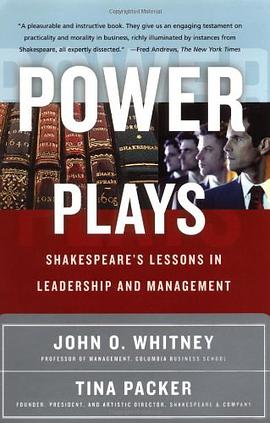
The issues fueling the intricate plots of Shakespeare's four-hundred-year-old plays are the same common, yet complex issues that business leaders contend with today. And, as John Whitney and Tina Packer so convincingly demonstrate, no one but the Bard himself can penetrate the secrets of leadership with such piercing brilliance. Let him instruct you on the issues that managers face every day:
* Power: Richard II's fall from power can enlighten us.
* Trust: Draw on the experiences of King Lear and Othello.
* Decision: Hamlet illustrates the dos and don'ts of decision making.
* Action: See why Henry IV was effective and Henry VI was not.
Whitney and Packer do not simply compare Shakespeare's plays with management techniques, instead they draw on their own wealth of business experience to show us how these essential Shakespearean lessons can be applied to modern-day challenges. Power Plays infuses the world of business with new life — and plenty of drama.
Amazon.com
The great Bard's influence has always been broad and far-reaching, but his insightful commentary on all forms of power and politics in his plays has made William Shakespeare the current darling of the management theory set. Power Plays stands out as an interesting and useful look at what Shakespeare has to teach leaders about the use and abuse of power, the skills of communication and persuasion crucial to a leader's success in achieving objectives, and reconciling and balancing values and responsibilities.
The coauthoring duo of Whitney and Packer is effective. John Whitney, a professor at the Columbia Business School, former CEO, and veteran of corporate startup and turnaround ventures, combines his professional knowledge of the business arena and his personal love of Shakespeare's plays with the dramatic experience and analytical insight of Tina Packer, the founder and president of Massachusetts's thriving Shakespeare and Company. Much of Whitney and Packer's interpretive skill lies in their ability to do just that--interpret effectively. Rather than merely attaching the human strengths and weaknesses exemplified by Shakespearean characters to any and every corporate success or failure they can pull out of the bag, the authors conduct careful examinations of exactly what it is that the playwright is attempting to convey. Only after demonstrating a perceptive grasp of the underlying messages of the dramatic action do they then apply that insight to contemporary, real-life businesspeople and environments. The messages range from the seemingly obvious though often ignored comments on power--"Use It Wisely or Lose It"--to the subtle complexities surrounding the development of an Iago character bent on evil revenge. The applications include examples from the authors' own experiences, as well as touching briefly on those of leaders such as Katherine Graham at the Washington Post, Larry Bossidy at Allied Signal, and the business consultant Dr. W. Edwards Deming. Though not often extensive explorations on their own, together the messages and applications offer engaging, informative lessons for leaders and managers in any environment.
--S. Ketchum
From Publishers Weekly
Whitney, a former president of Pathmark Supermarkets, and Packer, a founder of a classical theater company, present a rather pedestrian analysis of the Bard's insights on leadership. Whitney, who admits he made tactical mistakes when he took over running the troubled grocery chain, believes that Shakespeare's plays offer important lessons for today's business arena-e.g., that one of the worst strategies is vying for power simply to have more power. "What does Macbeth accomplish once he wears the crown?": the assassination of his best friends. Obviously, that's not the smartest boardroom tactic, but the authors believe many power-hungry managers do the same thing by firing the employees who once supported them. Good executives surround themselves with loyal supporters: Henry V is able to rally his troops the day before the Battle of Agincourt, and Mark Antony garners support by delivering a moving funeral oration for Caesar. Citing other characters and plots, the authors offer managers a mix of useful if somewhat obvious advice. The chapter on acting like a leader, however, is particularly strong; it explains how managers' behaviorAfrom their dress to the way they enter a roomAcan affect their authority. Although the practical information is not always successfully interwoven with the theatrical references, this unusual look at workplace behavior should help less experienced managers brush up on their people skills. (June)
From AudioFile
Who would have thought that Shakespeare could teach us about business? Whitney and Packer did, and here are their delightful insights. Both authors have a hand in the narration, explaining how, for example, OTHELLO's Iago is a perfect metaphor for corporate dissatisfaction as he is passed over for a promotion by the big boss. The authors are good speakers and make their concepts exciting to listen to. In the end, however, this audiobook is not about finding Shakespeare's hidden words of business wisdom but about Whitney and Packer's clever interpretations of the four-hundred-year-old literature for the benefit of the modern business world. R.A.P.
Book Dimension :
length: (cm)21.3 width:(cm)14
作者简介
目录信息
读后感
评分
评分
评分
评分
用户评价
老实说,这本书的内容对我来说,更像是一次对人性的深度探访,远超出了单纯的“技巧指南”范畴。作者以一种近乎哲学家的视角,探讨了驱动人类行为的那些底层逻辑——欲望、恐惧、以及对确定性的永恒追求。我特别欣赏作者在分析策略时,总是能及时地将镜头拉远,回到更宏大的人类社会结构上去审视。比如,书中对“共识的建立与瓦解”的论述,让我深刻认识到,很多时候,事实并不重要,重要的是人们“相信什么”。这种对社会心理学的细腻观察,让这本书的厚度大大增加,不再局限于职场或政治斗争的层面,而是触及了文明运行的本质。我读完后,感觉对周围的人和事都有了一种更加冷静、略带疏离的观察角度。它没有提供廉价的安慰,反而让你直面世界的复杂性,这才是真正有价值的阅读体验。读完之后,我需要时间来调整自己的心态,去适应这种“看透”之后的清醒感。
评分这本书的叙事风格实在是太迷人了,它不像那些干巴巴的理论书籍,而是充满了画面感和节奏感。我感觉自己不是在阅读文字,而是在观看一场场精心剪辑的纪录片,每个场景、每句对话都仿佛经过了反复推敲,目的就是为了最大化地烘托出那种山雨欲来的紧张氛围。作者似乎有一种魔力,能将那些原本枯燥的策略和概念,包装成引人入胜的故事片段。最让我印象深刻的是对几个关键历史人物决策过程的剖析,那种从微小的犹豫到最终做出颠覆性决定的心路历程,被刻画得淋漓尽致。我甚至能想象出当时的环境光线和人物的微表情。这种代入感极强,让我对“决策的艺术”有了更具象的理解,不再是抽象的公式,而是血肉之躯在巨大压力下的真实反应。通篇读下来,节奏的把握堪称完美,时而急促如鼓点,时而又放缓到近乎停滞,为的就是让你在喘息的间隙,好好回味一下刚才所经历的智力风暴。
评分这本书散发着一种非常成熟和内敛的力量感,它不像某些畅销书那样,用夸张的标题和浮夸的语言来吸引眼球,而是依靠内容本身的硬度来征服读者。文字表达极其克制,每一个词语似乎都经过了精确的称重,不多不少,恰到好处地传达了信息。我尤其欣赏作者在处理争议性话题时所表现出的那种不动声色的平衡感。他既展现了权力运作的残酷面,同时也暗示了这种运作背后的某种必然性,没有流露出过度的道德批判,也没有盲目地推崇。这种冷静、客观的叙事基调,使得全书的论点更有说服力,因为它不是基于情绪的宣泄,而是基于对系统性运作规律的深刻洞察。阅读它,就像是接受了一次高强度的智力训练,让人在不知不觉中,思维的韧性和清晰度都得到了显著的提升,受益匪浅。
评分这本书的结构编排非常巧妙,它采用了一种螺旋上升的叙事方式,看似在不同的案例间跳跃,实则每一章都在为最终的核心观点添砖加瓦。一开始,你可能会觉得有些零散,但随着阅读的深入,你会惊喜地发现,那些看似独立的片段是如何被一条无形的逻辑线索紧密串联起来的。作者在展示复杂情境时,非常注重细节的还原,他不会轻易地下结论,而是先把所有的变量摆在你面前,让你自己去推导。这种“引导式”的阅读体验,极大地锻炼了读者的逻辑推理能力。我甚至会在心里和作者“打赌”,猜想接下来会发生什么,而大多数时候,作者总能提供一个更加出人意料但又合乎情理的转折。这种智力上的互动感,是很多同类书籍所缺乏的。它要求你的注意力必须高度集中,一旦走神,就很容易错过关键的连接点。
评分这本书简直是本时代的启示录,它以一种近乎残酷的坦诚,撕开了我们习以为常的社会运作的遮羞布。作者的笔触犀利如刀,直插权力斗争的核心地带,没有丝毫的温情脉脉。我读到很多关于如何在复杂的人际网络中进行博弈的案例,那些精妙的布局和反制,读来令人拍案叫绝,同时也感到一丝寒意。它不是教人如何去操纵,而是让你深刻理解到,在很多关键时刻,你看似平静的表象下,其实是暗流涌动的角力场。特别是关于信息不对称的分析,简直是教科书级别的解读,让我对那些在幕后推动事件发展的“看不见的手”有了全新的认识。我花了很长时间才消化完其中的一些章节,因为它们要求读者不仅要用理性去分析,还要调动起全部的直觉去感受那种微妙的权力张力。这本书的价值在于,它迫使你走出舒适区,去审视那些你平时不愿承认的现实规则,对于任何身处竞争环境中的人来说,都是一本不可多得的指南。它带来的震撼是持久的,就像在你脑海中种下了一颗怀疑的种子,让你对任何事情都多了一层深入探究的欲望。
评分 评分 评分 评分 评分相关图书

















本站所有内容均为互联网搜索引擎提供的公开搜索信息,本站不存储任何数据与内容,任何内容与数据均与本站无关,如有需要请联系相关搜索引擎包括但不限于百度,google,bing,sogou 等
© 2026 book.quotespace.org All Rights Reserved. 小美书屋 版权所有