
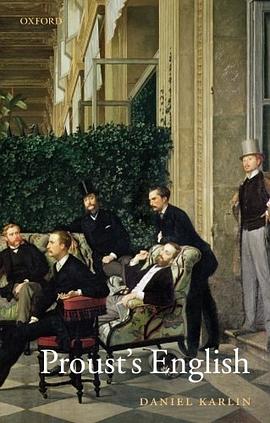
Proust's English pdf epub mobi txt 电子书 下载 2026
- 英文
- Proust
- Littérature
- France
- Critique
- Proust
- English Literature
- Literary Criticism
- Translation Studies
- Modernism
- Marcel Proust
- Comparative Literature
- Literary History
- French Literature
- Influence

具体描述
This introductory chapter begins with a brief description of the origin of the reasons behind writing this book, which is traced back to a small moment in the novel A la recherche du temps perdu that occurs at the end of a grand dinner Marcel attends, where among other aristocratic figures he has been introduced to the princesse de Parme. Proust uses the word snow-boots in a particular passage — a word very recent in French (first recorded in 1893) and one which belongs to a large group of English words which the French language borrowed for the new products, technologies, and social practices of the 19th century. The presence of this word prompted a collection of the English words and phrases in A la recherche. The chapter then sets out the purpose of the book, which is to present a fuller list and location map of identifiable English words and phrases in A la recherche. An overview of the subsequent chapters is also presented.
Keywords: Proust, intermediate language, A la recherche, English words, snow boots
On seeing the title ‘Proust’s English’, readers may be tempted to respond, as one of my colleagues did, by remarking: ‘No, he’s not.’ And of course he isn’t. And yet…At the seaside resort of Cabourg, in Normandy, in the summer of 1911, Proust wrote to his friend, the art dealer and collector René Gimpel:
Je vous verrai quand mon livre sera fini mais quand le sera-t-il? Je meurs d’asthme ici cette année. Je me lève un jour sur quatre et descends ce jour-là dicter quelques pages à une dactylographe. Comme elle ne sait pas le français et moi pas l’anglais mon roman se trouve écrit dans une langue intermédiaire à laquelle je compte que vous trouverez de la saveur quand vous recevrez le volume. (Corr. X, 320–1)1
[I shall see you when my book is finished but when will that be? I’m dying of asthma here this year. I get up one day in four, and on that day come downstairs to dictate a few pages to a stenographer. As she doesn’t know French and I don’t know English, my novel is being written in an intermediate language which I trust you will savour when you receive the volume.]
Proust exaggerates, of course; he wasn’t really dying, and À la recherche du temps perdu isn’t written in Franglais. Nevertheless his joke about the novel’s langue intermédiaire suggests a profound truth—as, indeed, does the joke about his illness. This book is about the ‘intermediate language’ of A la recherche: the presence in it of English words and phrases, the ‘Englishness’ of its social and artistic worlds, and the larger theme of mixed or impure language—the language which Proust is confident that his friend will ‘savour’.
I trace the origin of my own book to one such savoury moment—a small one in the novel, but which still gives me intense pleasure. It occurs (p.2) at the end of a grand dinner Marcel attends, where among other aristocratic figures he has been introduced to the princesse de Parme. Marcel is on his way out:
Dans le vestibule où je demandai à un valet de pied mes snow-boots que j’avais pris par précaution contre la neige, dont il était tombé quelques flocons vite changés en boue, ne me rendant pas compte que c’était peu élégant, j’éprouvai, du sourire dédaigneux de tous, une honte qui atteignit son plus haut degré quand je vis que Mme de Parme n’était pas partie et me voyait chaussant mes caoutchoucs américains. La princesse revint vers moi. “Oh! quelle bonne idée, s’écria-t-elle, comme c’est pratique! voilà un homme intelligent. Madame, il faudra que nous achetions cela”, dit-elle à sa dame d’honneur, tandis que l’ironie des valets se changeait en respect et que les invités s’empressaient autour de moi pour s’enquérir où j’avais pu trouver ces merveilles.
[In the hall where I asked a footman for my snowboots, which I had brought, not realising how unfashionable they were, as a precaution against the snow, a few flakes of which had already fallen, to be converted rapidly into slush, I felt, in the contemptuous smiles on all sides, a shame which rose to its highest pitch when I saw that Mme de Parme had not yet gone and was watching me put on my American “rubbers.” The Princess came towards me. “Oh! what a good idea,” she exclaimed, “it’s so practical! There’s a sensible man for you. Madame, we shall have to get a pair of those,” she said to her lady-in-waiting, while the mockery of the footmen turned to respect and the other guests crowded round me to inquire where I had managed to find these marvels.]
(II, 835; III, 632)2
What is it about the word snow-boots which makes it stand out here, and which gives the passage its ‘savour’? The word was very recent in French (first recorded in 1893) and belongs to a large group of English words which the French language borrowed for the new products, technologies, and social practices of the nineteenth century. Many more of these occur in A la recherche, from les films to les cocktails, from le revolver to le golf. Yet, as we shall see, Proust’s use of such words was almost never dictated by necessity; if he had wanted to avoid the word snow-boots here he could easily have done so, as the phrase ‘caoutchoucs américains’ demonstrates. He (p.3) chose it, I think, because it made a small but distinct contribution to the theme of snobbery and social embarrassment which is being developed in this episode. The shame that Marcel feels at his footwear faux pas is transposed to the word itself; is it an accident that it contains within it the word snob, itself one of the English keywords of A la recherche?3 Proust’s scrutiny of individual words, both French and English, was detailed and passionate enough to make this sous-entendu possible. At any rate, this is not the first time that an English word pops up in a context of social awkwardness.
I think it was the pleasure I took in Marcel’s snow-boots which prompted me, some ten or fifteen years ago, to start collecting the English words and phrases in A la recherche. Long after I had made my own list, I came across Étienne Brunet’s Le Vocabulaire de Proust, a concordance and detailed bibliometric study which analyses Proust’s vocabulary in the context of other literary works in the electronic corpus held at Nancy, the ‘TLF’ (Trésor de la langue française). Fascinating though Brunet’s work is, however, it has some gaps in its coverage of foreign words. Few single words slip through the net, though even here Brunet misses babys, darling, fast, liftman, patronizing, pianola, pushing, season, waters, and yes; but phrases and hyphenated words are not recorded at all, so that, for example, a cup of tea, cold cream, fair play, fishing for compliments, five o’clock tea, garden-party, hansom cab, good morning, good evening, and good bye are all missing, not to mention my dear, my love, and the right man in the right place.4 One of the aims of this book is therefore to present a fuller list and location map of identifiable English words and phrases in A la recherche, all of which, whether discussed in the main text or not, are given in the Appendix.
(p.4) I say ‘fuller’, and not ‘comprehensive’, both because my own list may well be incomplete, and because there is a difficulty in actually deciding what constitutes an ‘English’ word in the first place. Take the word ‘redingote’ (a frock-coat), which sounds perfectly French, and indeed is French—I’m confident that no modern French reader coming across it in a nineteenth-century French novel would think twice about it. Yet redingote is a corruption of the English ‘riding-coat’, first recorded in its francisized form in 1725. When it first appeared it elicited howls of protest, as did another word for a similar garment, frac, from ‘frock-coat’, which later came to designate what we now call ‘tails’. The English word ‘frock’ itself derives from an older French word, froc, meaning a monk’s habit, hence the priestly function itself; this sense survives in English where we still speak of an ‘unfrocked’ clergyman. Defenders of the French language especially resented such ‘reimportations’, which are one aspect of the continuing traffic between French and English which makes the origin and ‘nationality’ of many words so hard to determine. Volume I of Fraser Mackenzie’s historical survey, Les Relations de l’Angleterre et de la France d’après le vocabulaire (1939), combatively subtitled Les Infiltrations de la langue et de l’esprit anglais, make clear that English (in the form of Anglo-Saxon) had been ‘infiltrating’ French from before the Norman Conquest, and that the current of fashion which many English readers believe sets so strongly in the direction of Paris feels very different on the other side of the Channel. A host of words which look and sound French, which are in fact naturalized to the point of invisibility, turn out to have English antecedents, sometimes relatively recent ones—among them, for example, the word train (in the railway sense) which dates to the 1840s. No one, surely, would expect to see this word in a list of ‘English’ words in A la recherche; but what about album, clown, hall, jury, stock, and tennis?
The problem in the specific case of A la recherche is compounded by historical change. Like the scarlet threads in an old tapestry, the colour of some of Proust’s English words has faded with time. What stood out as unusual, or at any rate ‘marked’, for a French reader of Du côté de chez Swann when it was first published in 1913, might not do so today—sporting terms especially, perhaps (football, golf, match, record, skating), but also terms from social life (lunch, sandwich, pudding, toast). Contemporary reference works such as Édouard Bonnaffé’s Dictionnaire étymologique et historique des anglicismes, published during Proust’s lifetime, in 1920, offer some help here; I have used Bonnaffé as a guide—though not an (p.5) infallible one—as to the degree of ‘Englishness’ which attaches to Proust’s use of words such as interview, meeting, or speech.
My judgement in this area has been influenced by the relatively high number of unequivocal English words and phrases in A la recherche. English is, beyond question, the ‘second language’ of the novel; it outstrips all the other ancient and modern languages combined (principally Latin, Italian, and German, in that order); Proust’s linguistic, like his literary countenance, was turned towards England.5 My first chapter explores the paradox by which this writer who never travelled to England, never learned English, and confessed his inability either to speak the language or understand it when it was spoken, nevertheless not only translated two books by Ruskin but filled his novel with English words. Proust’s strange intimacy with English is the product of a personal history, but also of a wider social history whose keyword is anglomanie, the craze for Englishness in politics, social life, and the arts, which has affected (or afflicted) France since the mid-eighteenth century, and which was in a particularly virulent phase in Proust’s lifetime. The fashion for English manners, dress, furniture—for everything we now call by the term ‘lifestyle’—included a fashion for English words—for le gentleman, who might suffer the agonies of spleen in le Jockey-Club, or even in his comfortable home; for the lady-like duchess who might return from une garden-party at the height of la season, rueing the presence of so many snobs and wishing that her husband didn’t look so ungainly in his smoking, before going upstairs for a relaxing tub. Good-night, my love!6
The connection of anglomanie to ‘high society’—or the aspiration to belong to it—will be evident from these examples; it forces itself on the attention of readers of A la recherche through the figure of Odette de Crécy, the mistress and later the wife of Charles Swann—Odette with her proliferation of English phrases (most of the ones in the list on p. 3 are hers—a cup of tea, fair play, fishing for compliments, etc.)—and her love of English social rituals such as le five o’clock tea and le lunch, to the point where the French Noël has been replaced in her house by the English Christmas. But the relationship between Odette and Swann, the focus of (p.6) the second chapter, is inflected by Englishness in a far deeper and more significant way, one which begins to suggest the architectonic power of this theme in the novel, and which is as much to do with the exquisitely polished, artistically minded Swann, with his membership of le Jockey and his friendship with the Prince of Wales, as with the vulgar, ignorant Odette. Through Odette’s love for orchids, particularly the cattleya, and through Swann’s sexual identification of her with this flower, we can begin to grasp the complex network in which English words mediate both desire and loss in the novel; the significance of this theme becomes clear when we realize that both Swann and Odette, in different ways, trace their nature to an origine anglaise.
The ‘sign’ of Englishness, like so much else in the novel, is a double one, its Janus face turned towards vanity and spiritual death, but also towards the salvation of art. My third chapter explores this doubleness in the setting of Normandy, where, at the seaside resort of Balbec, Marcel will meet the great painter Elstir, one of the presiding artistic geniuses of the novel; but he will also learn that Elstir was one of the familiar faces in the Verdurins’ salon where Swann and Odette’s liaison first flourished, where he was known as ‘M. Biche’ and played the role of a dissolute buffoon. Elstir’s magnificent portrait of Odette as ‘Miss Sacripant’ links the ‘English’ world of the demi-monde to that of Balbec; for the whole resort, and especially its main attraction, the Grand Hotel, is suffused with Englishness, from the chatter of le lift to the appearance of Robert de Saint-Loup, whose allure is that of a supremely elegant sportsman. Balbec is based on Cabourg, which Proust knew well; he himself had stayed at its Grand Hotel, had accompanied friends around a golf course and been taken to a polo match. At Balbec, English sports and amusements fill the days of the jeunes filles en fleurs, the young girls in flower among whom Marcel will find his great love, Albertine; he has come to Balbec in search of Gothic churches and tempestuous seas, but finds le tennis and le yachting; yet these very emblems of vulgar modernity, which he despises on aesthetic grounds, are, it turns out, the material of Elstir’s transcendent canvases. Elstir shows Marcel that le yachting is a source of poetry, not vulgarity; and in redeeming the thing, he goes some way also towards redeeming the word. As for Albertine herself, her first appearance in the novel, before Marcel actually meets her in Balbec, is signalled by an English word, delivered by Odette’s anglophile daughter, Gilberte Swann, who says of her: ‘Elle sera sûrement très “fast”, mais en attendant (p.7) elle a une drôle de touche’ [She’s certain to be dreadfully “fast” when she’s older, but meanwhile she’s an odd fish] (I, 503; II, 98). The Pléiade editors note that fast in this context implies a fashionable freedom of behaviour; Gilberte is predicting not simply that Albertine will be loose-living, but that she will be so in a smart set. The use of an English slang term is entirely apt for Odette’s daughter; yet as so often in A la recherche a character is made to speak more than they know. Gilberte might not intend the meaning of fast as ‘rapid, swift’, but Proust does. The vulgar word prefigures, in its earlier sense, Albertine’s association with speed, fleeing along the roads around Balbec on her bicycle, eluding Marcel’s desire, finally eluding him in death. By the end, this ‘être de fuite’ [creature of flight], as Marcel calls her, emblem of the passage of time, has fulfilled Gilberte’s unconscious oracle.7
The example of fast suggests that the presence of the English language in A la recherche has more than a thematic significance; it is also a reflexive sign of the novel’s preoccupation with language itself. Anglomanie has never had things all its own way in France, whether in Proust’s day or ours; it stimulated fierce hostility, nowhere more so than in the linguistic domain, where resistance to the ‘invasion’ of English words was conducted with nationalistic fervour. Defenders of the ‘purity’ of the French language found themselves confronted, however, not just by the inexorability of change, the tide of popular usage which makes a mockery of prescriptive regulation, but by a fundamental paradox in their own position. Historical philology suggested that the concept of a ‘pure’ language was profoundly flawed; all languages are mixed; words such as ‘degeneration’, ‘corruption’, and ‘deformation’ lose their moral force when applied to the process of linguistic change, becoming modes of creation and renewal. Proust’s novel could not be written in an ‘unmixed’ language; purity is associated in the novel not with creation but with sterility, in the beautiful old French, for example, spoken by the childless Mme de Guermantes. My fourth chapter stages a kind of debate between writers and critics such as Remy de Gourmont, who protested against English and all its works, and others such as the poet (and teacher of English) Stéphane Mallarmé, whose treatise Les Mots anglais (1877) has a powerful affinity with Proust’s aesthetic. Mallarmé makes the philologist’s, but also the poet’s, case for (p.8) language as necessarily mixed and cross-bred; his analysis of English as an ‘idiome composite’ speaks directly to A la recherche; more important even than this, he suggests a potent reason for Marcel’s fascination with etymology, which occupies whole swathes of the novel’s later volumes and seems, at first sight, such an odd distraction from the business of social comedy or sexual tragedy. The connection between etymology and ‘involuntary’ memory, the mainspring of the novel’s creative impulse, forms the culminating point of the argument and the book.
When all is said and done, however, I come back to the ‘savour’ of words such as snow-boots and yachtswomen, great event and revolving door. When I think of the English words of A la recherche, it is these I see in my mind’s eye, along with the flying angels in Giotto’s frescos in the Arena Chapel in Padua, like aeroplane pilots ‘executant des loopings’. I hope the reader, too, will share this pleasure, for the ‘savour’ of Proust’s words is as vital to the novel as the little patch of yellow wall which Bergotte sees, before his death, in Vermeer’s View of Delft.
Notes:
(1) The stenographer’s name was Cecilia Hayward; she was retained by the Grand Hotel. Painter (II, 172) accepts the dictation story; Tadié (p. 557) says that in fact Proust dictated most of the pages to his secretary Albert Nahmias in his room, and that Miss Hayward then typed them. She certainly typed the first 700 or so pages of the novel, first at Cabourg and later in Paris. See also Philip Kolb’s introduction to vol. X of Correspondance, pp. xxix–xxx. It is entirely in keeping with the ‘Englishness’ of the Grand Hotel at Cabourg that Proust should have come across Miss Hayward there, as I explain in Chapter 3. She annoyed Proust, to her immortal English credit, by refusing to work at weekends.
(2) Vintage has ‘I asked the footmen’. Further on, ‘American rubbers’ is perfectly correct, and is found also in Mark Treharne’s recent version (The Guermantes Way (Penguin, 2002), 546), but the modern American slang sense of ‘rubber’ as a contraceptive sheath is hard to put aside, and I would suggest ‘galoshes’. Translation really is the devil, and the devil has a coarse sense of humour.
(3) I owe this observation to Samantha Matthews, who added that the effect would be accentuated by pronouncing both snob and snow-boots like Inspector Clouseau. For snob and snobisme, see Ch. 1.
(4) Brunet’s errors of omission are compounded by misleading inclusions, where a word whose orthography is the same in French and English is recorded as French even though its actual meaning in the text is English. Thus, although the phrase ‘fishing for compliments’ is not recorded, two of its words, ‘for’ and ‘compliments’, are recorded individually as though they were French words, alongside real occurrences such as ‘dans mon for intérieur’ ‘in my heart of hearts’, I, 586 (II, 198). The same goes for ‘place’ in ‘the right man in the right place’, ‘parties’ (imperfect tense, feminine plural, of the verb partir) in ‘garden-parties’, and ‘chairs’ (plural of ‘chair’, flesh) in ‘rocking-chairs’. Such errors are evidently the result of not checking the computer-generated lists against the text as a semantic field; it is less easy to account for the fact that, in the phrase ‘cold cream’, the second word should be recorded individually but not the first.
(5) See Ch. 1, p. 27, for his letter to Robert de Billy expressing a preference for English literature over every other, even on occasion French.
(6) All these words and phrases are in A la recherche, though I have used some of them in slightly different contexts. Smoking is an abbreviation of smoking-jacket, incorrectly used to denote evening dress.
(7) For these ‘êtres de fuite’ to whose class Albertine belongs, see III, 600; Vintage renders the phrase as ‘fugitive beings’ (V, 98).
作者简介
目录信息
读后感
评分
评分
评分
评分
用户评价
我向几位同样热爱经典文学的朋友推荐过这本书,但得到的反馈却出奇地两极化。有人立刻被其迷住了,称之为“精神食粮”,而另一些人则直言不讳地表示读不下去,觉得过于晦涩和冗长。我认为,这恰恰说明了本书的特质:它对读者的准备度和接受度有着很高的要求。对于那些对形式大于内容的文学作品抱有抵触情绪的读者来说,这本书无疑是一道难以逾越的高墙。但对于我而言,那种对语言本身进行雕琢的极致追求,简直是一种享受。每一个句子似乎都经过了无数次的打磨和校正,节奏的起伏、词汇的选择,都服务于营造一种特定的氛围和心境。当你最终适应了这种独特的语言韵律后,你会发现自己被一种强大的、近乎催眠的力量所笼罩,沉浸在那个由文字编织而成的、既遥远又无比真实的世界里,久久不能自拔。
评分这本厚重的书,初拿在手上时,那种沉甸甸的质感,着实让人对即将开启的阅读旅程充满了敬畏。我本来就对十九世纪末二十世纪初的欧洲知识分子生活抱有浓厚的兴趣,而这本聚焦于那个时代思想变迁的著作,无疑像是一扇通往过去世界的窗户。作者的笔触细腻得如同描绘一幅湿壁画,每一个细节都处理得恰到好处,让人仿佛能闻到当时咖啡馆里混合着烟草和旧书本的气味。尤其是对社会阶层间微妙的张力描绘,简直入木三分。那些贵族家庭内部的琐碎礼仪、他们如何用一套不成文的规矩来巩固自己的地位,读起来就像在看一出精心编排的戏剧,充满了高雅的虚伪和无可奈何的宿命感。我特别欣赏作者在叙事中穿插的那些关于艺术、哲学、乃至科学新发现的讨论,它们并非生硬地插入,而是如同河流中的支流,自然地融入了人物的日常思考之中,使得整个阅读体验非常丰满和立体。你会感觉到,知识本身就是那个时代背景下生活的一部分,而不是一种附加的装饰。
评分我花了整整一个多月才算是勉强“消化”了这本书的头一部分,坦白说,它的阅读难度远超我的预期,但其带来的思想冲击却是无可替代的。这不是那种可以轻松摊在沙滩上阅读的消遣之作,它更像是一场需要全神贯注的智力攀登。我必须反复停下来,查阅那些被作者轻描淡写提及的典故和历史事件,否则很多深层的讽刺和隐喻就会像水下的礁石一样被我忽略过去。最让我震撼的是作者对“时间”这一概念的处理方式。那种对记忆的反复挖掘和重塑,对瞬间感受的无限拉伸和剖析,让我的时间观都产生了一种奇异的扭曲感。书中的叙事节奏是极其缓慢的,它拒绝快速的故事情节推进,而是沉浸于人物内心的波动和对环境的细致观察。这种“慢”不是拖沓,而是一种刻意的、近乎冥想的状态,迫使读者也慢下来,去品味那些通常会在日常生活中被匆忙略过的微妙感受。读完一个章节,我常常需要放下书本,对着窗外发呆好一阵子,整理那些纷繁复杂的思绪。
评分这本书给我最直观的感受是:它构建了一个异常坚固且自洽的世界观。阅读过程中,我感觉自己像一个被邀请进入某个秘密社团的成员,逐渐熟悉了他们的暗语、他们的偏见以及他们对外部世界的警惕。作者对于细节的执着到了近乎偏执的地步,尤其是在描述不同社交场合的着装、餐桌礼仪乃至眼神交流的细微差别时,那种详尽程度让人叹为观止。这不仅仅是文学上的技巧,更像是一种社会学研究的田野记录。通过这些精确的描摹,你清晰地看到了权力是如何通过这些无形的规则来运作和维持的。我尤其喜欢书中那些配角的塑造,他们往往不是推动主线剧情的关键人物,但正是这些边缘化的形象,才让那个时代的群像得以丰满。他们的困境、他们的挣扎,有时比主要人物的史诗性探索更加贴近人性中那种普遍的无力感。这本书要求你付出耐心,但它给予的回报,是对一个逝去时代的深度理解,那种理解是任何历史教科书都无法提供的。
评分说实话,这本书的阅读体验是极其私密和个人的。它很少直接向你喊话,而是通过层层叠叠的内心独白和场景还原,让你自己去体会其中的情绪张力。我发现自己读到某些段落时,会不自觉地将书中的情境与自己生命中相似的,却从未被清晰表达过的感受对号入座。这可能就是伟大文学作品的魔力所在——它捕捉到了那些人类共通却又难以言喻的经验。比如那种对过去美好时光的不可逆转的怀旧,那种夹杂着甜蜜和痛苦的复杂情感,作者处理得极其高明,不落窠臼。然而,这种高度的内省性也意味着,如果你期待的是情节跌宕起伏或者角色迅速成长,你可能会感到失望。它更像是一部关于“存在”本身状态的深度剖析,而非一个传统意义上的故事。它让你思考:我们所感知到的一切,究竟是真实,还是仅仅是我们记忆和期待的产物?
评分 评分 评分 评分 评分相关图书






本站所有内容均为互联网搜索引擎提供的公开搜索信息,本站不存储任何数据与内容,任何内容与数据均与本站无关,如有需要请联系相关搜索引擎包括但不限于百度,google,bing,sogou 等
© 2026 book.quotespace.org All Rights Reserved. 小美书屋 版权所有