
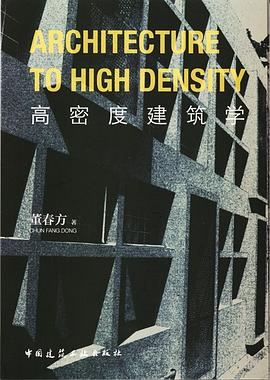

具体描述
这是一本有关城市高密度与建筑学观念及方法论的文本。
本书以城市高密度为环境条件与预设,论述因高密度而激发的建筑学方法。
内容分为上、下篇两大部分,上篇是背景和基础研究,下篇是经验的总结归纳与方法策略的提取及论述。
第一章从宏观层面论述了高密度建筑学的背景研究——紧缩城市与城市高密度环境。通过大量的数据和理论梳理,从人口、社会、经济、生态环境和城市演进等方面,论述了人类空间诉求的紧迫性和人口膨胀动力、城市化动力、生存条件与环境改善动力、生态补偿动力等因素。阐明人类需要空间的事实,并深入阐述了人类生存与繁衍所需空间与有限空间之间的尖锐矛盾。继而陈述了城市作为人类生存与发展的重要介质是满足空间诉求的切要。以此为依据,再通过中观层面描述城市高密度环境状态;阐述了城市高密度存在的必然性和历史性、对城市多样性与繁荣的价值,以及对可持续发展的积极意义。
第二章分析论述了密度与高密度的含义,并作为基础性内容为后续章节高密度建筑学方法策略的论述提供理论铺垫和技术支持。本章通过基本的数值量度和复合的人类感知概念,以物理密度、感觉密度和高密度三方面解释了密度的多种含义和量度方法。陈述了确定清晰物理密度量度的精确定义和方法,并进一步指出需要将多种密度指标结合成一种整体性的评价方法,用于评价、描述与预测建筑与城市形态、城市环境的关系,以及所呈现的密度状态。最后明确界定了城市高密度的内容和范围,厘清了高密度与城市高密度环境的含义和所指,并寻找发现其中的特征和潜能、存在问题和关联因素,从而为存在于之中的建筑应对策略与方法提供针对性依据。
第三章以时间为线索回顾了自20世纪初到21世纪近百年的基于城市高密度环境条件的建筑应变、实践与发展的历史。解析由城市高密度环境而激发的应对高密度的建筑理想、概念和理念,以及从探索、试验到实践的经验。将近百年的针对城市高密度环境的建筑应变与实践的历史分成三个时间阶段,分别为20世纪初至40年代的初始阶段、50年代至80年代的发展阶段以及90年代至21世纪初的成熟阶段。以密度的视角聚焦、独特地解析其中不同的建筑探索和实践所隐含的策略与应变方法,将从中总结归纳的经验作为第四章高密度建筑学策略的摹本与素材。
第四章在分析、归纳和总结第三章建筑应变与实践的经验基础上,利用第一章背景研究的成果和结论并结合第二章密度的基础技术和理论,展开针对城市高密度环境的建筑学策略的论述,也是高密度建筑学的主要观点。在解释了这种特定环境状态下的建筑学策略的含义和内容之后,提取并归纳高密度建筑学六大策略——多样性原则、亲近性原则、空中空间利用模式、三维立体模式、杂交与共生和空间补偿,并逐一展开深入剖析和论述。
最后本书对所提出的高密度建筑学策略的因果关系和逻辑结构作出总结。作为结论,指出通过高密度建筑学六大策略,以建筑为本,挖掘建筑构成中被密度所激发的潜能和特质,提升建筑空间的质和量并共生于高密度城市环境,最终构建协调发展的城市高密度环境。
关键词: 高密度,建筑学,多样性,亲近性,空中空间利用,三维立体,杂交与共生,空间补偿
This is a discourse of architecture methodology to urban high density.
Taking urban high density surroundings as precondition, the book discusses and elaborates the architecture strategies induced by high density. It is neither the intention for the text to interpret the specific aesthetics of buildings generated from high density nor to be a role taken to state aesthetics. But to search and study the responsiveness and solution of architecture from high density at the viewpoint of architecture while confronting the vital moment of how to develop cities, as well as to find out the architecture strategies to defuse problems produced by urban developing.
The book consists of two sections, the first of which is to study the background and basis of the text while the second section is about the collecting and summarizing of experiences along side with the demonstration for refinement of strategies.
Chapter one discusses the background of the subject on the macro lever, which is about compact city and urban high density surroundings as the precondition of the research subject. It analyzes the urgency of space need appealed by human being, ranging from efficient cause of population explosion, urbanization, improvement aspiration intensely of existence condition and surroundings to ecological compensation, by a large amount of statistics and classification of relevant theories. It not only clarifies the fact of the space need and the contradiction between the limited space and both existence and development of human being as well. Then it demonstrates that cities are the only option to satisfy the space appeal, when taking them as the medium for human being's existence and development. Afterwards it points out that both space appeal and limited space become the justification to support the value of compact city idea. After that, it states the condition of urban high density surroundings by medium perspective, expounds the necessity and historic significance of urban high density, which is the value to urban diversity and prosperousness, and is of the positive significance to the idea of sustainable development.
Chapter two analyzes and expounds the meanings of density and high density in the way from abstract to concreteness by both medium and micro perspectives, which is taken as the basic content of this subject, simultaneously as the technical support and evidence for the following strategies' discussion. It searches and explains the meanings and measure of density according to physical density, perceptive density and high density in the light of both basic numerical measure and the conception of mutual perception. It elaborates the accurate definitions and methods of physical density measurements. Further more it also points out the necessity to evaluate, describe and predict the relation between architecture and both of urban morphology and surroundings, as well as the emerging density status. Finally, this chapter defines the content and scope of urban high density, clarifies the meaning and signified both of high density and its surroundings. Then it searches and finds out the characteristic, potency, contained problems and related elements of urban high density, so that to discover the pertinent evidences for responsive strategies of architecture in urban high density.
Chapter three reviews the history of responsiveness, practice and evolvement of architecture from the beginning of 20 century to present in 21 century upon urban high density surroundings. It analyzes not only the thought, conception and idea of responsive architecture simulated by urban high density surroundings, and the experiences of its searching, experiment and practicing as well, which are taken as the historic content and practical experience of this subject. The history of practice consists of three stages, which are the initial stage from 1900s to 1940s, the developing stage from 1950s to 1980s and the mature stage from 1990s to present in 21 century. It uniquely analyzes the implicated responsiveness and strategies from differentiated researches and practices of architecture focused by view of density. Then it takes the results as the transcription and source for the following chapter that is about the strategies of architecture to urban high density surroundings.
Chapter four elaborates and discusses the architecture strategies to urban high density surroundings based upon the analysis, experiences and results of chapter three, by utilizing the achievements and conclusions of the background study in chapter one along with the basic technologies and theories of density in chapter two. Once interpreting the meaning and essence of the strategies in such specific surroundings, it refines and concludes the six architecture strategies induced from high density, which consists of diversity principle, proximity principle, model of space usage in the air, 3D model, hybrid and coexistence, and space compensation. Each of them is analyzed and discussed deeply one by one.
Ultimately this text gives the conclusions that include the cause and effect of the architecture strategies, and its logic structure as well. As the final conclusion the text declares that the six strategies are of revealing potencies and specialties consisted in architecture stimulated from density, to promote the quantities and qualities of architectural space that coexist coordinately in urban high density surroundings, for the purpose of towards the fine livable urban high density surroundings.
Moreover, this paper summarizes the significance of the strategies to creative ability for architecture, which would be a new research subject for the future.
Key Words: high density, architecture,
diversity, proximity, space usage in the air, 3D, hybrid and coexistence, space compensation
作者简介
董春方:建筑学工学博士,毕业于同济大学 建筑与城市规划学院;
长期从事建筑设计方法研究,并拥有丰富的建筑设计实践经验;
香港大学建筑系访问学者,游历欧洲多国,并与澳大利亚新南威尔斯大学、日本大阪大学、香港城市大学等建立研究与教学合作。
目录信息
绪论
上篇 背景与基础
第一章 紧缩城市与城市高密度环境
摘要
1.1 空间诉求的紧迫性及动力因
1.1.1 空间诉求的紧迫性
1.1.2 空间诉求的人口膨胀动力因
1.1.3 空间诉求的城市化动力因
1.1.4 空间诉求的生存条件与环境改善动力因
1.1.5 空间诉求的生态补偿动力因
1.2 密集紧缩城市与城市高密度环境的价值
1.2.1 紧缩还是分散
1.2.2 密集紧缩城市的价值
1.2.3 城市高密度环境
1.2.4 城市高密度环境的优势和多样性价值
结语
第二章 密度与高密度
摘要
2.1 物理密度
2.1.1 人口密度的量度方法
2.1.2 建筑密度的量度方法
2.1.3 密度梯度与密度分布
2.1.4 建筑密度与城市形态
2.2 感觉密度
2.2.1 空间密度和社会密度
2.2.2 感觉密度与建筑特征
2.3 高密度与城市高密度环境
2.3.1 高密度含义的主观性和模糊性
2.3.2 基于城市环境和城市形态的高密度内容
2.3.3 城市高密度环境的界定
2.3.4 城市高密度环境与拥挤
结语
下篇 经验与策略
第三章 高密度.建筑应变与实践
摘要
3.1 高密度.建筑应变与实践的背景和内容
3.2 建筑应变与实践的初始阶段
——未来都市与建筑的构想,1900s-1940s
3.2.1 摩天大楼的启示
3.2.2 整体都市主义策略的初探
3.2.3 三维立体模式及空间补偿策略的初探
3.2.4 杂交与共生策略的初探
3.3 建筑应变与实践的发展阶段
——应变策略的成形与广泛实践,1950s-1980s
3.3.1 空间补偿及杂交与共生策略的探索与实践
3.3.2 “空间城市”的启示
3.3.3 几何形体的高密度价值
3.3.4 垂直都市主义及杂交与共生策略的实践与发展
3.3.5 三维立体模式及其叠加模块的探索与实践
3.3.6 广泛的现实性实践与发展
3.4 建筑应变与实践的成熟阶段
——应变策略的回归、成熟与发展,1990s-2000s
3.4.1 走向更高的垂直城市
3.4.2 走向成熟的现实性巨构建筑
3.5 百年高密度.建筑应变与实践建筑师与案例列表
结语
第四章 高密度建筑学策略
摘要
4.1 高密度建筑学策略的含义
4.2 高密度建筑学策略的内容
4.3 多样性原则
4.4 亲近性原则
4.5 空中空间利用模式
4.5.1 空中空间利用的必然性
4.5.2 空中的空间诉求
4.5.3 空中空间利用模式的回归
4.5.4 空中空间利用模式的经验
4.6 三维立体模式——垂直都市主义
4.6.1 三维立体模式的环境因素
4.6.2 三维立体模式的价值和意义
4.6.3 三维立体模式的经验
4.6.4 叠加模式
4.6.5 悬挑模式
4.6.6 漂浮模式
4.6.7 建筑基面三维连续立体化
4.6.8 建筑公共空间与城市公共空间的三维接驳
4.6.9 地下空间的开拓
4.7 杂交与共生——整体都市主义
4.7.1 杂交与共生的类型学意义
4.7.2 杂交与共生的生存策略意义
4.7.3 杂交与共生的演进和经验
4.7.4 杂交与共生的效能和特征
4.7.5 杂交建筑
4.8 空间补偿
4.8.1 空间补偿的环境因素
4.8.2 空间补偿的价值和意义
4.8.3 空间补偿的具体手段
结语
结论
主要参考文献
图片资料来源
· · · · · · (收起)
读后感
这本三十万字的“教科书”,断断续续地看了一个月,终于翻阅一遍。而本书作者却写了五年,后记中提到,因为想给孩子树立一个良好的勤奋父亲形象而努力坚持完成本书的写作。这让我联想到作者曾在豆瓣日记里写过自己大龄读博的原因,是为了给孩子树立一个榜样,对于这样的父亲,...
评分其实,书中的大部分内容非常简单明了,没有什么让人觉得深奥、晦涩和不可理解。 看过后,可能会认为这些事情都知道。但是,大家是否发现,在我国一些城市中的高密度地区,我们的建筑方法仍然沿用习惯了的适合低密度条件下的手段,而全然不顾已经发生了变化了的高密度环境。 于...
评分书里清晰的阐述了高层及高密度建筑的发展,对当今高密度建筑及高密度城市有了全面的讲解,虽然只对城市发展做了相对客观保守的预测,但却是实际所面临的问题,而且六大策略,其实因该是那一套分析,解读特征及基本的解决方法,必然对研究此类城市建筑的同僚们有所帮助。对个人...
评分书里清晰的阐述了高层及高密度建筑的发展,对当今高密度建筑及高密度城市有了全面的讲解,虽然只对城市发展做了相对客观保守的预测,但却是实际所面临的问题,而且六大策略,其实因该是那一套分析,解读特征及基本的解决方法,必然对研究此类城市建筑的同僚们有所帮助。对个人...
评分书里清晰的阐述了高层及高密度建筑的发展,对当今高密度建筑及高密度城市有了全面的讲解,虽然只对城市发展做了相对客观保守的预测,但却是实际所面临的问题,而且六大策略,其实因该是那一套分析,解读特征及基本的解决方法,必然对研究此类城市建筑的同僚们有所帮助。对个人...
用户评价
这绝对是一本需要反复品读的书。初读之下,你会被书中那些令人惊叹的设计理念所吸引,但随着阅读的深入,你会发现作者在字里行间隐藏着更深层次的思考。它不仅仅是在谈论“如何建造”高密度建筑,更是在探讨“如何生活”在高密度环境中。书中对“垂直社区”的描绘,让我看到了一个全新的社交模式。人们不再被局限于单一的楼层,而是可以在不同的垂直空间中建立联系,形成多元化的社区网络。这种设计理念,是对传统邻里关系的颠覆,也是对未来城市生活模式的探索。作者对“公共性”的强调,也让我印象深刻。在高密度环境中,如何最大化地利用有限的公共空间,如何让这些空间真正服务于居民,是至关重要的。书中提到的那些“共享农场”、“社区工坊”、“露天剧场”,都为我们提供了宝贵的借鉴。这本书让我明白,高密度建筑学绝非一味地追求容积率,而是要在这份“密集”中,寻找人性的温暖和生活的乐趣。
评分我一直对城市规划和建筑设计抱有浓厚的兴趣,而《高密度建筑学》这本书,无疑是我近些年来阅读过的最具有启发性的作品之一。作者以一种极为宏观的视角,审视了全球范围内高密度城市的发展趋势,并深刻剖析了其背后所蕴含的机遇与挑战。让我眼前一亮的是,书中对“适应性设计”的论述,强调了建筑不仅仅是静态的实体,更应该是能够随着时间、环境和居民需求而不断变化的有机体。例如,书中提到的一些模块化设计,可以根据社区的发展需要进行灵活的调整和升级,这种前瞻性的思考,让我看到了高密度建筑在可持续发展方面的巨大潜力。此外,作者还深入探讨了技术在提升高密度居住体验中的作用,从智能化的能源管理系统到创新的交通解决方案,都为解决城市拥堵和资源浪费提供了新的思路。这本书不仅仅是一本理论著作,它更像是一份关于未来城市生活的行动指南,为我们描绘了一幅高效、宜居、充满活力的城市蓝图。
评分一本非常“硬核”但又极其引人入胜的书。《高密度建筑学》并非一本轻松的读物,它需要读者具备一定的建筑学基础,或者至少对城市发展有深入的思考。然而,正是这种“硬核”,才使得书中的观点如此具有说服力。作者在书中提出的“密度与韧性”的关系,让我豁然开朗。他认为,合理的高密度设计,反而能够增强城市的韧性,使其更能抵御自然灾害和经济冲击。这一点,在当今全球气候变化和资源日益紧张的背景下,显得尤为重要。书中对“空间效率最大化”的探讨,也让我看到了“少即是多”的哲学在建筑学中的体现。通过精巧的空间布局和多功能设计,原本狭小的空间也能实现多种用途,从而提升居民的生活品质。我尤其喜欢书中对“垂直绿化”和“立体交通”的分析,这些设计不仅能够缓解城市拥堵,还能在一定程度上改善生态环境,构建人与自然和谐共生的城市。这本书让我对“高密度”这个词有了全新的理解,它不再是问题的代名词,而是解决方案的载体。
评分坦白说,我一开始是带着一丝 skepticism 来翻开这本书的。《高密度建筑学》,这个名字听起来就充满了挑战性,我担心它会是一堆枯燥的理论和冰冷的图纸。但事实证明,我的担忧完全是多余的。作者的文字功底非常深厚,将原本可能晦涩的建筑概念,用生动形象的比喻和引人入胜的故事娓娓道来。我仿佛能看到那些在高密度环境下生长的绿色藤蔓,触摸到那些连接不同楼层的空中廊桥,甚至能听到社区里孩子们的嬉笑声。书中对“垂直城市”的设想,让我看到了城市发展的另一种可能,一种不再是无休止的摊大饼,而是向内生长、向上延伸的智慧。作者并没有回避高密度可能带来的挑战,而是深入分析了噪音、采光、通风等实际问题,并提供了切实可行的解决方案。这些解决方案,并非简单的技术堆砌,而是融合了对人性的深刻理解和对自然环境的尊重。读完这本书,我对城市的未来充满了乐观,也对建筑师这个职业有了更深的敬意。
评分这是一本让我脑洞大开的书!读这本书之前,我一直以为“高密度”就意味着狭窄、拥挤,是城市发展过程中不得不面对的无奈。然而,《高密度建筑学》彻底颠覆了我的认知。作者以一种近乎诗意的笔触,描绘了一个又一个充满活力的垂直社区,让我看到了如何将有限的空间转化为无限的可能性。书中穿插的案例分析,既有历史悠久的古老城市智慧,也有现代前沿的创新设计,让我惊叹于人类在解决居住问题上的创造力。我尤其喜欢书中对“共享空间”的探讨,那些巧妙融入建筑中的公共庭院、空中花园、社区活动中心,不再是冷冰冰的钢筋水泥,而是人与人之间情感交流的纽带。它让我思考,建筑不仅仅是遮风挡雨的场所,更应该承载着人文关怀和社区精神。这本书让我重新审视了我所居住的城市,开始留意那些被忽视的角落,思考如何让生活在其中的人们感受到更多的温暖和连接。它不仅仅是一本建筑学的书籍,更是一本关于未来生活方式的宣言。
评分睡不着起来看了看这本书,第一部分的密度分析让我想起了几年前一起做城市设计的时候,第二部分基本上把过去一百年里最经典的案例都介绍了,最后那部分的可操作性很强。所以,董老师这书很不错啊。以后我要细究其中的一部分问题。
评分库哈斯则无需多花笔墨就可了解到他是高密度的直接推崇者,早在20世纪70年代他在《癫狂的纽约》书中就被曼哈顿的高密度所癫狂,并推出了他的“拥挤文化”概念,而在之后的一系列建筑实践中都浸透着他的高密度情结。
评分库哈斯则无需多花笔墨就可了解到他是高密度的直接推崇者,早在20世纪70年代他在《癫狂的纽约》书中就被曼哈顿的高密度所癫狂,并推出了他的“拥挤文化”概念,而在之后的一系列建筑实践中都浸透着他的高密度情结。
评分字也排版太小了……
评分六大策略:两原则,基础,形式,生存,补偿。
相关图书





本站所有内容均为互联网搜索引擎提供的公开搜索信息,本站不存储任何数据与内容,任何内容与数据均与本站无关,如有需要请联系相关搜索引擎包括但不限于百度,google,bing,sogou 等
© 2026 book.quotespace.org All Rights Reserved. 小美书屋 版权所有