
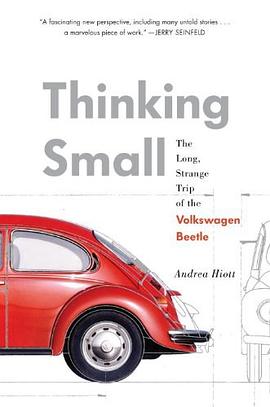

具体描述
Sometimes achieving big things requires the ability to think small. This simple concept was the driving force that propelled the Volkswagen Beetle to become an avatar of American-style freedom, a household brand, and a global icon. The VW Bug inspired the ad men of Madison Avenue, beguiled Woodstock Nation, and has recently been re-imagined for the hipster generation. And while today it is surely one of the most recognizable cars in the world, few of us know the compelling details of this car’s story. In Thinking Small, journalist and cultural historian Andrea Hiott retraces the improbable journey of this little car that changed the world.
Andrea Hiott’s wide-ranging narrative stretches from the factory floors of Weimar Germany to the executive suites of today’s automotive innovators, showing how a succession of artists and engineers shepherded the Beetle to market through periods of privation and war, reconstruction and recovery. Henry Ford’s Model T may have revolutionized the American auto industry, but for years Europe remained a place where only the elite drove cars. That all changed with the advent of the Volkswagen, the product of a Nazi initiative to bring driving to the masses. But Hitler’s concept of “the people’s car” would soon take on new meaning. As Germany rebuilt from the rubble of World War II, a whole generation succumbed to the charms of the world’s most huggable automobile.
Indeed, the story of the Volkswagen is a story about people, and Hiott introduces us to the men who believed in it, built it, and sold it: Ferdinand Porsche, the visionary Austrian automobile designer whose futuristic dream of an affordable family vehicle was fatally compromised by his patron Adolf Hitler’s monomaniacal drive toward war; Heinrich Nordhoff, the forward-thinking German industrialist whose management innovations made mass production of the Beetle a reality; and Bill Bernbach, the Jewish American advertising executive whose team of Madison Avenue mavericks dreamed up the legendary ad campaign that transformed the quintessential German compact into an outsize worldwide phenomenon.
Thinking Small is the remarkable story of an automobile and an idea. Hatched in an age of darkness, the Beetle emerged into the light of a new era as a symbol of individuality and personal mobility—a triumph not of the will but of the imagination.
作者简介
Andrea Hiott was born in South Carolina and graduated with a degree in philosophy from the University of Georgia in Athens. She then went to Berlin to study German and neuroscience, and ended up staying and working as a freelance journalist. In 2005, alongside a group of international artists and writers, she cofounded a cultural journal called Pulse. She now serves as editor-in-chief.
目录信息
读后感
评分
评分
评分
评分
用户评价
读完这本书的第一部分,我的心绪久久不能平静,作者对人性的洞察力简直达到了令人敬畏的程度。他并没有停留在对表象的描摹,而是像一个精妙的外科医生,层层剥开我们习以为常的认知外衣,直抵那些潜藏在意识深处的驱动力和矛盾。书中关于“选择的悖论”那一章节的论述,尤其让我感到醍醐灌顶。我原以为自己对某些人生抉择有着清晰的认识,但在作者的犀利分析下,才发现自己过去的许多判断都是基于多么脆弱的假设之上。他大量引用的案例,无论是历史典故还是日常生活中的微小事件,都被他巧妙地编织进理论体系中,使得原本可能枯燥的哲学思辨变得鲜活而富有张力。阅读的过程中,我常常需要停下来,合上书本,在房间里踱步许久,试图消化其中蕴含的巨大信息量。这已经不是简单的信息获取,而更像是一次深度的自我拷问和思维重塑的过程,它挑战了你既有的世界观,迫使你去重新审视自己与环境的关系。
评分这本书的收尾部分处理得极其巧妙和高级,它没有试图给出一个圆满的、皆大欢喜的结论,这恰恰是它力量的所在。作者似乎知道,他所探讨的议题本质上是开放性的、充满未解之谜的,因此,他选择了一种留白式的收束。在最后几章,笔锋变得更加内敛和哲学化,仿佛从宏大的社会分析,转入了对个体灵魂深处的关照。那些最后出现的几段话,字里行间充满了对存在本质的敬畏,但又带着一丝温和的宿命感。我甚至觉得,读到这里,这本书已经不再是一本书,而更像是一位智者在漫长旅途的终点,对同行者进行的一番语重心长的告别和叮嘱。它留下的不是答案,而是更深刻、更有重量的问题,鼓励读者带着这份未完待续的思考,继续前行。这种回味悠长、引人深思的结尾,使得这本书的价值得以在合上封面后,依然持续发酵和生长。
评分这本书的装帧设计真是让人眼前一亮,那种厚重而又不失典雅的感觉,拿到手里就仿佛触摸到了知识的重量。内页的纸张质感也无可挑剔,油墨的颜色饱满,即便是长时间阅读也不会感到视觉疲劳。我特别喜欢它在排版上下的功夫,字体的选择和行距的调整都恰到好处,让密集的文字也变得容易消化。当然,一本好书的价值绝不仅仅体现在外在,这本书的序言部分就极具吸引力,作者的笔触深沉而富有洞察力,寥寥数语便勾勒出了一个宏大而又引人入胜的叙事框架,让人立刻就对后续的内容充满了期待。它没有那种故作高深的腔调,而是用一种近乎对话的方式,邀请读者进入作者构建的世界,这种亲和力是很多学术著作所缺乏的。我甚至注意到,书脊的装订方式非常牢固,即便是频繁翻阅,也丝毫没有松动的迹象,可见出版方在制作上的用心。整体而言,从拿到书的那一刻起,就感受到了一种对阅读体验的尊重,这为接下来的深入阅读打下了坚实的基础。
评分在阅读这本书的过程中,我发现它提供的不仅仅是理论框架,更像是一套实用的“心智工具箱”。它教会我如何识别那些潜伏在日常决策中的认知偏差,以及如何系统性地去解构那些看似无法撼动的社会规范。例如,书中关于“信息茧房的动态形成”的分析,让我对过去几个月自己在网络上接收信息的方式进行了彻底的反思。作者提供的解构工具箱,并非那种教条式的步骤指南,而是更像一套底层逻辑的算法,它让你在面对新的、未曾预料的困境时,依然能够运用同样的思维模型去拆解问题,找到新的突破口。这种方法的普适性和迁移性,是这本书最具价值的部分之一。它真正实现了“授人以渔”,而不是简单地“授人以鱼”,让你在合上书本后,依然能带着一种被升级过的“操作系统”继续生活和工作,这才是真正有生命力的思想。
评分这本书的语言风格,我必须用“清冽而富有穿透力”来形容。它不像某些畅销书那样追求夸张的煽情或浅薄的励志口号,而是以一种近乎散文诗的精准和冷峻,描绘出那些宏大叙事背景下的个体挣扎。作者在构建逻辑链条时表现出了惊人的耐心和严谨性,每一个论点都建立在前一个论点的稳固基石之上,读起来酣畅淋漓,没有丝毫的拖泥带水。特别是在论述“时间和意义的相对性”时,他构建了一个多维度的参照系,让读者得以跳出线性的时间感知,从一个更为广阔的维度去审视生命中的得失。我尤其欣赏作者对复杂概念的处理方式——他不会用晦涩的术语来故作高深,而是擅长用精准的比喻和日常的语言去“翻译”这些概念,让深奥的理论变得可以触摸、可以感知。这种写作技巧,要求作者不仅要有深厚的学识,更要有非凡的表达艺术,这本书在这方面无疑是登峰造极的。
评分 评分 评分 评分 评分相关图书















本站所有内容均为互联网搜索引擎提供的公开搜索信息,本站不存储任何数据与内容,任何内容与数据均与本站无关,如有需要请联系相关搜索引擎包括但不限于百度,google,bing,sogou 等
© 2026 book.quotespace.org All Rights Reserved. 小美书屋 版权所有