
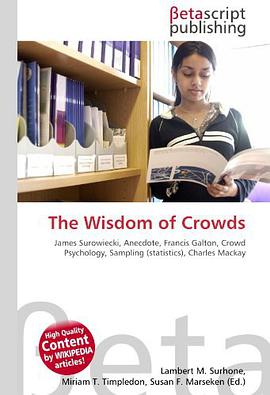

具体描述
While our culture generally trusts experts and distrusts the wisdom of the masses, New Yorker business columnist Surowiecki argues that "under the right circumstances, groups are remarkably intelligent, and are often smarter than the smartest people in them." To support this almost counterintuitive proposition, Surowiecki explores problems involving cognition (we're all trying to identify a correct answer), coordination (we need to synchronize our individual activities with others) and cooperation (we have to act together despite our self-interest). His rubric, then, covers a range of problems, including driving in traffic, competing on TV game shows, maximizing stock market performance, voting for political candidates, navigating busy sidewalks, tracking SARS and designing Internet search engines like Google. If four basic conditions are met, a crowd's "collective intelligence" will produce better outcomes than a small group of experts, Surowiecki says, even if members of the crowd don't know all the facts or choose, individually, to act irrationally. "Wise crowds" need (1) diversity of opinion; (2) independence of members from one another; (3) decentralization; and (4) a good method for aggregating opinions. The diversity brings in different information; independence keeps people from being swayed by a single opinion leader; people's errors balance each other out; and including all opinions guarantees that the results are "smarter" than if a single expert had been in charge. Surowiecki's style is pleasantly informal, a tactical disguise for what might otherwise be rather dense material. He offers a great introduction to applied behavioral economics and game theory.
Copyright © Reed Business Information, a division of Reed Elsevier Inc. All rights reserved.
作者简介
詹姆斯•索罗维基(James Surowiecki)
《纽约客》杂志特约撰稿人。他的文章见诸很多出版物,包括《纽约时报》《华尔街日报》《艺术论坛报》《连线》杂志和《候选人名单》杂志。索罗维基最初在《纽约客》杂志的“金融专版”阐述了群体智慧的思想,回答了美国社会长期以来对群体智慧和团队决策能力的质疑。
目录信息
读后感
群众的意见并不是统一的时候最准确,而恰恰是融合很多不同意见的时候,准确性超过任何个别专家的意见。 -------------------------------------- 作者区分了群众的力量可能解决的3种问题: cognition problem比如猜测股市价格,牛的重量等 coordination problem 比如协调开车,...
评分《The Wisdom of Crowds》是James Surowiecki于2004年写就的,彼时,Web2.0还是新生事物,他还得用猜公牛体重的逸闻趣事、猜豆子的实验来佐证群体智慧的主张。而今,群体智慧的应用则俯拾皆是,不胜枚举:譬如Google的PageRank,Wiki, Imdb的推荐影片和豆瓣的推荐阅读等等。 要...
评分读这书读到一半的时候,我猛然想起俺们中国人的俗话:三个臭皮匠,凑成一个诸葛亮。 这本书的作者,把现代西方的科学家对于群体智慧的各种研究做了一个综述。它不是给出一个结论,而是告诉我们是如何得出这个结论的,是怎样研究,怎样设计实验来获得数据的。 俺大学的时候,...
评分 评分2003年,在很多的国家和地区同时经历了SARS危机。这是一种很像流感的疾病,但实验显示它不是流感病毒,而是一种新型的病毒和疾病。还没有发现SARS病源之前,人们只能通过 “隔离”的方式对付这种流行病毒。同年的3月15日,世界卫生组织与遍布世界各国和地区的11个研究实验室取...
用户评价
有种穿越时光看过去的人如何群情激昂的感觉。。。。
评分有种穿越时光看过去的人如何群情激昂的感觉。。。。
评分有种穿越时光看过去的人如何群情激昂的感觉。。。。
评分有种穿越时光看过去的人如何群情激昂的感觉。。。。
评分有种穿越时光看过去的人如何群情激昂的感觉。。。。
相关图书











本站所有内容均为互联网搜索引擎提供的公开搜索信息,本站不存储任何数据与内容,任何内容与数据均与本站无关,如有需要请联系相关搜索引擎包括但不限于百度,google,bing,sogou 等
© 2026 book.quotespace.org All Rights Reserved. 小美书屋 版权所有