
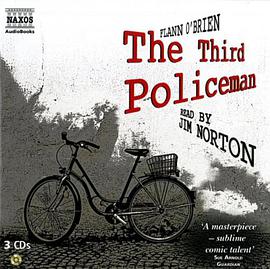

具體描述
The Third Policeman is Flann O'Brien's brilliantly dark comic novel about the nature of time, death, and existence. Told by a narrator who has committed a botched robbery and brutal murder, the novel follows him and his adventures in a two-dimensional police station where, through the theories of the scientist/philosopher de Selby, he is introduced to "Atomic Theory" and its relation to bicycles, the existence of eternity (which turns out to be just down the road), and de Selby's view that the earth is not round but "sausage-shaped." With the help of his newly found soul named "Joe," he grapples with the riddles and contradictions that three eccentric policeman present to him.
The last of O'Brien's novels to be published, The Third Policeman joins O'Brien's other fiction (At Swim-Two-Birds, The Poor Mouth, The Hard Life, The Best of Myles, and The Dalkey Archive) to ensure his place, along with James Joyce and Samuel Beckett, as one of Ireland's great comic geniuses.
——————
"A most sardonic novel about life after death with the dead man telling the comic and terrifying story . . . a strange, original comic genius." --New York Times
"As with Scott Fitzgerald, there is a brilliant ease in his prose, a poignant grace glimmering off every page." --John Updike
"Frenetic, dazzling, unconscionably funny . . . sparkles with wit, elegance, and eruditon (authentic and mock) . . . provides delight in profuse measure." --Newsweek
著者簡介
Flann O'Brien, whose real name was Brian O'Nolan, also wrote under the pen name of Myles na Gopaleen. He was born in 1911 in County Tyrone. A resident of Dublin, he graduated from University College after a brilliant career as a student (editing a magazine called Blather) and joined the Civil Service, in which he eventually attained a senior position.
He wrote throughout his life, which ended in Dublin on April 1, 1966. His other novels include The Dalkey Archive, The Third Policeman, The Hard Life, and The Poor Mouth, all available from Dalkey Archive Press. Also available are three volumes of his newspaper columns: The Best of Myles, Further Cuttings from Cruiskeen Lawn, and At War.
圖書目錄
讀後感
从下午三点到凌晨一点 中途去喝了杯玛格丽特 小说的开头十分精彩 i was born many years ago 看完一遍之后才能体会到这句话的暧昧与机智 风的颜色 小长袍 很美 人与自行车的互相融合(为什么是自行车?)匣中之匣 被拉伸的光 永恒之所 乔的一直在场和发言 煞有介事的虚拟注释...
評分#读书,我是认真的# 《第三个警察》 [爱尔兰] 弗兰·奥布莱恩 译 刘志刚 >> 人生在世本为幻觉,昼夜之分亦是如此(所谓夜,不过是黑气凝成的秽物)。死亡是终极的幻觉,明智的人不应畏惧。 ——德塞尔比 >> 可是既然人事是这样无常, 让我们也考虑到万一的不幸。 ...
評分#读书,我是认真的# 《第三个警察》 [爱尔兰] 弗兰·奥布莱恩 译 刘志刚 >> 人生在世本为幻觉,昼夜之分亦是如此(所谓夜,不过是黑气凝成的秽物)。死亡是终极的幻觉,明智的人不应畏惧。 ——德塞尔比 >> 可是既然人事是这样无常, 让我们也考虑到万一的不幸。 ...
評分湖南文艺这版的第三个警察的封面画面的主体是一个自行车链条,还有书中反复提到的自行车这个意向,让读完全文兴奋又懊丧的我莫名其妙想起了这句流行语。 之前对这位作者一点都不了解,对爱尔兰文学也没有多少概念,哪怕是著名的尤利西斯,与法国那本追忆似水年华一样,可以说是...
評分“风的长袍”“原子论”“自行车人”“看不见的匣子”, 将这一切荒诞的理论结合到一起会产生怎样精彩的作品?在爱尔兰作家弗兰·奥布莱恩笔下,这些看似不相连的所谓理论相遇后,竟碰撞出无比璀璨的火花。 这就是他的作品《第三个警察》。本书虽然创作于1939-1940年间,可直到...
用戶評價
相關圖書















本站所有內容均為互聯網搜索引擎提供的公開搜索信息,本站不存儲任何數據與內容,任何內容與數據均與本站無關,如有需要請聯繫相關搜索引擎包括但不限於百度,google,bing,sogou 等
© 2026 book.quotespace.org All Rights Reserved. 小美書屋 版权所有