具体描述
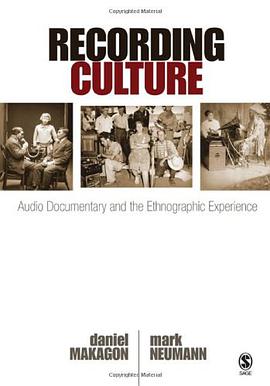
Recording Culture: Audio Documentary and the Ethnographic Experience is the first book to explore audio documentary as a research method. Authors Daniel Makagon and Mark Neumann demonstrate that audio documentary based in the practices of fieldwork increases the potential for researchers to reach academic and popular audiences and work collaboratively with people in the pursuit and representation of knowledge and experience. Key FeaturesEncourages readers to critically listen to their sites of analysis and the people they studyOffers an ethnographic alternative that moves beyond the written formProvides researchers with a broader historical context for recording culture projectsOffers students a better sense of ethnography s relationship to popular documentary fieldworkIncludes creative sonic fieldwork projectsDemonstrates how audio documentary as a qualitative fieldwork practice can be connected to public life and community-building as citizen storytellingOffers a practical guide to getting started in the Appendix Recording Culture: Audio Documentary and the Ethnographic Experience is paired with a companion Web site at www.recordingculture.org that contains links to exemplary audio ethnographies.
Recording Culture: An Introduction to Ethnographic Methods and Practices This book offers a comprehensive and practical guide to the art and science of ethnographic research, a fundamental methodology for understanding human societies and their intricate cultural fabric. "Recording Culture" moves beyond theoretical discourse to delve into the hands-on techniques and ethical considerations that underpin successful fieldwork. It is designed for students, researchers, and anyone seeking to develop a deep and nuanced understanding of how people live, interact, and make meaning in the world. The journey begins with a thorough exploration of the philosophical underpinnings of ethnography. We examine its historical evolution, tracing its roots from early anthropological explorations to its contemporary applications across diverse disciplines like sociology, anthropology, cultural studies, and even business and design. The core premise of ethnography—its commitment to immersion, observation, and empathetic engagement—is unpacked, highlighting its unique ability to capture the richness and complexity of lived experiences that often elude quantitative methods. Central to this guide is the meticulous breakdown of fieldwork preparation. This section equips readers with the essential tools and strategies for launching a research project. We address the crucial steps of defining research questions, formulating theoretical frameworks, and conducting a comprehensive literature review. Crucially, we emphasize the importance of developing cultural sensitivity and reflexivity before entering the field. This includes understanding potential biases, the power dynamics inherent in research relationships, and the ethical imperative of informed consent and participant anonymity. Practical advice on securing funding, navigating institutional review boards (IRB) processes, and assembling necessary equipment is also provided. The heart of "Recording Culture" lies in its in-depth examination of data collection methods. This is where the "recording" aspect of our title truly comes to life. We provide detailed instruction and practical examples for a range of ethnographic techniques: Participant Observation: This cornerstone of ethnography is explored in detail, moving from the initial challenges of gaining access and building rapport to the art of meticulous note-taking. We discuss different forms of observation, from overt to covert, and the ethical implications of each. Readers will learn to document not just what is seen, but also the sensory details, the atmosphere, and the emotional nuances of a setting. The importance of maintaining detailed field notes, including descriptive, reflective, and theoretical entries, is emphasized. Interviews: The book offers a comprehensive guide to conducting various types of interviews, including semi-structured, unstructured, and life history interviews. We address the art of crafting effective interview questions, the nuances of active listening, and techniques for probing deeper into participant responses. Strategies for overcoming communication barriers, navigating sensitive topics, and ensuring that interviews elicit rich, narrative accounts are explored. The importance of transcribing and anonymizing interview data is also covered. Documentary Analysis: Beyond direct observation and interaction, this section guides readers through the analysis of existing texts and artifacts. This can include written documents, visual media, audio recordings, and material culture. We explore how these materials can provide invaluable insights into the beliefs, values, and practices of a group. Visual and Auditory Recording: With the proliferation of digital technologies, the book addresses the ethical and practical considerations of using photography, video, and audio recording in fieldwork. We discuss how to obtain informed consent for recording, the techniques for capturing compelling visual and auditory data, and the challenges of analyzing these multi-modal forms of information. Mapping and Spatial Analysis: Understanding the social and cultural significance of space is a vital component of ethnography. This section explores methods for mapping physical environments and analyzing how social relationships, power dynamics, and cultural practices are inscribed within landscapes. Throughout these method-focused chapters, "Recording Culture" consistently emphasizes the iterative and emergent nature of ethnographic research. It’s not a linear process, but rather a dynamic interplay between data collection, analysis, and refinement of research questions. The book stresses the importance of flexibility and adaptability in the face of unexpected discoveries and challenges in the field. Furthermore, "Recording Culture" dedicates significant attention to the analytical phase of ethnographic research. Data collected in the field rarely speaks for itself. This section guides readers through the process of making sense of complex information. We explore various approaches to data analysis, including thematic analysis, discourse analysis, and narrative analysis. The book highlights the importance of identifying patterns, themes, and contradictions within the data, and how to ground these interpretations in theoretical frameworks. Techniques for organizing and coding large volumes of qualitative data are also discussed, along with strategies for developing convincing arguments and narratives from ethnographic findings. Ethical considerations are woven throughout the entire text, not confined to a single chapter. The book underscores the profound responsibility that ethnographers bear towards the communities and individuals they study. We delve into the complexities of power imbalances, the potential for exploitation, and the importance of ensuring that research benefits participants as well as advancing academic knowledge. Detailed discussions on informed consent, confidentiality, anonymity, and the repatriation of research findings are provided, along with guidance on navigating situations where ethical dilemmas arise. The concept of "giving back" to the community is also explored as an integral part of responsible ethnographic practice. Finally, "Recording Culture" concludes by exploring the dissemination of ethnographic findings. This section provides practical advice on how to communicate research results effectively to diverse audiences, including academic peers, policymakers, and the communities themselves. We discuss the conventions of ethnographic writing, the use of narrative, and the importance of representing participants and their cultures with accuracy, respect, and nuance. The book also touches upon the broader societal impact and potential applications of ethnographic research in addressing real-world challenges. In essence, "Recording Culture" is more than just a manual; it's an invitation to engage with the world in a deeply observant and analytical way. It encourages readers to cultivate a sense of curiosity, empathy, and critical engagement, equipping them with the skills and ethical compass necessary to authentically record and understand the diverse tapestry of human culture.