
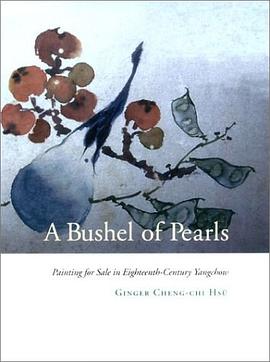

具体描述
Painting in eighteenth-century Yangchow, a city that dominated the political and economic scene of mid-Qing China, has traditionally been viewed as the product of a group of nonconformist, “eccentric” artists who were supported by wealthy merchants.
This book, however, does not focus on the creative energy of the individual artist, the rise of the Yangchow school of painting, or patronage narrowly defined. Rather, it studies eighteenth-century Yangchow paintings as artistic products shaped by collective social and cultural experiences, and by constant exchanges between the artists and their audience. The author examines the paintings as commodities, revealing the mechanism of their exchange and the values negotiated, and she interprets the paintings in a framework that moves beyond economics into the social, political, historical, and literary contexts of their creation and appreciation.
The book begins by considering merchant patrons long associated with the Yangchow school of painting, and goes on to reveal that there were patrons from lower socioeconomic levels who were, in fact, perhaps the major consumers of Yangchow painting. The author then discusses four artists who exemplify the diversity of backgrounds and artistic traditions of Yangchow painters and patrons.
Fang Shih-shu represents the traditional scholar painter of conservative orthodox landscapes. Huang Shen, by contrast, represents painters with craftsman backgrounds who mingle the values of the literati with the technical skill of artisans. The last two painters, Cheng Hsieh and Chin Nung, represent the emergence of new types of artists who adopted painting as an occupation and commercialized both their artistic products and their personal cultural refinement and literati status.
By reconstructing the economic lives of these artists, examining their social roles, identifying their networks of patronage, and investigating their aesthetic choices, this book illuminates the process of professionalization of the scholar-artist and the commodification of literati culture in late imperial China.
作者简介
Ginger Cheng-chi Hsü is Associate Professor of Art History at the University of California, Riverside.
目录信息
读后感
评分
评分
评分
评分
用户评价
**书评五:** 这部作品的语言风格是那种带着古典韵味的现代散文,句子结构复杂而不累赘,充满了音乐性和节奏感。它有一种奇特的魔力,能够将最普通的人际交往描写得如同史诗般重要。我特别关注了书中人物之间的互动模式,尤其是那些未言明的张力——那些停顿、那些眼神的交汇,远比直接的争吵更具杀伤力和感染力。作者对于“沉默”的运用,简直是教科书级别的典范,有时候,人物什么也没说,但读者却能清晰地感受到他们内心深处的风暴。这本书对“选择”与“命运”的探讨也是其核心亮点之一。它没有简单地归咎于命运的捉弄,而是深入剖析了每一个微小抉择如何如同蝴蝶效应般连锁反应,最终塑造了一个人的轨迹。阅读这本书,就像是偷窥了一段段被时间打磨得光滑的记忆碎片,它们既冰冷又温暖,既遥远又无比贴近我们自己的生活经验,让人读完后久久无法抽离那种情绪共振之中。
评分**书评一:** 这本书简直是一场视觉与心灵的盛宴,作者的笔触如同最精细的丝线,编织出一幅幅流光溢彩的画面。我尤其被那种对日常细微之处的捕捉能力所折服,仿佛置身于那个充满烟火气和古老韵味的世界里。故事的节奏把握得恰到好处,时而如清晨的薄雾般轻柔舒缓,引人沉思,时而又如同夏日午后的雷阵雨般骤然而至,充满了戏剧性的张力。角色的塑造立体而鲜活,他们不仅仅是文字的符号,更是带着血肉和呼吸的个体,他们的挣扎、欢笑与泪水,都深深地烙印在读者的脑海中。我花了很长时间去回味那些充满哲思的对话,它们没有生硬的说教,而是以一种润物细无声的方式,探讨着关于时间和记忆的深刻命题。阅读的过程,与其说是消费时间,不如说是一种沉浸式的体验,让人愿意放下一切,只专注于那一行行文字所构建的宏大而又精微的宇宙。这本书的结构处理也极为巧妙,看似松散,实则暗藏精妙的伏笔和呼应,每一次不经意的重读,都能发现新的惊喜和更深层次的关联,这才是真正有生命力的文学作品该有的样子。
评分**书评三:** 这本书的氛围营造能力简直达到了出神入化的地步。从泛黄的纸张气味到窗外淅沥的雨声,作者成功地构建了一个具有强烈触感和听觉联想的阅读环境。它不是靠宏大的情节驱动,而是依赖于对特定场景、特定情绪的极致渲染。我尤其着迷于作者对光影的描绘,那种黄昏时分斜射进房间的最后一道光,或者月光穿过树叶投下的斑驳阴影,都被赋予了近乎形而上学的意义。读完后,那种久久不散的“感觉”比故事梗概更让人难忘。而且,这本书在处理“失落”这一主题时,展现了一种成熟而温柔的姿态。它没有陷入无谓的悲情,而是将失落视为生命不可分割的一部分,用一种近乎接受现实的平静态度去审视它,这种哲学层面的豁达,让人在合上书页时,感到一种奇异的平静和释然,仿佛自己也经历了一次深刻的洗礼。
评分**书评二:** 坦率地说,初读时我有些跟不上作者的叙事风格,它不像我习惯的那些线性叙事那么直白明了。它的魅力在于那种近乎意识流的跳跃和对意象的偏执运用,初看时犹如一团迷雾,但坚持读下去后,你会发现,这迷雾本身就是作者想要描绘的某种情感状态——那种模糊、难以捉摸却又真实存在的内心波动。这本书的语言密度极高,几乎没有一句废话,每一个词语似乎都经过了千锤百炼,承载了超越其字面意思的重量。我特别欣赏它在处理情感冲突时的克制与爆发力的结合,那些最激烈的内心翻腾,往往是通过极度平静的外部描写来衬托的,这种反差制造出的张力,比直接的呐喊更具穿透力。它迫使你慢下来,去咀嚼那些看似寻常的词句,去感受词语间那些留白和沉默的力量。对于那些寻求快速娱乐的读者来说,这本书或许会显得有些“晦涩”,但对于真正热爱文字和愿意与作品进行深度对话的人来说,这无疑是一场思想上的探险,其收获绝对值得付出时间和精力去探索。
评分**书评四:** 我必须承认,这本书在结构上确实是反传统的,它更像是一组精心排列的艺术品集合,而不是一个单一的雕塑。章节之间的过渡有时是跳跃性的,可能前一秒还在讲述一个古老的传说,下一秒就突然聚焦于一个现代的琐碎场景。然而,正是这种看似破碎的拼贴,最终在读者的脑海中重组成了一个关于“时间循环与个体记忆”的宏大主题。作者对于细节的执着令人赞叹,那些关于地方历史、民间习俗的考据,都显示出其深厚的底蕴和严谨的态度。这种“满盈”感使得文本充满了可挖掘的层次,你甚至可以感觉到作者在某些段落里故意留下的“空白”,鼓励读者用自己的经验去填补。这本书不提供明确的答案,它更像是一个精美的迷宫,邀请你去探索,去迷失,最终在迷失中找到属于自己的那条路径。对我而言,这是一次需要全神贯注的智力挑战,但回报是丰厚的。
评分扬州八怪研究经典文章
评分扬州八怪研究经典文章
评分扬州八怪研究经典文章
评分Although I only read the introduction for research, this book is very interesting in the way that tries to show the diversity of the salt merchants and the complex situation of artists and patron in 18thc Yangzhou.
评分Although I only read the introduction for research, this book is very interesting in the way that tries to show the diversity of the salt merchants and the complex situation of artists and patron in 18thc Yangzhou.
相关图书







本站所有内容均为互联网搜索引擎提供的公开搜索信息,本站不存储任何数据与内容,任何内容与数据均与本站无关,如有需要请联系相关搜索引擎包括但不限于百度,google,bing,sogou 等
© 2026 book.quotespace.org All Rights Reserved. 小美书屋 版权所有