
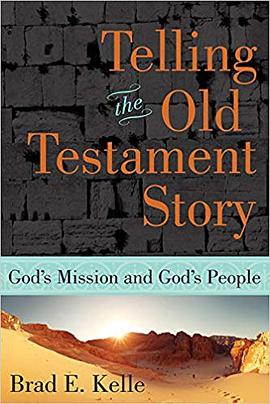

具体描述
While honoring the historical context and literary diversity of the Old Testament, Telling the Old Testament Story is a thematic reading that construes the OT as a complex but coherent narrative. Unlike standard, introductory textbooks that only cover basic background and interpretive issues for each Old Testament book, this introduction combines a thematic approach with careful exegetical attention to representative biblical texts, ultimately telling the macro-level story, while drawing out the multiple nuances present within different texts and traditions.
The book works from the Protestant canonical arrangement of the Old Testament, which understands the story of the Old Testament as the story of God and God’s relationship with all creation in love and redemption—a story that joins the New Testament to the Old. Within this broader story, the Old Testament presents the specific story of God and God’s relationship with Israel as the people called, created, and formed to be God’s covenant partner and instrument within creation.
The Old Testament begins by introducing God’s mission in Genesis. The story opens with the portrait of God’s good, intended creation of right-relationships (Gen 1—2) and the subsequent distortion of that good creation as a result of humanity’s rebellion (Gen 3—11). Genesis 12 and following introduce God’s commitment to restore creation back to the right-relationships and divine intentions with which it began. Coming out of God’s new covenant engagement with creation in Gen 9, this divine purpose begins with the calling of a people (who turn out to be the manifold descendants of Abraham and Sarah) to be God’s instrument of blessing for all creation and thus to reverse the curse brought on by sin. The diverse traditions that comprise the remainder of the Pentateuch then combine to portray the creation and formation of Israel as a people prepared to be God’s instrument of restoration and blessing. As the subsequent Old Testament books portray Israel’s life in the land and journey into and out of exile, the reader encounters complex perspectives on Israel’s attempts to understand who God is, who they are as God’s people, and how, therefore, they ought to live out their identity as God’s people within God’s mission in the world. The final prophetic books that conclude the Protestant Old Testament ultimately give the story of God’s mission and people an open-ended quality, suggesting that God’s mission for God’s people continues and leading Christian readers to consider the New Testament’s story of the Church as an extension and expansion of the broader story of God introduced in the Old Testament.
The main methodological perspective that informs the book includes work on the phenomenological function of narrative (especially story’s function to shape the identity and practice of the reader), as well as more recent so-called “missional” approaches to reading Christian scripture. Canonical criticism provides the primary means for relating the distinctive voices within the Old Testament texts that still honor the particularity and diversity of the discrete compositions.
Accessibly written, this book invites readers to enter imaginatively into the biblical story and find the Old Testament's lively and enduring implications.
作者简介
Brad E. Kelle is Professor of Old Testament and Hebrew, School of Theology and Christian Ministry, Point Loma Nazarene University in San Diego, California. He has served as the chair of the SBL’s Warfare in Ancient Israel Consultation at the Annual Meeting of the Society of Biblical Literature. He is also the past president and current member at large (executive board) of the Society of Biblical Literature Pacific Coast Region. He is the Old Testament editor for Currents in Biblical Research and has written or edited a variety of works on the Old Testament and ancient Israel.
目录信息
读后感
评分
评分
评分
评分
用户评价
坦率地说,这本书的语言风格充满了古典的美感,但绝不落入矫揉造作的窠臼。它像一位经验丰富的老者,用沉稳而富有韵律的语调,向你娓娓道来那些尘封已久的事迹。我尤其喜欢作者在转折处所使用的那些富有哲理性的短句,它们如同散落在故事脉络中的珍珠,晶莹剔透,引人深思。这些句子常常能在叙事的高潮或低谷时恰到好处地出现,为读者提供了一个暂停和反刍的空间。阅读体验是极为舒缓且充实的,每一次翻页都伴随着对文字深层含义的咀嚼。它赋予了那些耳熟能详的片段一种全新的、更加人性化的解读,让人对文本的理解达到了前所未有的高度。
评分令人称奇的是,作者在保持叙事流畅性的同时,并没有牺牲历史的厚重感。他对不同时期社会背景的描摹,精准而富有层次,使得原本可能枯燥的历史事件焕发出鲜活的生命力。我发现自己不仅仅是在阅读一个故事,更像是在参与一场深度的考古发掘,每一层文本都揭示出那个时代独特的社会结构、道德规范乃至日常生活细节。这种将宏大叙事与微观细节完美结合的笔法,极大地增强了阅读的沉浸感。特别是那些关于早期社群建立和律法制定的部分,处理得极为精妙,没有使用任何晦涩的学术术语,却能让普通读者清晰地把握其深远影响。这无疑是一部在学术严谨性和大众可读性之间找到了完美平衡的杰作。
评分这本书最让我感到震撼的是它对“人性”本身的探讨,那种永恒不变的挣扎与渴望。作者似乎洞悉了人类心灵深处的密码,即便是面对超自然的力量或严格的律法,个体的欲望、恐惧、爱与背叛依然是推动故事发展的核心驱动力。它成功地剥离了神话色彩的外衣,直抵那些根植于人类本性的情感共鸣点。这种对人类共同经验的深刻挖掘,使得这部作品超越了其特定的宗教或历史范畴,成为了一部探讨存在意义的深刻文本。合上书本后,那种萦绕在心头的沉思感久久不散,它迫使我以更广阔的视角去审视现代生活中的种种选择与后果。
评分从排版和装帧来看,这本书显然是经过精心设计的,看得出出版方对内容的尊重。纸张的质感和墨水的清晰度,都极大地提升了阅读的舒适度,长时间阅读也不会感到视觉疲劳。更重要的是,书中穿插的那些高质量的插图或地图,虽然我不会在这里具体描述它们的内容,但它们的作用是无可替代的——它们提供了一个直观的参照系,帮助读者在大脑中快速构建出复杂的地理环境和时间轴线。这种视觉辅助不是可有可无的点缀,而是有效梳理复杂信息流的关键工具,使得那些涉及地域变迁和世代更迭的叙述变得清晰易懂,极大地降低了理解的门槛。
评分这本书的叙事结构简直是一场穿越时空的史诗之旅。作者以一种极其细腻且富有洞察力的方式,将那些跨越千年的古老故事编织成一幅连贯的画卷。我特别欣赏作者在处理人物刻画上的深度,那些在历史长河中挣扎、信仰动摇又最终坚定的形象,被描绘得栩栩如生,仿佛他们就站在我眼前,与我一同呼吸。这不是简单的事件罗列,而是一次深入灵魂的探索,让人不禁反思自身在面对信仰与命运抉择时的态度。阅读过程中,我时常被那种宏大叙事下的个体命运所震撼,体会到人类在面对未知与神圣力量时的敬畏与渺小。那种文字的张力,仿佛能拉动读者一同进入那个遥远的时代背景,感受当时的文化氛围与精神面貌。
评分挺好的survey,以God's mission,和人起初和持续的unbelieve和self-secure为主题串起整个OT。可以留到以后翻译。
评分挺好的survey,以God's mission,和人起初和持续的unbelieve和self-secure为主题串起整个OT。可以留到以后翻译。
评分挺好的survey,以God's mission,和人起初和持续的unbelieve和self-secure为主题串起整个OT。可以留到以后翻译。
评分挺好的survey,以God's mission,和人起初和持续的unbelieve和self-secure为主题串起整个OT。可以留到以后翻译。
评分挺好的survey,以God's mission,和人起初和持续的unbelieve和self-secure为主题串起整个OT。可以留到以后翻译。
相关图书







本站所有内容均为互联网搜索引擎提供的公开搜索信息,本站不存储任何数据与内容,任何内容与数据均与本站无关,如有需要请联系相关搜索引擎包括但不限于百度,google,bing,sogou 等
© 2026 book.quotespace.org All Rights Reserved. 小美书屋 版权所有