
Trans-Himalayan Borderlands pdf epub mobi txt 电子书 下载 2026
- 郁丹
- 生计
- 现代性
- 区域性
- 人类学
- 中國民族誌
- #泥蕃
- Trans-Himalayan Borderlands
- Himalayas
- Borderlands
- Central Asia
- Tibet
- China
- India
- Pakistan
- Culture
- Politics
- Geography
- History
- Anthropology

具体描述
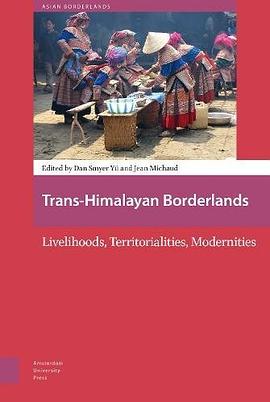
The societies in the Himalayan borderlands have undergone wide-ranging transformations, as the territorial reconfiguration of modern nation-states since the mid-twentieth century and the presently increasing trans-Himalayan movements of people, goods and capital, reshape the livelihoods of communities, pulling them into global trends of modernisation and regional discourses of national belonging. This book explores the changes to native senses of place, the conception of border - simultaneously as limitations and opportunities - and what the authors call "affective boundaries," "livelihood reconstruction," and "trans-Himalayan modernities." It addresses changing social, political, and environmental conditions that acknowledge growing external connectivity even as it emphasises the importance of place.
作者简介
Dan Smyer Yü, Professor and Director of Center for Trans-Himalayan Studies at Yunnan Minzu University, is the author of The Spread of Tibetan Buddhism in China: Charisma, Money, Enlightenment (Routledge 2011) and Mindscaping the Landscape of Tibet: Place, Memorability, Eco-aesthetics (De Gruyter 2015), and co-editor of Religion and Ecological Sustainability in China (Routledge 2014).
Jean Michaud , Professor of Social Anthropology at Université Laval, Canada. Is the author of 'Incidental' Ethnographers. French Catholic Missions on the Tonkin-Yunnan Frontier, 1880-1930 (Brill 2007), Historical Dictionary of the Peoples of the Southeast Asian Massif (Scarecrow 2006, 2nd edition in progress); co-authored Frontier Livelihoods: Hmong in the Sino-Vietnamese Borderlands (U. of Washington Press 2015); co-edited Moving Mountains: Ethnicity and Livelihoods in Highland China, Vietnam and Laos (UBC Press 2011) and Hmong/Miao in Asia (Silkworm 2004).
目录信息
I. TERRITORY, WORLDVIEWS, AND POWER THROUGH TIME
1. Livelihood Structure in the Southeast Asian Massif[-]Jean Michaud
2. The Properties of Territory in Nepal's State of Transformation[-]Sara Shneiderman
3. Trans-Himalayan Buddhist Secularities: Sino-Indian Geopolitics of Territoriality in Indo-Tibetan Interface[-]Dan Smyer Yü
4. Buddhist Books on Trans-Himalayan Pathways: Materials and Technologies Connecting People and Ecological Environments in a Transnational Landscape Hildegard Diemberger
5. Seeking China's Back Door: On English Handkerchiefs and Global Local Markets in the Early Nineteenth Century[-]Gunnel Cederlï
II. LIVELIHOOD RECONSTRUCTIONS, FLOWS, AND TRANS-HIMALAYAN MODERNITIES
6. Contested Modernities: Place, Subjectivity, and Himalayan Dam Infrastructures[-]Georgina Drew
7. Plurality and Plasticity of Everyday Humanitarianism in the Karen Conflict[-]Alexander Horstmann
8. Being Modern: Livelihood Reconstruction among Land-Lost Peasants in Chenggong (Kunming)[-]Yang Cheng
9. Tibetan Wine Production, Taste of Place, and Regional Niche Identities in Shangri-La.[-]Brendan A. Galipeau
10. Tea and Merit-Landscape Making in the Ritual Lives of De'ang People in Western Yunnan[-]Li Quanmin
11. In between Poppy and Rubber Fields: Experimenting a Trans-Border Livelihood among the Akha in the Northwestern Frontier of Laos-Li Yunxia
12. A Fortuitous Frontier Opportunity: Cardamom Livelihoods in the Sino-Vietnamese Borderlands[-]Sarah Turner
CONCLUSION
Frictions of Change in the Trans-Himalayas-Jean Michaud.
· · · · · · (收起)
读后感
评分
评分
评分
评分
用户评价
我必须承认,这本书的深度和广度远超我的预期。它并非那种肤浅的游记或泛泛而谈的文化介绍,而是深入到了社会结构、政治边缘化以及经济生态的肌理之中。作者显然花费了大量时间进行田野调查,这种扎实的功底使得书中的论证极具说服力。特别是关于边界如何塑造身份认同的章节,提供了许多令人耳目一新的视角。例如,书中探讨了气候变化如何不成比例地影响了依赖传统牧业的社区,这种将宏观环境变化与微观个体命运联系起来的叙事手法,极具震撼力。文字的节奏感把握得非常好,时而紧凑如快马加鞭,时而舒缓如雪山融水,引导着读者的思绪在广阔的地理空间中自由驰骋,同时也让人深思人类在面对不可抗拒的自然力量时的韧性与挣扎。
评分这本关于喜马拉雅山脉边境地带的书,读起来真像是一场穿越时空的探险。作者的笔触细腻而富有张力,仿佛带着我们亲身走过那些崎岖不平的山路,感受着高原上稀薄空气带来的喘息与震撼。书中对当地风土人情的描绘尤为生动,那些古老的宗教仪式、独特的部族生活方式,都被娓娓道来,充满了神秘的吸引力。我尤其喜欢作者对于历史变迁与地理环境相互作用的探讨,它不仅仅是一本地理记录,更是一部鲜活的人类史诗。那些关于贸易路线、文化交融与冲突的记述,让我对这个复杂而美丽的地区有了更深层次的理解。语言的运用极其考究,时而如诗如画,时而如刀斧般犀利,精准地捕捉了边境地带那种既壮丽又脆弱的特质。读完之后,仿佛自己也沾染上了高原的尘土与信仰的光芒,久久不能平复。
评分说实话,这本书的阅读体验非常“沉浸”。它不像教科书那样枯燥,反而充满了人文关怀和一种近乎朝圣般的敬畏感。作者似乎不仅仅是在记录,更是在倾听那些无声的故事。我特别欣赏其中对少数族裔口述历史的尊重与呈现方式,那些失落的传说和未被主流史学记录的片段,在这里得到了重生。每一页都散发着一种独特的“在地感”,让你感觉自己正坐在某个偏远山村的火塘边,听着老人讲述着祖辈的迁徙史。这种真诚度是很多学术著作所缺乏的,它成功地架设了一座沟通古老智慧与现代视野的桥梁。尽管有些段落涉及复杂的历史事件,但作者的叙事技巧确保了即便是初涉该领域的读者也能轻松跟进,不至于迷失在繁杂的地名和年代中。
评分这是一部非常需要静心品读的佳作,它的价值在于其对复杂性的坦诚接纳,而非急于给出简单的结论。作者巧妙地回避了对“边境”这一概念的简单化定义,而是将其呈现为一个流动的、充满矛盾的动态场域。我印象深刻的是对跨国河流治理的分析,那种多方博弈、互不相让的微妙平衡,被描绘得淋漓尽致。书中的插图和地图虽然只是辅助,但其选择的精准性极大地增强了文字的说服力,让人可以随时对照地理位置,构建起脑海中的立体空间模型。总而言之,它提供了一种非常成熟的全球视野,展示了偏远地带如何在全球化浪潮中进行自我调适与抵抗。读完后,我对世界政治地理学的理解提升到了一个新的维度,它不再是抽象的线条和国界,而是鲜活的人群和他们的生存智慧。
评分这本书的叙事腔调非常独特,它带着一种深沉的、近乎哲学的反思,探究了“边缘”的意义。作者的文笔极具画面感,尤其是在描写极端天气和自然灾害的段落,那种宏大叙事下的个体无助感,读来令人心悸。最让我震撼的是对宗教符号在世俗权力斗争中被重新解读和挪用的探讨,这种对文化符号的精妙解构,显示了作者深厚的社会学功底。它不是那种迎合大众口味的通俗读物,更像是一份献给求知者的厚礼,需要读者投入时间去消化其丰富的内涵和微妙的暗示。它挑战了我们对“文明”与“蛮荒”的传统二元对立思维,展现了在地理隔绝地带所孕育出的独特的生存哲学。毫无疑问,这是一部值得反复阅读,并时常从中汲取新洞见的重量级作品。
评分读了第二部分,有点意思。【Galipeau, Brendan A. “Tibetan Wine Production, Taste of Place, and Regional Niche Identities in Shangri-La, China.” ;Li Quanmin. “Tea and Merit-Landscape Making in the Ritual Lives of De'ang People in Western Yunnan.”】
评分读了第二部分,有点意思。【Galipeau, Brendan A. “Tibetan Wine Production, Taste of Place, and Regional Niche Identities in Shangri-La, China.” ;Li Quanmin. “Tea and Merit-Landscape Making in the Ritual Lives of De'ang People in Western Yunnan.”】
评分读了第二部分,有点意思。【Galipeau, Brendan A. “Tibetan Wine Production, Taste of Place, and Regional Niche Identities in Shangri-La, China.” ;Li Quanmin. “Tea and Merit-Landscape Making in the Ritual Lives of De'ang People in Western Yunnan.”】
评分读了第二部分,有点意思。【Galipeau, Brendan A. “Tibetan Wine Production, Taste of Place, and Regional Niche Identities in Shangri-La, China.” ;Li Quanmin. “Tea and Merit-Landscape Making in the Ritual Lives of De'ang People in Western Yunnan.”】
评分读了第二部分,有点意思。【Galipeau, Brendan A. “Tibetan Wine Production, Taste of Place, and Regional Niche Identities in Shangri-La, China.” ;Li Quanmin. “Tea and Merit-Landscape Making in the Ritual Lives of De'ang People in Western Yunnan.”】
相关图书
















本站所有内容均为互联网搜索引擎提供的公开搜索信息,本站不存储任何数据与内容,任何内容与数据均与本站无关,如有需要请联系相关搜索引擎包括但不限于百度,google,bing,sogou 等
© 2026 book.quotespace.org All Rights Reserved. 小美书屋 版权所有