

具体描述
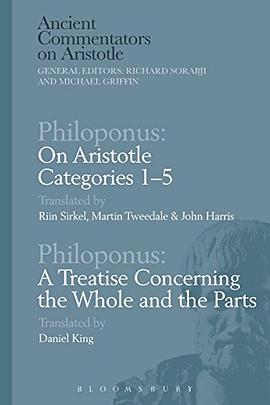
Philoponus' On Aristotle Categories 1-5 discusses the nature of universals, preserving the views of Philoponus' teacher Ammonius, as well as presenting a Neoplatonist interpretation of Aristotle's Categories. Philoponus treats universals as concepts in the human mind produced by abstracting a form or nature from the material individual in which it has its being. The work is important for its own philosophical discussion and for the insight it sheds on its sources. For considerable portions, On Aristotle Categories 1-5 resembles the wording of an earlier commentary which declares itself to be an anonymous record taken from the seminars of Ammonius. Unlike much of Philoponus' later writing, this commentary does not disagree with either Aristotle or Ammonius, and suggests the possibility that Philoponus either had access to this earlier record or wrote it himself. This edition explores these questions of provenance, alongside the context, meaning and implications of Philoponus' work. The English translation is accompanied by an introduction, comprehensive commentary notes, bibliography, glossary of translated terms and a subject index. The latest volume in the Ancient Commentators on Aristotle series, the edition makes this philosophical work accessible to a modern readership. Philoponus was a Christian writing in Greek in 6th century CE Alexandria, where some students of philosophy were bilingual in Syriac as well as Greek. In this Greek treatise translated from the surviving Syriac version, Philoponus discusses the logic of parts and wholes, and he illustrates the spread of the pagan and Christian philosophy of 6th century CE Greeks to other cultures, in this case to Syria. Philoponus, an expert on Aristotle's philosophy, had turned to theology and was applying his knowledge of Aristotle to disputes over the human and divine nature of Christ. Were there two natures and were they parts of a whole, as the Emperor Justinian proposed, or was there only one nature, as Philoponus claimed with the rebel minority, both human and divine? If there were two natures, were they parts like the ingredients in a chemical mixture? Philoponus attacks the idea. Such ingredients are not parts, because they each inter-penetrate the whole mixture. Moreover, he abandons his ingenious earlier attempts to support Aristotle's view of mixture by identifying ways in which such ingredients might be thought of as potentially preserved in a chemical mixture. Instead, Philoponus says that the ingredients are destroyed, unlike the human and divine in Christ. This English translation of Philoponus' treatise is the latest volume in the Ancient Commentators on Aristotle series and makes this philosophical work accessible to a modern readership. The translation in each volume is accompanied by an introduction, comprehensive commentary notes, bibliography, glossary of translated terms and a subject index.
作者简介
John Philoponus (/fᵻˈlɒpənəs/; Ἰωάννης ὁ Φιλόπονος; c. 490 – c. 570), also known as John the Grammarian or John of Alexandria, was an Alexandrian philologist, Aristotelian commentator and Christian theologian, author of a considerable number of philosophical treatises and theological works.
A rigorous, sometimes polemical writer and an original thinker who was controversial in his own time, John Philoponus broke from the Aristotelian–Neoplatonic tradition, questioning methodology and eventually leading to empiricism in the natural sciences. He was one of the first to propose a "theory of impetus" reminiscent of the modern concept of inertia over Aristotelian dynamics.
Later in life Philoponus turned to Christian apologetics, arguing against the eternity of the world, a theory which formed the basis of pagan attack of the Christian doctrine of Creation. He also wrote on Christology, and was posthumously condemned as a heretic by the Imperial Church in 680–81 because of what was perceived of as a tritheistic interpretation of the Trinity.
His by-name ὁ Φιλόπονος translates as "lover of toil", i.e. "diligent", in reference to a Monophysite sect in Alexandria, the philoponoi who were active in debating pagan (i.e. Neoplatonic) philosophers.
His posthumous condemnation limited the spread of his writing, but copies of his work did circulate in Greek or Latin versions in medieval Europe, influencing Bonaventure and Buridan. His work was also received in Arabic scholarly tradition, where he is known as Yaḥyā al-Naḥwī (i.e. "John the Grammarian"). His critique of Aristotle in the Physics commentary was a major influence on Giovanni Pico della Mirandola and Galileo Galilei, who cited Philoponus substantially in his works.
目录信息
读后感
评分
评分
评分
评分
用户评价
《Philoponus》这本书,它给我带来的,是一种前所未有的思想的碰撞。作者在某些章节提出的观点,极具颠覆性,它挑战了我固有的认知,让我开始重新审视那些我习以为常的观念。这种挑战,并非是恶意攻击,而是一种建设性的批判。 我特别喜欢作者在解释某些科学理论时的清晰度和条理性。他能够用非常简洁明了的语言,将复杂的科学原理呈现在读者面前。这种将科学与人文融会贯通的能力,让我由衷地感到敬佩。
评分我得说,《Philoponus》这本书,它真的重新定义了我对“深度阅读”的理解。它不是那种可以让你轻松消遣的书籍,也不是一本可以让你在短时间内速成的指南。相反,它要求你付出专注,需要你投入时间和精力去品味。我发现自己经常会在阅读过程中,时不时地合上书本,让那些信息在脑海中沉淀片刻,然后再继续。 作者在构建论证时的逻辑严密性,是我从未在其他书籍中见过的。每一个观点,都经过了精心的铺垫和严谨的论证,让人无法轻易反驳。而且,作者在语言运用上的克制和精准,也让我受益匪浅。他用最少的词语,表达最丰富的意思,让每一句话都充满了力量。
评分不得不承认,《Philoponus》这本书,它对我的思维方式产生了相当大的影响。在阅读它之前,我可能更倾向于接受现成的答案,而在这本书的引导下,我开始学会了如何去探寻问题背后的根源,如何去构建自己的逻辑体系。作者的叙事风格非常沉稳,不急不躁,一步一步地引领着读者深入到思想的核心。 书中对某些理论的构建和发展过程的描述,更是让我看到了知识是如何一步步积累和完善的。这是一种非常宝贵的学习过程,它让我明白,每一个伟大的思想,都不是凭空产生的,而是经历了漫长的探索和不断的修正。
评分《Philoponus》这本书,对我来说,更像是一次智力上的远足。它带我走过了那些我从未涉足的思想领域,让我见识了那些我从未想象过的观点。作者的视角非常独特,他能够跳出固有的思维模式,从一个全新的角度来审视问题。这种跨领域的连接能力,让我惊叹不已。 我特别喜欢书中关于某些历史事件的解读。作者并没有简单地陈述事实,而是深入分析了事件背后的驱动因素和长远影响。这种深度的挖掘,让我对历史有了更深刻的认识,也让我开始反思自己对许多事情的看法。
评分坦白说,《Philoponus》这本书,它的阅读过程,更像是一场循序渐进的心灵探索。作者并没有试图一蹴而就地灌输思想,而是通过层层递进的论述,慢慢地引导读者进入到他所构建的知识体系之中。我喜欢作者那种不动声色的叙事风格,它有一种强大的吸引力,让人不由自主地跟随他的思想前进。 书中对于某些文化现象的解读,也让我受益匪浅。作者能够敏锐地捕捉到时代变迁中的细微之处,并从中提炼出具有普遍意义的社会规律。这种对文化的高度敏感性,让这本书充满了时代感。
评分《Philoponus》这本书,它所带来的震撼,更多的是一种潜移默化的影响。它不像某些作品那样,用华丽的辞藻或激昂的情绪来抓住你的眼球,而是以一种沉静而坚定的力量,慢慢渗透到你的认知深处。读这本书的过程,更像是在进行一次漫长的对话,与作者,也与自己。我喜欢作者那种不动声色的洞察力,能够在看似平常的现象中挖掘出不寻常的意义,并在字里行间流露出对人类智慧的敬畏。 书中对于某些观念的批判性分析,尤其让我印象深刻。作者并没有全盘接受现有的理论,而是以一种审慎的态度,对其进行细致的解剖和质疑。这种批判精神,不仅仅是对知识的尊重,更是对真理的不懈追求。我在这本书中获得的,不仅仅是知识的积累,更是一种思考方式的启迪,一种面对问题时敢于质疑、勇于探索的精神。
评分这本《Philoponus》的阅读体验,就像是踏入了一片未经开垦的知识森林,每一步都充满了惊喜与挑战。刚翻开书页,就被其宏大的叙事框架和深邃的思想所吸引。作者在开篇就为我们勾勒了一个广阔的智识图景,将历史、哲学、科学等不同领域的脉络巧妙地编织在一起,形成了一幅波澜壮阔的画卷。我尤其欣赏作者在梳理复杂概念时的清晰度,尽管书中涉及的理论可能晦涩难懂,但通过层层递进的解释和恰到好处的比喻,我能感受到作者试图将最前沿的思考以最易于理解的方式呈现给读者。 书中对某些哲学流派的探讨,更是让我醍醐灌顶。作者并没有停留在简单的介绍层面,而是深入挖掘了这些流派的核心思想,并将其置于更广阔的历史和文化背景下进行审视。我发现自己常常会在某个段落停下来,反复咀嚼作者的论述,试图消化其中蕴含的深意。这种沉浸式的阅读体验,让我仿佛与作者一同在思想的海洋中遨游,时而激起思维的浪花,时而又陷入沉思的漩涡。
评分读完《Philoponus》,我感觉自己像是经历了一场精神上的洗礼。这本书的深度和广度,都远远超出了我的预期。作者在某些章节的论述,简直可以用“精妙绝伦”来形容,他能够将看似无关的概念联系起来,并从中提炼出具有普遍意义的规律。 我对作者在分析某些历史人物的动机时所展现出的深刻洞察力,更是佩服得五体投地。他能够透过表象,看到人性的复杂和多面性。这种对人性的深刻理解,让这本书不仅仅是一本知识性的读物,更是一本关于人生的启示录。
评分《Philoponus》这本书,它就像一位睿智的长者,用平和而深刻的语言,向我讲述着关于世界和人类的奥秘。我喜欢作者在文字中流露出的那种深邃的智慧,它不是那种高高在上的说教,而是像一股暖流,慢慢地滋润着我的心灵。 我尤其欣赏作者在处理复杂问题时的那种细腻和耐心。他不会轻易给出结论,而是引导读者一步步去思考,去发现。这种互动式的阅读体验,让我觉得自己不仅仅是一个被动的接受者,更是一个积极的参与者。
评分《Philoponus》这本书,它就像一个精心打磨的艺术品,每一个字,每一个句,都充满了作者的匠心。我喜欢作者在处理某些微妙的情感和思想时,所展现出的那种细腻和婉约。它不是那种直白的宣泄,而是内敛而深沉的表达。 我特别欣赏作者在构建一些思想实验时的创造力。他能够跳出常规思维的束缚,设计出一些引人入胜的场景,并从中引出深刻的哲学思考。这种思维的灵活性,让这本书充满了活力。
评分 评分 评分 评分 评分相关图书









本站所有内容均为互联网搜索引擎提供的公开搜索信息,本站不存储任何数据与内容,任何内容与数据均与本站无关,如有需要请联系相关搜索引擎包括但不限于百度,google,bing,sogou 等
© 2026 book.quotespace.org All Rights Reserved. 小美书屋 版权所有