
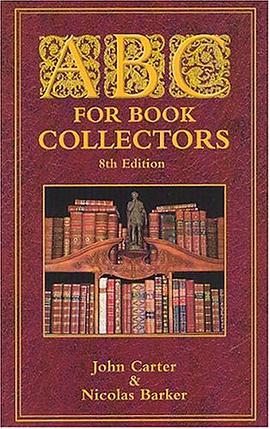

具体描述
Eighth Edition
By John Carter and Nicholas Barker
New Castle, DE: Oak Knoll Press, 2004
232 pages
Paper back: ISBN: 1-58456-112-2 Price: $29.95
There are more changes to the eighth edition of ABC than in all previous editions combined
ABC for Book Collectors is the standard primer and glossary for book collecting in the English-speaking world. It enumerates the terminology used, commonly and uncommonly, among collectors, booksellers, auction houses, librarians, and scholars. It describes the life of the book, from the original holograph manuscript, through galley proofs, to issue as parts in wrappers, until binding and distribution. The history of books and book collecting in the West is indirectly retold in the biographical entries for major printers, binders, collectors, and notable figures such as Roger Payne, Edwards of Halifax, and William Lowndes. ABC also delineates the canon of bibliographical literature, frequently abbreviated or referenced only by surname: ABPC, ISTC, NUC, McKerrow and Gaskell. Reading ABC is a course in Book Collecting 101.
It’s a good read, too, one of the few reference volumes that can be enjoyed cover-to-cover. This is due to Carter’s writing, which Barker has seamlessly expanded. The style is eloquent, precise, and succinct. It’s also very British in its spelling, tone, and humor. Carter and Barker have strong, wry opinions. They don’t hesitate to share them in such entries as issue-mongers (“one of the worst pests of the collecting world”) and the chronological obsession. Of that obsession, and biblio-obsessions in general, they write: “If a slightly acid note is discernible in the comments offered [here]…it must be set down to the conviction that all extremes are a bore.” The reader’s knowledge and amusement is amplified by their generous discussion and good sense. John Carter, who worked for Scribner’s and Sotheby’s, wrote ABC over a half century ago in 1952. Nicolas Barker, former Head of Conservation at the British Library and editor of The Book Collector, assumed stewardship of ABC after Carter’s death in 1975. Barker’s contributions to each new edition have grown, and the eighth edition rightfully gives him full credit as co-author alongside Carter.
If you are a book collector or book lover, and you don’t own this book, buy it. Now. Stop reading, go to your local bookstore, buy this book, and read it. If you have an older copy sitting on your shelf, the rest of this review is intended to help you make the decision to upgrade.
I performed an informal collation of the new eighth edition against the seventh, sixth, and first editions. I was fortunate to find a copy of the first edition in the Boston Public Library’s Rare Book Department. I counted the number of entries in each volume and tracked each entry across editions, noting additions and deletions. Under deadline and unable to find a Hinman collator at my local Best Buy, I didn’t compare each definition in every edition line-by-line, but I discovered there are more changes in this edition of ABC than in all previous editions combined.
The first edition contains 459 entries. The sixth edition, published in 1980, has 519, a net growth of only sixty entries in twenty-eight years. Fewer than a dozen entries were removed (the Ashley Catalogue, mould-made paper, and mint-condition fetishists fell from bibliophilic fashion). Between the sixth edition and the seventh in 1995, only twenty-two new entries were added and a half-dozen removed. Over the course of forty-three years, ABC swelled by a grand total of eighty-two entries.
In stark contrast, the differences between the seventh and eighth editions are enormous: there are 130 new terms. Some of these are cross-references to extant entries, but most are brand new. Several fill in the lacunae in previous editions regarding subject fields like printer jargon (balls, chase, frisket, and quoins) and binding terms (french-sewn, hair-sheep, tacket, and tawing). The canon of reference works and authors is expanded to include Duff, Greg, Heber, and Bowers. Some entries are excavated from others: minuscule warranted distinction from majuscule. A few items that deserved entries in earlier editions finally make it. Dibdin (patron saint of bibliomaniacs) certainly warrants his own description, where in previous editions he was often cited but never explained. His colleagues at the Roxburghe Club also get their own place in the book, where previous editions focused on the Roxburghe Style of bindings. Perhaps there was an assumption that most readers knew who Dibdin and the Roxburghe Club were, and no reference was needed.
One obvious change makes its first appearance in the new ABC: the Internet. Given the impact of online bookstores and resources since the last edition in 1995, it should surprise nobody that the word Internet gets an entry. E-mail addresses now are included in contact information for bibliographic organizations. Even eBay makes an appearance.
Another change underlies many of the revisions to this edition—the evolving community and market of collectors. Barker’s ruminative introduction remembers when the first ABC appeared:
It is strange, now, to look back on those days. Our world was indeed a small one and, it seemed, contracting. There were few antiquarian booksellers, mostly old men. Their memories stretched back to the Depression and beyond, when old books were commoner and so were collectors. They were, they felt, the last generation: the last books would soon be locked up in institutional libraries, and the trade that they knew would soon be wound up.
Of course, as Barker goes on, the community wasn’t “wound up,” but rejuvenated by economic and geographic changes for booksellers and by a new generation of collectors, scholars, and librarians in the 1970s and 1980s. The question now is will a new generation of collectors take their place over the next twenty-five years?
ABC for Book Collectors isn’t a fixed codex of book words. Rather, it cogently reflects and explains the living bibliographical world. Much of the terminology has been around for several centuries, and its fundamentals will remain intact for another generation. Barker laments the dissolution of bookbinding as an industry, but points to the survival of the craft and its jargon among a new generation of book conservators and art binders. Similarly, the world of book collecting, selling, and scholarship is transforming itself to take advantage of new technology and to meet the needs of a new generation. ABC has shown it can keep pace and will be a constant in that world.
资料来自http://www.finebooksmagazine.com/reviews/ABC_for_Book_Collectors-John_Carter_and_Nicholas_Barker
作者简介
目录信息
读后感
评分
评分
评分
评分
用户评价
我最近手头有一本探讨中世纪炼金术与早期化学科学交汇点的研究性书籍,其内容之奇谲,完全超出了我的想象。这本书没有将炼金术简单地归类为迷信,而是非常审慎地梳理了其中蕴含的早期实验方法论和对物质转化的执着追求。作者大量引用了阿拉伯语和拉丁文的手稿片段,解析了那些晦涩的符号和隐喻背后,所隐藏的对元素构成和提纯技术的初步探索。书中对于“贤者之石”的追求如何间接推动了蒸馏、煅烧等基础化学操作的完善,这一论证链条构建得非常扎实且富有启发性。阅读起来,仿佛能闻到实验室里弥漫的硫磺和汞蒸气的味道,感受到那些求索者在漫长黑夜中,对自然奥秘的敬畏与渴望。这本书成功地架起了一座桥梁,连接了神秘学传统与实证科学的萌芽阶段,让读者明白,很多伟大的科学发现,往往是从看似荒诞的想象中诞生的。它不仅普及了知识,更激发了对人类理性探索历程的深深敬意。
评分这本书的封面设计简直是一场视觉的盛宴,那种低饱和度的墨绿色搭配烫金的书名,立刻就将我带入了一种古典而又神秘的氛围之中。我猜想,这本书的内容一定是对那些珍稀古籍和初版印刷品的深度挖掘。光是看着书脊上那种细微的纹理,我就能想象到作者在撰写时,是如何沉浸于那些泛黄的书页和墨迹的芬芳之中。这本书的装帧质量,足以让任何一个对实体书怀有敬畏之心的藏书家为之侧目。我特别期待它能详细剖析不同年代装订工艺的演变,比如十九世纪末期精装本的皮面处理技术,或者早期活字印刷油墨的独特气味是如何随着时间沉淀下来的。如果书中能附带一些高清的、特写镜头下的书页微观结构照片,那就更完美了。总而言之,这本书从触感、视觉乃至嗅觉的想象空间上,都成功地建立了一种仪式感,让人迫不及待地想翻开它,去探索那些深藏于纸张背后的历史秘密和匠人精神。它不仅仅是一本书,更像是一个精心制作的艺术品,散发着时间的重量感和知识的厚度。
评分我的书架上最近增添了一本关于全球贸易路线变迁的经济地理学专著。这本书的宏大视野和对数据的精妙处理给我留下了极其深刻的印象。它没有采用那种枯燥的年份事件罗列,而是通过追踪一粒咖啡豆或一块锡锭的旅程,清晰地勾勒出了跨越数个世纪的全球供应链的脉络。作者对于海权国家兴衰与内陆贸易通道的动态博弈分析得入木三分,尤其对苏伊士运河开通前后,地中海与印度洋贸易格局的颠覆性变化进行了极具洞察力的解读。书中穿插的那些复古的航海图和不同时期的关税壁垒图表,不仅是装饰,更是强有力的论据支撑。阅读过程中,我不断地在思考,我们今天习以为常的“全球化”实际上是多么脆弱而又精密的系统。这本书成功地将复杂的宏观经济学概念,转化成了引人入胜的地理故事,让我清晰地看到了那些看似无关紧要的港口城市,是如何在全球权力结构中扮演了关键角色。读完之后,我对任何国际新闻中的贸易摩擦都多了一层历史和地理的厚度来理解。
评分近期研读了一本关于早期电影剪辑技术发展史的学术读物,其内容之详尽,几乎让人感觉置身于那个闪烁着碳弧灯火光的无声电影片场。这本书的叙事角度非常独特,它聚焦于那些被历史略过的幕后工作者——剪辑师。作者通过对葛里菲斯时代以及苏联蒙太奇学派关键片段的逐帧分析,生动地展现了“匹配剪辑”和“跳接”这些技巧是如何从单纯的技术手段,演变为一种强有力的叙事工具和情感催化剂的。书中对于不同剪辑模式下,观众生理反应和心理预期的对比实验描述,严谨得如同心理学论文。我特别喜欢其中对于爱森斯坦“辩证蒙太奇”的解析,作者没有回避其复杂性,而是用清晰的图示和案例,将原本晦涩的理论变得通俗易懂。这本书不仅是对电影史的贡献,更是一本关于节奏、时空重构和非线性叙事哲学的教科书。它彻底改变了我观看电影时那种被动接受的状态,让我开始主动去“阅读”画面之间的留白和连接。
评分我最近翻阅了一本关于艺术史的著作,它专注于探讨文艺复兴时期佛罗伦萨画派的色彩哲学。这本书的叙事逻辑极其严谨,作者仿佛是一位经验丰富的策展人,引导读者穿梭于美第奇家族的图书馆和秘密画室之间。其中关于“群青”这种颜料的获取难度和它在宗教画中象征意义的论述,简直是令人拍案叫绝。作者并没有停留在简单的历史事件梳理上,而是深入到了艺术家的日常困境和他们对完美光影的不懈追求。比如,书中详细描述了提香晚期作品中,光线是如何被用来分割情感层次的,那种处理手法细腻到令人窒息。阅读这本书的过程,就像是上了一堂高阶的美学大师课,每一个章节都提供了一个全新的视角去解构我们习以为常的视觉经验。我尤其欣赏它在引用原始文献时的那种谦逊和审慎,没有武断的结论,只有基于扎实考据的推测和论证。对于任何想提升自己鉴赏能力,而非仅仅停留在“好看”这个层面的读者来说,这本书绝对是不可多得的宝藏,它真正教会了我如何“看懂”艺术。
评分Reading for Descriptive Bibliography. 很有用的工具书,排版到位,标注很有特色。Rare books真的没有听上去这么酷,我可以接受一遍遍翻书数数校对的枯燥,但是无力面对这么多似是而非的术语、动辄完全看不懂的拉丁语希腊语希伯来语、经常连字母都分辨不清,读了这么多年的书在这门课上依然像个文盲。
评分Reading for Descriptive Bibliography. 很有用的工具书,排版到位,标注很有特色。Rare books真的没有听上去这么酷,我可以接受一遍遍翻书数数校对的枯燥,但是无力面对这么多似是而非的术语、动辄完全看不懂的拉丁语希腊语希伯来语、经常连字母都分辨不清,读了这么多年的书在这门课上依然像个文盲。
评分Reading for Descriptive Bibliography. 很有用的工具书,排版到位,标注很有特色。Rare books真的没有听上去这么酷,我可以接受一遍遍翻书数数校对的枯燥,但是无力面对这么多似是而非的术语、动辄完全看不懂的拉丁语希腊语希伯来语、经常连字母都分辨不清,读了这么多年的书在这门课上依然像个文盲。
评分Reading for Descriptive Bibliography. 很有用的工具书,排版到位,标注很有特色。Rare books真的没有听上去这么酷,我可以接受一遍遍翻书数数校对的枯燥,但是无力面对这么多似是而非的术语、动辄完全看不懂的拉丁语希腊语希伯来语、经常连字母都分辨不清,读了这么多年的书在这门课上依然像个文盲。
评分Reading for Descriptive Bibliography. 很有用的工具书,排版到位,标注很有特色。Rare books真的没有听上去这么酷,我可以接受一遍遍翻书数数校对的枯燥,但是无力面对这么多似是而非的术语、动辄完全看不懂的拉丁语希腊语希伯来语、经常连字母都分辨不清,读了这么多年的书在这门课上依然像个文盲。
相关图书












本站所有内容均为互联网搜索引擎提供的公开搜索信息,本站不存储任何数据与内容,任何内容与数据均与本站无关,如有需要请联系相关搜索引擎包括但不限于百度,google,bing,sogou 等
© 2026 book.quotespace.org All Rights Reserved. 小美书屋 版权所有