

具体描述
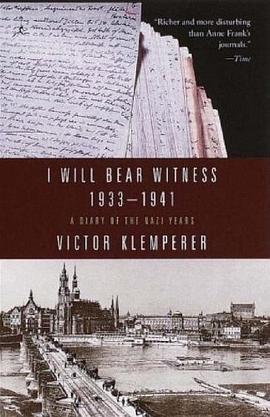
The publication of Victor Klemperer's secret diaries brings to light one of the most extraordinary documents of the Nazi period. "In its cool, lucid style and power of observation," said The New York Times, "it is the best written, most evocative, most observant record of daily life in the Third Reich." I Will Bear Witness is a work of literature as well as a revelation of the day-by-day horror of the Nazi years.
A Dresden Jew, a veteran of World War I, a man of letters and historian of great sophistication, Klemperer recognized the danger of Hitler as early as 1933. His diaries, written in secrecy, provide a vivid account of everyday life in Hitler's Germany.
What makes this book so remarkable, aside from its literary distinction, is Klemperer's preoccupation with the thoughts and actions of ordinary Germans: Berger the greengrocer, who was given Klemperer's house ("anti-Hitlerist, but of course pleased at the good exchange"), the fishmonger, the baker, the much-visited dentist. All offer their thoughts and theories on the progress of the war: Will England hold out? Who listens to Goebbels? How much longer will it last?
This symphony of voices is ordered by the brilliant, grumbling Klemperer, struggling to complete his work on eighteenth-century France while documenting the ever- tightening Nazi grip. He loses first his professorship and then his car, his phone, his house, even his typewriter, and is forced to move into a Jews' House (the last step before the camps), put his cat to death (Jews may not own pets), and suffer countless other indignities.
Despite the danger his diaries would pose if discovered, Klemperer sees it as his duty to record events. "I continue to write," he notes in 1941 after a terrifying run-in with the police. "This is my heroics. I want to bear witness, precise witness, until the very end." When a neighbor remarks that, in his isolation, Klemperer will not be able to cover the main events of the war, he writes: "It's not the big things that are important, but the everyday life of tyranny, which may be forgotten. A thousand mosquito bites are worse than a blow on the head. I observe, I note, the mosquito bites."
This book covers the years from 1933 to 1941. Volume Two, from 1941 to 1945, will be published in 1999.
作者简介
Victor Klemperer (9 October 1881 – 11 February 1960) worked as a commercial apprentice, a journalist and eventually a Professor of Literature, specialising in the French Enlightenment at the Technische Universität Dresden. His diaries detailing his life under successive German states—the German Empire, the Weimar Republic, Nazi Germany and the German Democratic Republic—were published in 1995. His recollections on the Third Reich have since become standard sources; extensively quoted by Saul Friedlander, Michael Burleigh and Richard J. Evans.
目录信息
读后感
评分
评分
评分
评分
用户评价
这本书的叙事手法简直是教科书级别的,作者以一种近乎冷峻的笔触,勾勒出了那个特定历史时期下普通民众的生存图景。我尤其被其中对细节的捕捉能力所震撼,那种对日常琐事的细腻描摹,让人仿佛身临其境,呼吸着那个年代特有的空气。它不是那种高屋建瓴的宏大叙事,而是将视角聚焦于那些微小的、容易被历史洪流冲刷掉的个体命运。在阅读的过程中,我常常会停下来,反复咀嚼某个句子,思考作者是如何能在如此沉重的主题下,依然保持着如此克制而精准的语言张力。那种由内而外散发出的真实感,比任何夸张的渲染都要来得有力。它更像是一部用生命书写的时间胶囊,忠实地记录了那些沉默者的声音,让人在合上书本之后,依然能感受到一种强烈的历史回响。作者的叙事节奏把握得极好,时而缓慢沉郁,如同凝固的琥珀,时而又在不经意间爆发出令人心悸的张力,精准地击中了人性中最脆弱也最坚韧的部分。
评分阅读体验上,这本书给我带来了一种极其私密且深刻的共鸣感。它没有用华丽的辞藻去粉饰太平,而是用一种近乎自白的方式,将人性的复杂性毫无保留地摊开在你面前。我发现自己不自觉地被卷入到那些角色纠结的内心挣扎之中,他们的每一个决定,无论对错,都带着那个时代烙印的无奈与挣扎。这不仅仅是阅读一个故事,更像是一场与历史的深度对话。我欣赏作者在处理道德模糊地带时的那种勇气和坦诚,没有简单地进行黑白二元对立的划分,而是展现了在极端环境下,人性光辉与阴影并存的真实状态。每一次翻页,都像是在揭开一层又一层的迷雾,让你不得不审视自己面对困境时的选择。那种沉甸甸的阅读重量感,是很多轻松读物无法比拟的,它要求读者投入心神,细细品味那些潜藏在字里行间的重量。
评分从文学性的角度来看,这本书的语言运用达到了极高的水准,它拥有古典文学的韵味,却又饱含现代的冷静和洞察。作者对于词汇的选择极为精准,没有一个多余的字,却能用最朴素的表达,勾勒出最复杂的内心活动。我特别喜欢那种不动声色的力量,它不像某些作品那样试图用激昂的言辞去说教,而是通过意象的反复出现和语气的微妙变化,让情感自然地渗透出来。这种克制的书写,反而使得情感的爆发点更具穿透力,它要求读者自己去填补那些未言明的空白,从而实现了作者与读者之间深层次的共同创造。这本书更像是经过千锤百炼的玉石,表面温润,内里却有着极其坚硬的骨架,是值得反复品味和研究的文本。
评分这本书的结构设计非常巧妙,它并非遵循传统的小说线性叙事,而是更倾向于一种片段式的、日记体的拼贴艺术。这种结构上的创新,反而极大地增强了历史的碎片感和真实感。你仿佛是在整理一份被时间尘封已久的手稿,每一个片段都带着各自独立的情感温度,但当它们被放在一起时,一股强大的、不可抗拒的整体力量便油然而生。作者对时间跨度的驾驭非常高明,时而聚焦于某个瞬间的漫长煎熬,时而又快速地跳跃,暗示着岁月的无情流逝。这种跳跃并非是突兀的,而是通过一些反复出现的意象和主题,将分散的叙事线索巧妙地串联起来,形成一种螺旋上升的张力。这种阅读体验是对传统故事结构的一种挑战,但最终证明,它更贴合记录真实历史的本质需求。
评分我必须称赞作者在氛围营造上的功力,那种弥漫全书的宿命感和压抑感,让人喘不过气来,却又难以自拔。通篇的基调是低沉的,但这种低沉并非是消极的,反而激发了一种深层次的反思。作者没有刻意去渲染悲惨,而是通过环境的描绘和人物的微表情,构建了一个令人信服的、充满张力的世界观。特别是对特定场景的描绘,比如那些光线昏暗的室内,或是漫长而寂静的等待,都处理得极其到位,仿佛能闻到那股陈旧的气味。这种沉浸式的体验,需要读者有足够的耐心去适应和接纳,但一旦你适应了这种节奏,你会发现,那种由内而外散发出的历史厚重感,是任何快节奏作品都无法给予的深度慰藉。它让人思考,在历史的巨轮面前,个体所能坚守的“人性”的边界究竟在哪里。
评分这种书存在是有意义的,但也只停留在有历史意义上,杂七杂八的琐碎生活让人提不起兴趣来。
评分怎么说呢,尽管时世艰难确实不假,Klemperer你自己心里也总得有点数吧?钱都快用光了,还在那里各种给自己建房子,难道不算是自找的穷途末路?
评分怎么说呢,尽管时世艰难确实不假,Klemperer你自己心里也总得有点数吧?钱都快用光了,还在那里各种给自己建房子,难道不算是自找的穷途末路?
评分这种书存在是有意义的,但也只停留在有历史意义上,杂七杂八的琐碎生活让人提不起兴趣来。
评分怎么说呢,尽管时世艰难确实不假,Klemperer你自己心里也总得有点数吧?钱都快用光了,还在那里各种给自己建房子,难道不算是自找的穷途末路?
相关图书














本站所有内容均为互联网搜索引擎提供的公开搜索信息,本站不存储任何数据与内容,任何内容与数据均与本站无关,如有需要请联系相关搜索引擎包括但不限于百度,google,bing,sogou 等
© 2026 book.quotespace.org All Rights Reserved. 小美书屋 版权所有