具体描述
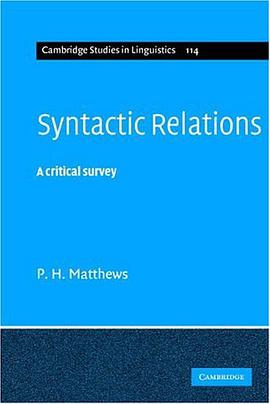
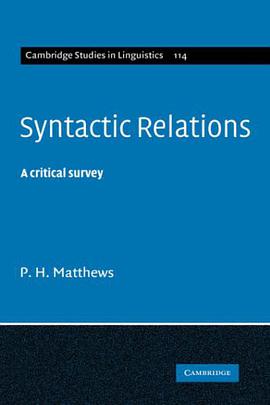
Accounts of syntax are usually based on two assumptions: firstly, that a sentence comprises a hierarchy of phrases, forming a 'tree' structure; and secondly, that phrases have 'heads', on which subordinate units depend. These fundamental assumptions are questioned in this critical survey, which argues that neither concept is important as is claimed, and that syntactic relations are in fact far more varied. Drawing on data from English as well as other major European languages, it summarizes earlier accounts of syntactic structure and looks at the different ways in which specific constructions have been described - the subject of much disagreement between linguists. It explores the problems faced by particular analyses, and raises the question of whether syntax should be made simpler than it is. Suitable for non-specialists and complete with a clear and useful glossary, Syntactic Relations will become an essential and thought-provoking read for students and researchers in linguistic theory.
Syntactic Relations: Unveiling the Architecture of Meaning In the intricate tapestry of language, meaning is not woven from isolated words alone, but from the precise and deliberate arrangement of those words into coherent structures. This fundamental principle lies at the heart of Syntactic Relations, a comprehensive exploration that delves into the very scaffolding of human communication. Far from a dry recitation of grammatical rules, this work offers a vibrant and insightful journey into how words connect, influence, and ultimately create meaning within sentences. Syntactic Relations navigates the complex landscape of how words enter into specific relationships with one another. It investigates the underlying principles that govern these connections, revealing the hidden architecture that makes our sentences not just a jumble of sounds, but meaningful expressions of thought and intent. The book systematically unpacks the various types of syntactic relationships, providing clear definitions, illustrative examples, and in-depth analyses. At its core, the book addresses the fundamental question: how do we understand the grammatical role each word plays in a sentence? It moves beyond simple subject-verb-object distinctions to explore the nuanced interplay between words. We learn how a noun can be modified by an adjective, how a verb can be governed by an adverb, and how clauses can be linked together to form complex thoughts. The exploration encompasses concepts such as dependency relationships, where one word’s presence and form dictate the requirements of another, and constituency, the idea that words group together into larger meaningful units. Readers will discover how these relationships are not arbitrary but are governed by principles that are both universal to human language and subject to variation across different languages. Syntactic Relations meticulously examines these variations, offering comparative insights into how different linguistic traditions structure meaning. Whether it’s the rigid word order of some languages or the flexible case marking of others, the book illuminates the diverse strategies languages employ to encode syntactic connections. The book also tackles the crucial role of syntax in conveying semantic information. It demonstrates how the arrangement of words directly impacts the interpretation of a sentence, highlighting cases where slight changes in syntactic structure can lead to dramatically different meanings. The subtle nuances of grammatical voice, the impact of negation placement, and the construction of embedded clauses are all explored to showcase the power of syntactic relations in shaping our understanding of the world. Syntactic Relations doesn't shy away from the theoretical underpinnings of syntax. It engages with various theoretical frameworks that have attempted to model and explain these relationships, offering a balanced perspective on different approaches. From generative grammar to functionalist perspectives, the book provides a critical overview of the major schools of thought, allowing readers to appreciate the ongoing intellectual effort to unravel the mysteries of sentence structure. This theoretical engagement is not an academic exercise in isolation; rather, it is directly tied to understanding how these theories help us account for the observed patterns in natural language. Furthermore, the book emphasizes the practical implications of understanding syntactic relations. For linguists, it provides a foundational understanding essential for analyzing language structure, describing grammatical phenomena, and developing computational models of language. For language learners and educators, it offers a deeper insight into the mechanics of grammar, aiding in the acquisition and teaching of new languages. The book’s clear explanations and abundant examples make complex syntactic concepts accessible to a broad audience, including those embarking on their journey into linguistic study. Syntactic Relations is also a valuable resource for anyone interested in the cognitive aspects of language. It touches upon how the human brain processes syntactic information, exploring the mental operations involved in constructing and comprehending sentences. This interdisciplinary approach bridges the gap between linguistic theory and cognitive science, offering a more holistic view of language as a fundamental human capacity. The book’s commitment to clarity and depth is evident in its structure. Each chapter builds upon the previous ones, creating a logical progression of ideas. The authors employ a wealth of real-world examples from a diverse range of languages, ensuring that the concepts presented are grounded in empirical observation. The careful organization and pedagogical approach make Syntactic Relations an indispensable guide for anyone seeking a profound understanding of how language constructs meaning. In essence, Syntactic Relations is more than just a grammar book; it is an invitation to appreciate the elegant complexity of language. It reveals the invisible threads that bind words together, creating the intricate and meaningful structures we use to express our thoughts, share our experiences, and connect with one another. This work stands as a testament to the enduring fascination with the architecture of meaning, offering a comprehensive and engaging exploration that will deepen your appreciation for the power and beauty of language.