

具体描述
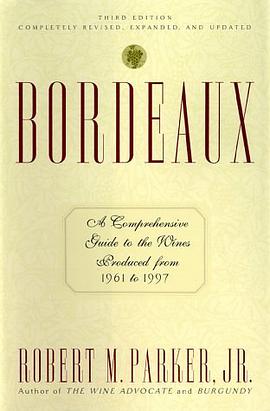
When Robert M. Parker, Jr.'s Bordeaux was first published in 1985, it was greeted with tremendous enthusiasm by such legendary authorities as Hugh Johnson and Michael Broadbent. Time, Newsweek, Business Week, Esquire, and People magazines soon joined in the praise, and the book became a huge commercial and critical success. In England, it won the prestigious Glenfiddich award.
Since that time, Parker has published eight other books for wine lovers, many of which have received critical awards -- Burgundy, The Wines of the Rhône Valley and Provence, four editions of the Wine Buyer's Guide, The Wines of the Rhône Valley, and an updated edition of Bordeaux in 1991 -- as well as his highly respected newsletter, The Wine Advocate, and bi-monthly columns in Food & Wine magazine. With each book, his audience has expanded to the point where not only American wine consumers but also those in France, England, Japan, Sweden, and Germany have quickly learned to trust his palate. In 1995, Parker became the first American in the wine field to receive La Croix du Chevalier de l'Ordre Nationale du Mérite (The Cross of the Knight of the National Order of Merit), one of France's two highest honors, conferred on him directly by President François Mitterrand. In 1998, he won the James Beard Award for Outstanding Wine and Spirits Professional. Clearly, it can be said that Robert Parker is America's foremost wine professional.
With this third edition of the classic that launched him, Parker strives to maintain his unprecedented independence, objectivity, clarity, and enthusiasm in reporting on the vintages of Bordeaux and provides the prodigious comprehensiveness for which he is known. Not only has he added tastings for the vintages in the intervening years between this and the last edition but he has also retasted and reevaluated many earlier vintages. His accessible and direct style welcomes both the seasoned wine collector and the eager beginner to the pleasures of fine wine and France's most illustrious châteaux.
Organized by appellation, Bordeaux moves alphabetically from one producer to the next, providing essential information and an overview of the property and its owners, listing each vintage, and including numerical ratings and detailed tasting notes of most of that chateau's wines for the past thirty-seven years. At the end of each tasting note, Parker estimates the "anticipated maturity" -- the range of time when the wine should peak in flavor and balance -- and each entry concludes with a summary of the chateau's older vintages. Throughout these extensive commentaries and tasting notes, there is never a doubt that this is the most complete consumer's guide to the wines of Bordeaux ever written.
Who is making Bordeaux's best and worst wines? What has a specific château's track record been over the last thirty or forty years? What châteaux are overrated and overpriced? Which are underrated or underpriced? Always with an eye toward the consumer, Parker distinguishes true value from perceived value.
While the bulk of the book is given over to these ratings, the opening and closing chapters of the book provide readers with a true sense of the changes in the region and its vintages. Such critical issues as: Who most influences winemaking styles?, What role does technology play in modern wine production?, and What impact do second labels have on the quality of the first? are tackled here. Parker also lovingly describes the growing conditions in the region year by year, spending considerable time discussing the 1995 vintage, which he terms "the most consistently top-notch vintage since 1990." In addition to this, Parker reassesses the Bordeaux Classifications, the effects of the soil on the grapes, and the different winemaking processes. He then rounds out this incredible volume with a User's Guide to Bordeaux Wines, practical travel and dining information for wine-touring trips, a complete glossary of terminology, and a quick reference index of the entire book.
As the first book to discuss the 1995, 1996, and 1997 vintages in detail -- vintages that are being hailed as the Best of the Century -- the third edition of Bordeaux is the best tool to use in making both purchasing and consuming decisions. From the wine writer The Sunday Times (London) calls "the world's most experienced and trustworthy palate," Bordeaux provides all the information today's consumer needs in order to select the perfect bottle.
作者简介
目录信息
读后感
评分
评分
评分
评分
用户评价
这本书最让我赞叹的一点是其结构上的创新和大胆。它采用了非线性的叙事方式,时间轴被打散重组,信息一点点地、如同碎片般地呈现给读者。起初,这确实需要读者付出额外的注意力来拼凑整个故事的脉络,但这正是它令人上瘾的地方。每一次成功地将一个看似不相干的场景或对话与主线联系起来时,都会带来一种巨大的成就感,就像解开了一个极其复杂的谜题。这种叙事手法,完美地模拟了人类记忆和创伤重构的过程——记忆往往不是线性的,而是跳跃的、充满盲点的。作者没有把所有答案直接递给你,而是让你亲手去挖掘真相。而且,这种结构也极大地增强了悬念和张力,因为你知道的越多,反而越感到不安,因为你开始意识到事情的真相远比你想象的要黑暗和宏大。这种对传统阅读习惯的颠覆,让这本书在同类作品中显得如此与众不同,它挑战了读者的耐心,但最终给予的奖励是无与伦比的叙事体验。
评分我得说,这本书在人物塑造上的成就,是近年来我所见过的最令人印象深刻的。它完全摒弃了“完美英雄”和“绝对恶棍”的刻板印象。书里的每个人物,无论地位高低,都带着他们各自的缺陷、偏见和不为人知的脆弱。最让我感到震撼的是,作者似乎非常擅长于挖掘那些“次要角色”的内在深度,他们并非推动主线的工具人,而是有血有肉、有着自己完整人生轨迹的个体。我甚至开始思考,如果故事是围绕着那个看似不起眼的配角展开,剧情又会是怎样一番光景?这种对“人”的细致入微的观察和描摹,展现了作者对人性的深刻洞察力。这种深度,使得情感的冲突爆发时,更具撕裂感和真实性,因为你很难真正去憎恨任何一个角色,你只能理解他们的选择,哪怕那些选择是错误的、悲剧性的。阅读过程中,我多次因为某个角色做出的艰难抉择而感到心绞,那不是因为我不同意他的决定,而是因为我太理解他背负的重担了。
评分这本书的语言风格简直是为我量身定制的,那种带着淡淡忧郁和古典韵味的文字,读起来就像是品尝一杯陈年的、带有复杂果香的红酒,需要慢慢地、细心地去感受。作者的遣词造句充满了音乐感,有些长句的结构之精妙,读起来简直像在听一首完美的交响乐,每一个词语都恰到好处地占据了它应该有的位置,多一分则冗余,少一分则空洞。我尤其喜欢作者对环境描写的笔触,即便是描写最寻常的街景,也总能捕捉到那种独特的、能引发共鸣的情绪氛围。比如描绘一座古老城市的清晨,那种湿漉漉的、带着青苔气息的寂静,通过作者的文字,我几乎能闻到那种味道,感受到皮肤上的微凉。这种强烈的感官代入感,是区分普通作品和平庸之作的关键。我发现自己时不时地会回溯到前几页,不是为了查找情节,而是单纯地想再沉浸于那种优美的文字氛围中。对于热爱文学性写作的读者来说,这本书的书页本身就是一件艺术品。
评分天哪,我最近沉迷的这本小说,简直是文字的盛宴,阅读体验如同置身于一个精心雕琢的奇幻世界。作者对细节的把控达到了令人发指的地步,无论是宏大的场景描绘,还是人物内心细微的情绪波动,都被刻画得入木三分。我必须承认,一开始我还有些担心故事情节会过于庞杂,毕竟故事线索众多,人物关系错综复杂,但随着阅读的深入,所有的线索都巧妙地交织在一起,没有一丝拖沓或多余。特别是关于主角的成长历程,那种挣扎、迷茫到最终坚定的转变,真实得让人心疼,仿佛我就是那个陪伴他走过漫长岁月的见证者。书中的哲学思考也相当深刻,它不仅仅是一个冒险故事,更是一次对人性、命运和自由意志的探讨。我常常读到某个段落,会情不自禁地停下来,望着窗外发呆好久,消化那些沉甸甸的思考。这本书的叙事节奏掌控得极佳,高潮迭起,低谷处又充满诗意,让人欲罢不能,常常一翻开就忘了时间的存在。那种沉浸感,不是随便一部作品能够给予的,它需要作者极高的文学修养和对叙事艺术的精湛掌控。
评分读完这本书,我感觉自己像是经历了一场酣畅淋漓的智力角逐,每一个转折都出乎意料,却又在回味时觉得“原来如此”。这本书的魅力就在于它的“反套路”,它没有遵循传统叙事中那种清晰的二元对立结构,善恶的界限模糊不清,每个人物都有其复杂且难以简单定义的动机。我特别欣赏作者在构建世界观时所展现出的那种严谨性,那些虚构的文化、历史背景,甚至连那些独特的术语和仪式,都拥有自洽的逻辑体系,仿佛它们真的存在于另一个维度。每一次阅读,都能发现新的伏笔或者先前被忽略的线索,这简直是为深度解读爱好者量身定做的一份大礼。我甚至在网上找了些书友的讨论区,大家对某个关键情节的解读五花八门,这本身就证明了文本的丰富性和开放性。相较于那些情节直白的快餐读物,这本书要求读者拿出耐心和思考力,但付出的回报是巨大的——你会收获一个真正属于你自己的、独一无二的阅读体验。说实话,能写出这样一部作品的作者,其头脑的复杂程度,恐怕不亚于他笔下的任何一个角色。
评分 评分 评分 评分 评分相关图书










本站所有内容均为互联网搜索引擎提供的公开搜索信息,本站不存储任何数据与内容,任何内容与数据均与本站无关,如有需要请联系相关搜索引擎包括但不限于百度,google,bing,sogou 等
© 2026 book.quotespace.org All Rights Reserved. 小美书屋 版权所有