
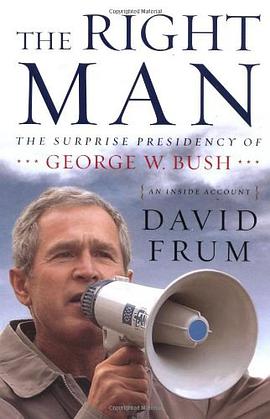

具体描述
在线阅读本书
Publisher Comments :
The Right Man is the first inside account of a historic year in the Bush White House, by the presidential speechwriter credited with the phrase axis of evil. David Frum helped make international headlines when President George W. Bush’s 2002 State of the Union address linked international terrorists to Iran, Iraq, and North Korea. But that was only one moment during a crucial time in American history, when a president, an administration, and a country were transformed.
Frum worked with President Bush in the Oval Office, traveled with him aboard Air Force One, and studied him closely at meetings and events. He describes how Bush thinks—what this conservative president believes about religion, race, the environment, Jews, Muslims, and America’s future. Frum takes us behind the scenes of one of the most secretive administrations in recent history, with revealing portraits of Karl Rove, Karen Hughes, Condoleezza Rice, and many others. Most significant, he tells the story of the transformation of George W. Bush: how a president whose administration began in uncertainty became one of the most decisive, successful, and popular leaders of our time.
Before becoming a White House speechwriter, David Frum was a highly regarded author of books and political commentary and an influential voice on the pages of The Wall Street Journal and The Weekly Standard. His commentary has been described by William F. Buckley as “the most refreshing ideological experience in a generation.” Now, in The Right Man, we see Frum as a front-row observer and participant. Not since Peggy Noonan’s account of her time in the Reagan White House has an insider portrayed a sitting president with such precision, verve, honest admiration, and insight.
The Right Man will command international attention for its thoughtful account of George W. Bush in the midst of his greatest challenge. It will be an essential reference for anyone seeking to understand who our president really is and how he is likely to lead us in the future.
Synopsis:
With honest admiration for George W. Bush, the presidential speech writer credited with the phrase "axis of evil" tells the story of a remarkable year in the life of an American president as he witnessed it. In "The Right Man, " Frum becomes a front-row observer of a new president in the midst of his greatest challenge.
Synopsis:
David Frum helped make international headlines when President George W. Bush's 2002 State of the Union address linked international terrorists to Iran, Iraq, and North Korea in an "axis of evil." But that was only one moment during one of the most crucial times in American history, when a president, an administration, and a country were transformed.
David Frum's political commentary has been described by William F. Buckley as "the most refreshing ideological experience in a generation." Now, in The Right Man, Frum becomes a front-row observer and participant. With honest admiration for President Bush, Frum tells the story of a remarkable year in the life of an American president as he witnessed it. Writes Frum: "Bush is no lightweight. He is rather a very unfamiliar sort of heavyweight. But he did not become a heavyweight all at once. The Right Man is the story of how he grew - how his administration followed - and what the consequences of this evolution will be for the future of American politics."
Not since Peggy Noonan's portrait of Ronald Reagan has an insider portrayed a sitting president with such precision and insight. The Right Man will command international attention for its thoughtful portrait of George W. Bush in the midst of his greatest challenge.
From Publishers Weekly
Frum, author of Dead Right and the phrase "axis of evil," looks back on a year as a speechwriter in the Bush White House in this affable and witty but slightly cagey account. Frum recounts the travails of crafting the President's public pronouncements and the ordeal of the terrorist attacks, and draws funny thumbnail sketches of White House personalities like communications director Karen Hughes, who "disliked verbs" because they "conveyed action, not feeling." Mostly, though, he keeps the focus on Bush, vigorously disputing the notion that the President is a dim-witted figurehead for powerful advisors like Dick Cheney and Karl Rove and insisting that Bush is a commanding leader who came into his own after 9/11. But he also describes the president as "ill informed" and "sometimes glib, even dogmatic," with "a poor memory for facts and figures"; his strengths are "tenacity," "courage," a "large and clear" vision and a "Holden Caulfield streak" of sincerity. Frum was not part of the inner circle, so his evidence for Bush's leadership sometimes consists of the bold statements Bush made in speeches that were crafted by others to explain policies hashed out by his subordinates. His sketchy defense of Bush's policy-making is similarly unconvincing; concerns about the energy industry's influence on the plan to drill in Alaska are dismissed as "goofy," and his recap of the Bush tax cut doesn't answer the main criticism that it is skewed toward the rich. Frum is an engaging writer, but this is very much a speechwriter's book-packed with graceful sound bites, but ultimately more spin than substance.
Amazon.com
According to former White House speechwriter David Frum, George W. Bush is "a good man who is not a weak man. He is impatient, quick to anger; sometimes glib, even dogmatic, often uncurious, and as a result ill-informed." All the same--well, look at the book's title. Frum chronicles a tenure spent serving a president whom he comes to admire more after the events of September 11, 2001. It is after working with Bush in times of war that Frum says of Bush "outweighing the faults are his virtues: decency, honesty, rectitude, courage, and tenacity." The Right Man creates an arc in that Frum is originally dubious of Bush's leadership capacity and ends up sold on Bush as commander-in-chief. But in truth, Frum never has far to go. He's impressed with Bush from the start and when war comes, he's more impressed. And while the book is as much about the author as the president, sections, such as an argument with Barbra Streisand and a Washington Post gossip storm may strike the reader as somewhat petty. Fortunately, there are entertaining helpings of candor: the stringent White House dress code, infighting among cabinet members, and unbelievably cool Air Force One trips. Also of particular interest are events surrounding the controversial phrase "axis of evil": Frum helps coin it, his wife boasts of that fact in an e-mail to friends, the e-mail is widely forwarded, and, soon after, Frum resigns. While both he and the White House deny he was fired, Frum is so insistent on the fact that he quit on his own that it really makes you wonder. The Right Man is a multifaceted glimpse at the life of a White House insider and a president in a time of crisis; it should appeal to readers curious to learn about the inner workings of the American presidency.
--John Moe
About Author
David Frum received a simultaneous B.A. and M.A. in history from Yale University in 1982. He was appointed visiting lecturer in history at Yale in 1986; in 1987 he earned a J.D. from Harvard Law School. He is a contributing editor to the National Review and a fellow at the American Enterprise Institute, and he has written regularly for The Wall Street Journal, Forbes, The Weekly Standard, and Canada?s National Post. He is a contributor to National Public Radio?s Morning Edition. From January 2001 to February 2002, he was a special assistant to President Bush for economic speechwriting. He lives in Washington, D.C., with his wife, journalist and novelist Danielle Crittenden Frum, and their three children.
Book Dimension
Height (mm) 235 Width (mm) 178
作者简介
目录信息
读后感
评分
评分
评分
评分
用户评价
这本书给我的感觉是,它不仅讲述了一个故事,更是在探讨一种人生哲学。作者在叙事中融入了许多关于坚持、关于责任、关于理想的深刻思考。这些思考并非生硬的理论说教,而是通过人物的经历和命运,自然地流淌出来,引人深思。我特别喜欢作者对“责任”的理解,它不仅仅是对自己承诺的履行,更是对他人、对社会的一种担当。书中人物在承担责任的过程中,经历了磨难,也获得了成长。他们的选择,影响着自己的命运,也改变着周围的世界。这种对责任的深刻诠释,让我对“正确”有了更深一层的理解——真正的“正确”,往往伴随着沉甸甸的责任。此外,书中对于“理想”的探讨也让我感触颇深。在现实的重压下,如何守护自己的理想,如何在妥协与坚持之间找到平衡,是许多人物面临的困境。作者并没有给出简单的答案,而是通过展现他们的努力和挣扎,鼓励读者去追寻自己的内心所向。
评分这本书的魅力还在于它对于人物内心世界的深度挖掘。作者笔下的人物,绝非扁平的符号,而是拥有丰富的情感和复杂的思想。他们会喜悦,会痛苦,会迷茫,也会坚持。我尤其喜欢作者对人物内心独白的刻画,那些深沉的思考,那些难以启齿的秘密,都被作者以极其细腻的笔触展现出来。这些内心独白,就像是打开了人物心灵的窗户,让我得以窥见他们最真实的一面。在阅读过程中,我常常会为人物的某个选择而感到揪心,为他们的困境而感到担忧,也为他们的成长而感到欣慰。这种强烈的代入感,让我仿佛置身于他们的生活之中,与他们一同经历着人生的起伏。作者并没有试图去评判人物的对错,而是以一种包容和理解的态度,展现了人性的多面性。它让我开始思考,在面对相似的困境时,自己又会做出怎样的选择,又会经历怎样的内心挣扎。
评分我尤其欣赏作者构建的那个庞大而精巧的叙事框架。故事的线索错综复杂,却又井然有序,每一条线都在以自己的节奏向前推进,最终汇聚成一条壮丽的河流。在阅读的过程中,我时常会因为某个情节的巧妙伏笔而惊叹,作者似乎早已预见了我可能产生的疑问,并在后续的章节中一一解答,或者引出更深的悬念,让我欲罢不能。这种层层递进的叙事手法,极大地提升了阅读的沉浸感。书中人物的成长轨迹更是让我印象深刻。他们并非一开始就完美无缺,而是在经历了一系列的磨难、考验和反思后,逐渐蜕变,最终找到了属于自己的“正确”。这种真实的人物弧光,让读者能够感同身受,在他们身上看到自己的影子,也从中获得面对生活挑战的勇气和力量。作者对于历史背景的考据也做得非常扎实,字里行间透露出深厚的功底。这种将宏大的历史进程与个体命运巧妙结合的写法,赋予了作品更广阔的视野和更深刻的内涵。它不仅仅是一个关于“正确的人”的故事,更是一部关于时代变迁、人性探索的史诗。
评分这本书的封面设计就带着一股沉静的力量,深邃的蓝搭配着烫金的标题,在书架上独树一帜。拿到手里,纸张的触感温润而厚实,仿佛承载着一段久远而重要的故事。翻开第一页,我就被作者流畅而富有画面感的文字深深吸引。叙事节奏张弛有度,既有波澜壮阔的宏大场面,又不乏细腻入微的情感刻画。书中人物的塑造更是立体而鲜活,他们不仅仅是故事的载体,更是拥有复杂内心和真实情感的个体。我仿佛能看到他们眉宇间的愁绪,听到他们心底的呐喊,感受到他们在命运洪流中的挣扎与成长。作者对于细节的把握堪称精妙,无论是对环境的描绘,还是对人物心理活动的揣摩,都达到了炉火纯青的地步。这种细致入微的描写,让整个故事世界仿佛触手可及,我身临其境地感受着角色的喜怒哀乐,跟随他们的脚步,一同经历那些跌宕起伏的岁月。每一次阅读,都像是在品味一杯醇厚的佳酿,初尝时或许平淡,但回味却无穷无尽,让人久久不能忘怀。它不仅仅是一本小说,更像是一次心灵的洗礼,让我对人性、对选择、对生命的意义有了更深层次的思考。
评分整本书读下来,我最大的感受就是其史诗般的厚重感。作者似乎在用一种宏大的视角审视着历史的长河,并将个体命运巧妙地编织其中。故事的背景设定极为宏大,但作者却能在这宏大的背景下,精准地捕捉到那些微小而又关键的情感细节。这让我看到了宏大叙事与个体情感之间的完美契合,也体会到了普通人在历史洪流中的渺小与伟大。书中人物的抉择,往往是在时代的大背景下,在个人理想与现实困境之间艰难权衡的结果。这些抉择,直接影响着他们的人生走向,也折射出那个时代的精神风貌。我非常喜欢作者对这些关键性时刻的处理,他并没有简单地将人物塑造成英雄或反派,而是展现了他们选择背后的复杂动机和内心挣扎。这种 nuanced 的处理方式,让人物更加丰满,也让故事更具深度。它让我开始思考,在历史的进程中,究竟是什么样的力量,塑造了那些“正确”的人,又是什么样的选择,让他们成为了历史的推动者。
评分这本书带给我的不仅仅是阅读的愉悦,更是一次深刻的思维启迪。作者在探讨“正确”的定义时,并没有给出单一的标准答案,而是通过展现不同人物在不同情境下的选择和结果,引导读者去独立思考。这种开放式的处理方式,让我对“正确”这个概念有了更宽泛的理解。它可能是一种坚持,一种妥协,一种牺牲,甚至是一种放手。重要的是,这个“正确”是源于内心的召唤,是与自己的价值观相符的选择。书中对于人物内心世界的挖掘,也让我受益匪浅。作者毫不避讳地展现了人性的复杂性,有善良,也有自私;有勇敢,也有怯懦。正是这些矛盾与挣扎,才使得人物更加真实可信。通过阅读,我更加理解了人类情感的多样性和丰富性,也学会了如何以更包容的心态去对待自己和他人。这本书也让我开始反思自己在生活中的一些选择,是否也曾有过犹豫不决的时候,是否也曾为了追求所谓的“正确”而迷失了方向。
评分我特别欣赏作者在叙事结构上的巧思。这本书并非简单的线性叙事,而是巧妙地运用了多条时间线和叙事视角,将故事娓娓道来。这种非传统的叙事方式,一开始可能会让读者感到一丝挑战,但一旦你沉浸其中,就会发现它带来的独特阅读体验。通过不同人物的视角,我看到了同一事件的不同侧面,也对人物的内心世界有了更全面的了解。作者仿佛是一位高明的导演,用镜头在不同的人物之间切换,捕捉他们最真实的情感和最微妙的反应。这种多角度的叙事,也让故事的张力更加饱满,悬念丛生,每一次视角转换都可能揭示新的信息,让我对故事的走向充满了好奇。而且,这种结构也极大地丰富了主题的解读空间,读者可以通过不同的视角去理解“正确”的含义,从而形成自己独立的见解。它让我明白,很多时候,所谓的“正确”并非只有一个固定不变的答案,而是取决于你看待问题的角度和立场。
评分我不得不提一下作者对于情节设置的精妙之处。故事的推进充满着戏剧性,却又不失真实感。作者擅长在看似平静的叙事中埋下伏笔,然后在关键时刻将这些伏笔一一揭开,带来令人意想不到的反转。这种巧妙的结构,让整个故事充满了吸引力,我常常在阅读时被情节的发展所震撼,为人物的命运而捏紧拳头,又为某个意想不到的转折而倒吸一口凉气。而且,这些情节的设置并非为了制造噱头,而是与人物的性格和故事的主题紧密相连,每一个转折都显得顺理成章,具有内在的逻辑性。它让我明白了,好的故事,不仅仅是情节的堆砌,更是对人性、对命运的深刻洞察。它也让我开始审视生活中的一些“巧合”,是否也隐藏着不为人知的联系和深意。这本书让我对“意外”和“必然”有了更深的理解。
评分最令我印象深刻的,是这本书所传递出的那种积极向上、永不言弃的精神力量。即使在最黑暗的时刻,书中人物也从未放弃希望,他们用坚韧的意志和不懈的努力,去寻找属于自己的“正确”道路。这种精神,就像是一盏明灯,照亮了我前行的道路,也给了我面对生活困难的勇气。作者对于人物的塑造,不仅仅是展现他们的优点,更重要的是展现他们如何克服缺点,如何从失败中学习,最终实现自我超越。这种对“成长”的深刻理解,让我明白,所谓的“正确”,往往不是一蹴而就的,而是一个不断探索、不断修正、不断完善的过程。它也让我更加珍惜生命中的每一次经历,无论是成功还是失败,都是塑造更强大自己的宝贵财富。这本书的结尾,更是给我留下了深刻的启示,它并没有给出完美的结局,而是留下了继续前进的希望,这让我深感振奋。
评分我不得不说,这本书的语言风格独树一帜。作者的文字有一种独特的韵律感,读起来朗朗上口,却又不失力量。他擅长运用比喻和象征,将抽象的情感和哲理具象化,让读者在理解起来更加轻松,同时又能体会到文字背后的深邃。例如,某处描绘人物内心挣扎的段落,作者用了“如同在无尽的迷雾中寻找方向的船只”这样的比喻,瞬间就将那种迷茫和无助感传达得淋漓尽致。我特别喜欢作者对人物对话的刻画。对话不仅推进了情节,更重要的是,它揭示了人物的性格、动机和彼此之间的关系。每一句台词都经过精心打磨,充满了潜台词和深意,需要读者去细细品味,才能领略其中的妙处。这种“言有尽而意无穷”的表达方式,让阅读体验充满了探索的乐趣。此外,作者在叙事中穿插的那些充满哲思的旁白,也像是一盏盏明灯,指引着读者去思考那些关于人生、关于选择的终极问题。这些旁白并非生硬的说教,而是与故事自然融合,恰到好处地升华了主题。
评分 评分 评分 评分 评分相关图书










本站所有内容均为互联网搜索引擎提供的公开搜索信息,本站不存储任何数据与内容,任何内容与数据均与本站无关,如有需要请联系相关搜索引擎包括但不限于百度,google,bing,sogou 等
© 2026 book.quotespace.org All Rights Reserved. 小美书屋 版权所有