具体描述
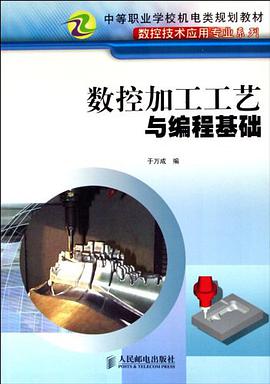
《数控加工工艺与编程基础》共分7章。主要内容包括数控机床的组成、分类及特点,切削用量的选择方法、刀具几何参数的选择和影响数控加工精度与表面质量的因素;工件的装夹方法、数控加工工艺分析与工艺设计的方法;程序的结构与格式和常用编程指令的使用方法;数控车削加工工艺与编程方法、宏程序及其调用方法;数控铣削加工工艺与编程方法和子程序编写与调用方法;加工中心的加工工艺与编程方法;数控电火花加工和线切割加工工艺与编程方法。《数控加工工艺与编程基础》以项目训练为载体,突出技能训练,强调学生分析问题和解决问题能力的培养。
《数控加工工艺与编程基础》可作为中等职业学校数控技术应用专业教材,也可作为机械制造专业和模具专业的教材。
machining processes and programming fundamentals This book delves into the essential knowledge and practical skills required for modern machining operations. It begins with a comprehensive overview of fundamental machining principles, explaining the underlying physics and mechanics that govern material removal. Readers will gain a solid understanding of various cutting tools, their geometries, materials, and applications in different machining scenarios. The text then proceeds to explore a wide array of common machining processes. This includes detailed descriptions of turning operations, covering different types of lathes and their functionalities, as well as the specific techniques involved in generating external and internal cylindrical surfaces, facing operations, and threading. Milling is another core focus, with explanations of various milling machine types, such as horizontal, vertical, and universal milling machines, along with discussions on different milling cutter designs and their use in producing flat surfaces, slots, pockets, and complex contours. Drilling and boring operations are also thoroughly covered. The book elucidates the principles of hole making, the selection of appropriate drill bits, and the techniques for achieving precise hole diameters and locations. Boring, as a process for enlarging and finishing existing holes, is examined in detail, highlighting its importance in achieving tight tolerances. Furthermore, the book introduces grinding as a precision finishing process. It explores different types of grinding machines and abrasive wheels, and discusses their role in achieving high surface finishes and dimensional accuracy, particularly for hardened materials. The principles of abrasive machining and the factors influencing surface quality are thoroughly explained. Beyond the individual processes, the book emphasizes the importance of workpiece fixturing and setup. It discusses various clamping methods, vises, chucks, and specialized fixtures, explaining how proper setup ensures workpiece rigidity, accuracy, and safety during machining. Understanding these aspects is crucial for efficient and repeatable manufacturing. The latter part of the book transitions to the realm of programming. It introduces the fundamental concepts of Computer-Aided Manufacturing (CAM) and the role of machining instructions in controlling machine tools. Readers will learn about the structure of G-code and M-code, the universal languages that direct CNC machines. The book breaks down common G-code commands, explaining their purpose in controlling axes of motion, spindle speed, feed rate, coolant activation, and tool changes. Specific programming examples are provided for various machining operations discussed earlier, illustrating how to generate code for turning, milling, drilling, and other processes. This practical application helps solidify the understanding of programming logic and its direct correlation with machining outcomes. The book also covers essential programming considerations such as tool compensation, coordinate systems, and program subroutines, which are vital for efficient and error-free programming. Emphasis is placed on optimizing machining parameters. The text guides readers on how to select appropriate cutting speeds, feed rates, and depths of cut based on material properties, tool characteristics, and desired surface finish. This optimization is key to achieving both productivity and tool longevity. Safety in the machining environment is a recurring theme throughout the book. It highlights potential hazards associated with operating machinery, handling sharp tools, and managing cutting fluids. Readers are educated on best practices for personal protective equipment, safe machine operation, and emergency procedures. Finally, the book touches upon the integration of machining with broader manufacturing concepts, such as quality control and inspection. It briefly explains how machining precision contributes to overall product quality and the importance of verifying dimensions and surface integrity. This holistic approach prepares the reader for the realities of modern manufacturing workflows.