
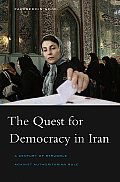

具体描述
Review
Twentieth-century Iranian history provides wonderful examples of recurring themes of revolution, authoritarian rule, and the attempt to create democratic institutions. In this landmark book, Fakhreddin Azimi illuminates a subject of the greatest importance to Iran, the Middle East, and, indeed, the rest of the world. Elegantly written and deeply informative, The Quest for Democracy in Iran is a must read.
--Roger Owen, Harvard University (20081201)
Azimi's impressive book offers a penetrating analysis of what sustained authoritarian rule in Iran over the last one hundred years and how the aspirations and quest for social justice, the rule of law, and freedom have remained both frustrated and resilient. He shows that the key hopes and agendas associated with the 1906 Constitutional Revolution remain as salient as ever.
--Ehsan Yarshater, Columbia University
The Quest for Democracy in Iran is a book of immense erudition, yet it is also a work of passion and sympathy for the Iranian people. A rigorous and fair-minded assessment of the Pahlavi dynasty and the revolution under Khomeni, it will command the attention of the general public as well as scholars.
--Wm. Roger Louis, University of Texas at Austin
For Azimi, all Iranian history after 1905 is an attempt to fulfill, partially accommodate or circumvent the ideals of a constitutional movement that placed popular representation at the fore of its priorities. He traces how at various moments public alienation and resentment have been articulated or expressed and finally, how "a culture of confrontation" emerged. His book goes a long way toward recuperating a history of Iranian democracy that has been expunged by Orientalists who wonder aloud if there is something about Muslim lands that makes them inhospitable to democracy or, alternatively, those who have dismissed periods of hectic parliamentary activity as mere chaos.
--Negar Azimi (The Nation )
Fakhreddin Azimi's The Quest for Democracy in Iran is particularly strong on retrieving the importance of the Constitutional Revolution and threading it through to the Islamic Republic's current dialectic between republicanism and theocracy.
--David Gardner (Financial Times )
The sophistication of [Azimi's] concepts of democracy and authoritarianism, his command of the sources, and his intellectual clarity and energy have combined to produce an insightful book that will draw the attention of all interested in Iranian culture and history.
--L. J. Alderink (Choice )
Product Description
The Constitutional Revolution of 1906 launched Iran as a pioneer in a broad-based movement to establish democratic rule in the non-Western world. In a book that provides essential context for understanding modern Iran, Fakhreddin Azimi traces a century of struggle for the establishment of representative government.
The promise of constitutional rule was cut short in the 1920s with the rise of the Pahlavi dynasty. Reza Shah, whose despotic rule Azimi deftly captures, maintained the façade of a constitutional monarch but greeted any challenge with an iron fist: “I will eliminate you,” he routinely barked at his officials. In 1941, fearful of losing control of the oil-rich region, the Allies forced Reza Shah to abdicate but allowed Mohammad Reza to succeed his father. Though promising to abide by the constitution, the new Shah missed no opportunity to undermine it.
The Anglo-American–backed coup of 1953, which ousted reformist premier Mohammed Mosaddeq, dealt a blow to the constitutionalists. The Shah’s repressive policies and subservience to the United States radicalized both secular and religious opponents, leading to the revolution of 1979. Azimi argues that we have fundamentally misunderstood this event by characterizing it as an “Islamic” revolution when it was in reality the expression of a long-repressed desire for popular sovereignty. This explains why the clerical rulers have failed to counter the growing public conviction that the Islamic Republic, too, is impervious to political reform—and why the democratic impulse that began with the Constitutional Revolution continues to be a potent and resilient force.
作者简介
目录信息
读后感
评分
评分
评分
评分
用户评价
这本书的气场让人感觉它是一部关于“未竟事业”的沉思录。我设想书中一定包含了对历次重大民主浪潮失败原因的深刻反思——1979年的机会错失,2009年绿色运动的黯然收场,这些节点无疑是全书的核心矛盾点。我期待作者能以一种近乎冷峻的笔触,剖析权力结构自我保护的机制,揭示那些隐藏在官方叙事背后的权力交接的“潜规则”。特别是关于公民社会的作用,伊朗的知识分子、艺术家、商人,他们在多大程度上能够形成一个有效的、有组织的反对力量?是受制于严酷的镇压,还是因为自身的分裂和目标的不一致?我个人非常欣赏那种不粉饰太平、敢于直面历史教训的写作态度。这本书如果能提供一个清晰的脉络,说明伊朗的“民主实验”在哪些关键的历史岔路口选择了偏离方向,并将这种选择归因于结构性限制而非简单的道德缺陷,那它将是一部极具洞察力的著作。
评分这本书的篇幅和书名结构暗示了一种对历史纵深感的追求,它试图将现代的民主呼声置于数千年波斯文明的背景之下进行审视。这种宏大的视角,可能会探讨伊朗文化中根深蒂固的权威主义倾向,以及对“贤明君主”或“精神领袖”传统的依赖,如何潜移默化地阻碍了对现代代议制政府的接受。我期望看到作者能够超越单纯的政治事件年表,转而关注社会心态和文化认同的缓慢变迁。例如,现代伊朗青年对“西方民主”概念的接受程度如何?他们是在寻求一种本土化的、具有伊朗特色的民主形式,还是完全拥抱普世价值?这种内部观念的冲突和融合,是理解未来走向的关键。如果书中能够引入社会学调查或者深度访谈的元素,让那些在体制内和体制外挣扎的伊朗人的声音得以呈现,那么这本书就能从一份冷静的政治分析,升华为一部充满人性和温度的时代见证。
评分这本关于伊朗民主之路的书籍,尽管我尚未深入阅读,但从其厚重的封面和严肃的标题中,我已经能感受到作者试图剖析这一复杂议题的雄心壮志。它似乎不仅仅是一部历史梳理,更像是一场对数十年间政治光谱拉锯战的深度剖析。我个人对中东地区的政治演变抱有极大的兴趣,尤其是那些在专制与开放之间摇摆不定的国家,伊朗无疑是其中最引人注目的一例。这本书的选材和结构,从其目录的只言片语推测,想必涵盖了从巴列维王朝末期的社会思潮到伊斯兰革命后的权力真空,再到当代社会运动的兴起与挫折等多个维度。我期待它能提供一种超越西方视角、更贴近伊朗本土知识分子和普通民众心声的叙事框架,避免将复杂的内部动态简化为简单的善恶二元对立。特别是关于改革派与保守派之间那些微妙的权力制衡与博弈,如果能被细致入微地描绘出来,那将是极大的收获。这本书的重量感,预示着它试图搭建起一座理解伊朗现代困境的复杂桥梁,而不是提供廉价的答案。
评分阅读书名《The Quest for Democracy in Iran》,脑海中立刻浮现出一种史诗般的悲壮感。这绝不是一本轻松愉快的读物,它必然充满了关于希望的破灭与重燃的故事。我推测作者必然花费了大量精力去梳理那些被历史的尘埃掩盖的民间声音,那些在咖啡馆里、在地下文学中酝酿的自由火花。这种“追寻”(Quest)的措辞,暗示了民主的道路是漫长、充满陷阱和反复的。我特别好奇作者如何处理“伊斯兰性”与“现代性”之间的内在张力——伊朗的民主进程,与西方启蒙运动下产生的世俗民主模型,究竟是并行不悖,还是存在着根本性的冲突与融合?如果书中能对不同代际的活动家——从七十年代的左翼学生到今日的社交媒体倡导者——的理念差异进行对比分析,那么这本书的价值将得到极大的提升。那种深入骨髓的文化与政治语境的交织,是任何肤浅的报道都无法触及的。它仿佛在邀请读者一同进入一个充满迷雾和悖论的迷宫,去理解为何在一个拥有如此深厚文明底蕴的国度,民主的实现却如此艰难。
评分从封面的设计风格来判断,这本书应该倾向于学术研究的严谨性,但又不失对现实政治的敏锐洞察。我非常关注作者在处理伊朗与外部世界关系时的论述角度。伊朗的政治命运,从来都与地缘政治的棋局密不可分,无论是冷战时期的美苏干预,还是当代地区强权的角力,都深刻地塑造了其内部的民主空间。我希望能看到作者如何将这些外部压力内化为内部政治选择的一部分,而不是简单地将民主的停滞归咎于“外部敌对势力”。更深层次地,我想探究书中是否涉及了经济因素的作用——石油财富如何固化了现存的权力结构,或者说,经济不平等和青年失业率如何成为推动变革诉求的底层燃料。如果这本书能够提供详实的经济数据和政治经济学的分析模型,将极大地增强其论证的说服力,让这场“追寻”不仅仅停留在理想主义的层面,更能落地到柴米油盐和国家财政的现实考量之中。
评分 评分 评分 评分 评分相关图书











本站所有内容均为互联网搜索引擎提供的公开搜索信息,本站不存储任何数据与内容,任何内容与数据均与本站无关,如有需要请联系相关搜索引擎包括但不限于百度,google,bing,sogou 等
© 2026 book.quotespace.org All Rights Reserved. 小美书屋 版权所有