
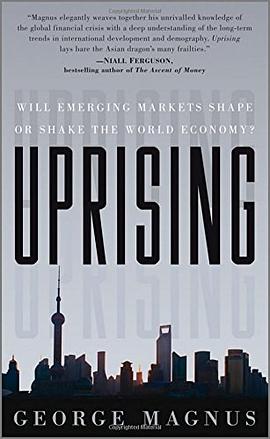

具体描述
Emerging markets are big news. But after the financial crisis, what does the future really hold for them? And what does this future mean for global business? George Magnus, one of the world's most respected economic analysts, is your guide through the challenges and opportunities for emerging markets and those doing business in them. This magisterial book looks in detail at China and India – the big players – and also less hyped but crucial markets, including Eastern European countries and Turkey. Magnus takes in his sweep everything from commodity prices to climate change, and from comparative advantage to demographic to provide a compelling analysis of what the future might look like – not just for emerging markets, but for investors, businesses and economies everywhere. Uprising is a must-read for anyone who cares about the future of the global economy.
Exclusive Q&A with Author George Magnus
Author George Magnus How did you first become interested in the impact that emerging markets are having on the global economy in the wake of the financial crisis?
I took the view early in 2007 that the West was headed for a serious and protracted debt crisis, the sort that's typically associated with emerging markets, and unprecedented in scale in richer economies since the 1930s. I was thinking about writing a book on the meltdown and who and what was to blame, but became attracted to more forward looking global implications of the crisis. If we in the West were going to be shocked for a decade, would emerging markets keep the global economy afloat? Would they be able to sustain a model of development that relied on the hedonism of Western consumers? So I decided to ask whether the pre-crisis assumptions about emerging countries were still valid in a more fractious and unpredictable global economy, where linear extrapolations had become meaningless. Would emerging markets, especially China, be able to embrace extensive economic and political reform to deal with key structural issues, for example, unbalanced global trade which was - and remains - at the heart of our weakened global system. Then I found a lot of people and authors arguing that the world was reverting to a system that had existed before the birth of Christ and until about 1800 when China really did rule the world. So I decided to investigate and assess the credentials of this statement. Uprising is quite an interesting title for the book -- do you think that what we’re seeing an ‘uprising’ of emerging markets?
Yes. The Western model of capitalism, especially financial capitalism, has been punctured. The so-called Washington Consensus is seen by many as yielding now to a Beijing Consensus. China and other emerging nations are vocal about ending the US dollar-centric financial system. Emerging markets, while a disparate group, have some common interests in lining up against the West over economic policies, technology transfer, and climate change. Those infamous tectonic plates of power are certainly shifting towards emerging countries, but the questions are how far, and so what? Since China is the only major rival to the US as a global power and leader, can it exercise a global leadership role? Does it want to? And what if it can't or won't? Your argument in the book, that China in particular is over-hyped at the moment, is quite controversial. Why do you think it’s an issue that provokes such strong feelings?
Basically because a lot of people think we may be at some sort of tipping point where vested interests and beliefs play a big role. China, unlike other major emerging markets, isn't just big and populous. It really can shake things up in Asia and the world. So Sino-philes and Sino-phobes both have loud drums to bang. More specifically, I'd suggest three reasons. First, there are many people who claim self-servingly, often for blatantly commercial reasons, that this is now the Chinese century. Second, there are those who think the Western globalization model is now so flawed, that there's no way back. The future has to belong to someone else. And third, there are many who see China's achievements with such awe - not without cause - that they can't imagine weakness or failure, especially when the West is in such difficulties. Your last book, The Age of Aging was about the problems caused for the economy by an aging population. Is demographics a big part of the story about emerging markets too?
Very much so. Most emerging markets are going to enjoy reaping the 'demographic dividend' for another 20 years or so. This captures the economic benefits of the fall in child dependency on the working age population, and before rising old age dependency really kicks in. But by the 2030s, most emerging markets will be where the West is today. Will they be able to grow rich too before they grow old, to coin a cliché? It's by no means certain. Further, I'm not sure how well understood it is that China is the fastest aging country on Earth and faces an imminent and protracted fall in its youth and working age populations. Or what the unintended social and economic consequences of the one child policy are. How will India generate jobs for the teeming millions of children now aged under 15? And could the younger, poorer and more populous emerging world come into more frequent conflict with the older, richer world over water, food, resources, for example? What’s the most interesting thing that you’ve learned about emerging markets while researching the book?
I was no stranger to the economics and demographics of emerging markets though new material crops up all the time. But I think what fascinated me most was the history lesson of Chinese civilization and its role in the global system for two millennia, and of why the Industrial Revolution happened in a two-horse town in northern England, and not on the Yangtse Delta. This steered me towards the quality of institutions, both political and legal, as one of the great unsung heroes and determinants of economic development and success, rather than GDP or a raft of other economic variables. And in turn, why this is as relevant as ever. What do you think is the future for emerging markets in the medium term?
I don't doubt that emerging markets have strong economic fundamentals that will enable them to catch up economically vis -a-vis the West. But I think this hangs on some important assumptions. We need to maintain an open trading system, sound international institutions and high levels of co-operation and co-ordination. These are the core characteristics of the kind of globalization in which emerging markets have already made great progress. My worry is that it's all too easy for this to fall apart, and for emerging markets to suffer more - because they are poorer - if the biggest emerging markets fail to offer good leadership and governance at home and on the global stage. This is not to let the US and the West off the hook at all. It is to recognize, though, that a system works because all participants contribute to its smooth functioning, and that goes for emerging markets too.
作者简介
GEORGE MAGNUS is Senior Economic Adviser at UBS Investment Bank, London. Previously, he was Chief Economist at UBS; he has held similar positions with Union Bank of Switzerland and SG Warburg.
George Magnus is well-known and respected as a public commentator on the long-term consequences of the financial crisis. His first book The Age of Aging: How Demographics are Changing the Global Economy and Our World was published by Wiley in 2008. He lives, works and writes in London, is married and has four children.
目录信息
Introduction.
Chapter 1 Back to the Future?
Chapter 2 Who Are Those Guys?
Chapter 3 To Armageddon and Back.
Chapter 4 Atomic Clouds of Footloose Funds.
Chapter 5 After the Crisis: Catharsis or Chaos?
Chapter 6 Older and Wiser: Demographic and Technological Challenges.
Chapter 7 The Climate Change Catch 22.
Chapter 8 Who Will Inherit the Earth?
Notes.
Index.
· · · · · · (收起)
读后感
评分
评分
评分
评分
用户评价
这是一次令人难忘的阅读旅程。作者的想象力实在是太丰富了,构建了一个如此完整而又充满魅力的世界。我被这个世界的设定深深吸引,里面的各种规则、文化、以及人物之间的互动,都设计得非常巧妙。每一次阅读,我都能从中发现新的惊喜,仿佛这个世界还在不断地生长和变化。 故事的节奏感把握得极佳,张弛有度,让人既能感受到紧迫的危机感,又不至于感到疲惫。转折点和高潮处的处理更是堪称完美,将整个故事推向了一个又一个的高峰。我甚至在阅读的时候,脑海中已经开始想象电影画面了,这样的故事,真的太有改编的潜力了!
评分这本书带给我的震撼,是文字所难以完全形容的。它不仅仅是一个故事,更像是一次心灵的洗礼。我跟随主角一起经历他们的迷茫、挣扎,也见证了他们的成长和蜕变。那些看似平凡的瞬间,在作者的笔下被赋予了深刻的意义,让我重新思考生命的价值和存在的意义。每一次翻开,都仿佛打开了一个全新的世界,让我得以逃离现实的喧嚣,沉浸在另一个时空里,与书中的人物一同呼吸,一同感受。 那些宏大的场景描写,仿佛在我眼前徐徐展开,让我身临其境。无论是波澜壮阔的战争场面,还是错综复杂的人物关系,都被作者描绘得淋漓尽致,却又不显得杂乱。每一个细节都处理得恰到好处,既有画面感,又有张力。我能想象到那些恢弘的城市,感受到那些紧张的对峙,甚至闻到空气中弥漫的尘土和血腥味。这种沉浸式的阅读体验,真是前所未有。
评分很难用简单的词汇来评价这本书,它带来的感受太过复杂而又强烈。作者的文字功底毋庸置疑,每一个词语的选择都恰到好处,每一个句子都充满了力量。读起来非常流畅,但又不是那种快餐式的阅读,而是需要细细品味,才能体会其中的深意。 这本书让我重新认识了“坚持”这个词的含义。在无数的困难和挫折面前,书中人物展现出的那种毅力,简直令人肃然起敬。它不是那种盲目的冲动,而是一种深思熟虑后的决心。这种精神力量,让我深受鼓舞,也给了我很大的启发。合上书本的时候,心中涌起的是一种复杂的情感,有不舍,也有满足,更有一种想要立刻开始下一段旅程的冲动。
评分这本书的气场真的太绝了!从拿到手的那一刻起,就被它的封面设计深深吸引,那种神秘又充满力量的感觉,仿佛预示着即将到来的史诗。读完第一章,我便彻底沦陷了。作者的笔触就像一位技艺精湛的雕塑家,寥寥几笔便勾勒出鲜活的人物,每一个角色都跃然纸上,仿佛就坐在我对面,在诉说着他们的故事。他们的情感如此细腻真实,时而让我心潮澎湃,时而又为他们的命运担忧不已,甚至有好几次,我捧着书,眼泪就这么不受控制地滑落。 那种跌宕起伏的情节,简直能把人的心提到嗓子眼!故事的发展总是出乎意料,当你以为已经猜到下一步会发生什么时,作者总能给你一个华丽的转折,让你重新审视之前的一切。这种悬念的设置,真是太高明了!我常常因为太过投入而忘记时间,一看表才发现已经深夜,但即便如此,也舍不得放下,总想着“再看一章就好”,结果就是一夜无眠。
评分这绝对是我近期读到的最令人振奋的书籍之一!它所传递出的那种不屈不挠的精神,那种在绝境中寻求希望的力量,深深地打动了我。读这本书的时候,我感觉自己也仿佛获得了无穷的勇气,去面对生活中的挑战。作者的叙事风格非常独特,既有史诗般的宏大叙事,又不失细腻的情感刻画,两者完美地融合在一起,构成了这本独一无二的作品。 我尤其喜欢书中的那些哲学思考。作者并没有直接给出答案,而是通过故事和人物的经历,引导读者去思考。每一次阅读,我都会有新的感悟,仿佛每一次都是一次对自我的探索。它让我跳出固有的思维模式,以更广阔的视角去审视周围的世界。这本书的价值,远不止于一个精彩的故事,它更像是一位智慧的导师,引领着我走向更深的思考。
评分 评分 评分 评分 评分相关图书











本站所有内容均为互联网搜索引擎提供的公开搜索信息,本站不存储任何数据与内容,任何内容与数据均与本站无关,如有需要请联系相关搜索引擎包括但不限于百度,google,bing,sogou 等
© 2026 book.quotespace.org All Rights Reserved. 小美书屋 版权所有