
Dreamweaver CS5 pdf epub mobi txt 电子书 下载 2026
- theMissingManual
- Dreamweaver CS5
- 网页设计
- HTML
- CSS
- JavaScript
- Adobe
- 前端开发
- 网站制作
- 软件教程
- 设计工具

具体描述
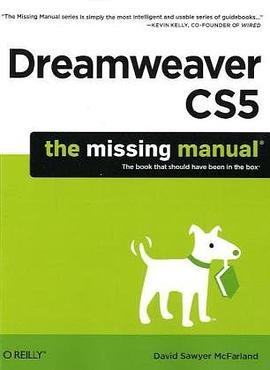
Web designers, web producers, and webmasters rely on one program above all others to design, build, and manage professional websites: Adobe Dreamweaver. It provides the tools you need to create everything from simple HTML pages to database-driven PHP pages. But what makes Dreamweaver so versatile is also what makes it difficult to learn. This bestselling guide offers you with clear, jargon-free explanations to help you master this sophisticated program -- and bring stunning, contemporary websites to life. Written by veteran Dreamweaver teacher and author David McFarland, Dreamweaver CS5: The Missing Manual takes you through site creation step-by-step, from building your very first page to launching a template-driven, fully interactive site. You'll hone your skills with the help of hands-on, guided tutorials throughout the book. Learn how to control the appearance of your web pages with CSS, from basic to advanced techniques Design dynamic, database-driven websites, from blogs to product catalogs, and from shopping carts to newsletter signup forms Add interactivity to your website with ready-to-use JavaScript programs from Adobe's Spry Framework Effortlessly control the many helper files that power your website and manage thousands of pages Examine web page components and Dreamweaver's capabilities with the book's "live examples"
Add Spry Tabbed Panels to Web Pages
Some website visitors are loath to scroll; if they don’t see what they want when a page first loads, they move on. Because of this, some web designers divide long passages of information into multiple pages so that each page presents small, easy-to-digest chunks. Of course, that means building several pages instead of just one, and forces visitors to click through (and wait for) a series of pages. Spry Tabbed Panels provides an alternative (see Figure 13-1). Instead of creating one long page, or several smaller pages, you can organize information into separate tabbed panels. That way, your content is always front and center, and your visitors can easily access different sections by clicking a tab above each panel.
Adding a Tabbed Panel
You can place Spry tabbed panels anywhere on a web page. But since the tabs form a single row at the top of the group of panels, you need enough horizontal space to accommodate all the tabs. Unless you have only a couple of tabs with one-word text labels, you should place the tabbed panels in a fairly wide space, such as the main column of a web page, or across the entire width of the page. Just follow these steps:
Figure 13-1. Organize your page’s content into easily accessible panels with
the Spry Tabbed Panels widget. Clicking a tab opens a new panel’s worth of
information without the browser having to load a new web page.
1. In the document window, click where you wish to insert the panels. For example, inside a div tag.
2. Choose Insert > Spry > Spry Tabbed Panels, or, on the Insert panel’s Spry category, click one of the Spry Tabbed Panel’s buttons (see Figure 13-2).
You can find all the Spry goodies on the Insert panel’s Spry category (Figure 13-2, left); you’ll also find several Spry widgets (including tabbed panels) listed under the Layout category (Figure 13-2, right), and other Spry buttons grouped under other tabs (form validation Spry widgets appear under the Forms tab, for example).
Figure 13-2. In the Insert panel, you can identify a Spry icon by the starburst
in the button’s lower-right corner. It’s even easier to distinguish them from
other buttons if, from the Insert Panel’s category menu, you choose Color
Icons--this changes the drab gray starburst to a bright orange.
After you insert a tabbed panel, you see two tabs and two panels on the page (Figure 13-3); in addition, a blue tab appears above the panels indicating the Spry widget. The blue tab appears only in Dreamweaver’s Design view, not in a guest’s web browser. It gives you an easy way to select the Spry widget and access its properties in the Property inspector. Note : When you save a page after inserting a Spry Tabbed Panel, Dreamweaver notifies you that it has added two files to the site: a CSS file (SpryTabbedPanels.css) for formatting the panel group, and a JavaScript file (SpryTabbedPanels.js) to make the panels appear and disappear when visitors click the tabs. Dreamweaver saves both files in the SpryAssets folder in your site’s root folder. Make sure you upload this folder when you move your site onto your web server.</ul
3. In the Property inspector, name the panel group (Figure 13-3).
This step is optional. Dreamweaver provides a generic name (TabbedPanels1, for example) for the group of panels. You don’t really have to change this name; it never appears in a browser window. But if you ever take the plunge into manually modifying your Spry widgets in Code view, you may want to change the Spry panel group’s name to something more descriptive. If you create a group of tabbed panels to house information about a product, for example, you might name the panel group productPanels . A descriptive name helps you identify code related to the panel group if you work in Code view to enhance or change the functionality of the panels.
Figure 13-3. Normally, when a browser downloads a page containing Spry panels, it highlights the first
tab and panel. However, if you’d rather open another panel when the page loads, select
the relevant tab’s name in the Property inspector’s “Default panel” menu.
4. Add additional panels.
If two panels aren’t enough for your needs, use the Property inspector to add more. Above the list of tab names, click the + button (see Figure 13-3) to add a new panel. To remove a panel, in the same list, click the name of a tab, and then click the minus (-) button. You can also reorder the panels by selecting a tab from the list, and then clicking the up or down arrow button. The up arrow moves a panel to the left, while the down arrow moves a panel to the right. Note : A Spry widget’s properties appear in the Property inspector only when you select the widget. To do so, click the blue tab above the elements inside the widget.
作者简介
目录信息
读后感
评分
评分
评分
评分
用户评价
我一直对那些能够将创意转化为现实的工具充满着敬意,而Dreamweaver CS5无疑是网页设计领域的一张王牌。虽然我并非专业的程序员,但我一直渴望能够亲手打造属于自己的在线作品集,展示我那些天马行空的创意。我购买这本书,就是希望能够借助Dreamweaver CS5这个强大的平台,将那些只存在于我脑海中的视觉概念,转化为一个个生动、有吸引力的网页。我非常期待书中能够详细阐述如何利用Dreamweaver CS5的视觉编辑模式,来快速搭建网页的骨架,如何通过灵活的拖拽和排版,实现页面的美化。我更关心的是,这本书能否教会我如何运用Dreamweaver CS5来添加一些更具互动性的元素,比如图片轮播、弹出窗口,甚至是简单的表单提交功能,这些都能让我的作品集更加生动有趣。我希望这本书能够成为我开启网页设计之旅的“启蒙老师”,让我能够从一个门外汉,逐渐成长为一名能够独立完成创意展示的“数字艺术家”。
评分我一直是个对新技术充满好奇的人,虽然我的工作内容并不是直接与网页开发相关,但我总觉得了解和掌握一些前沿的网页制作工具,能够让我更好地理解互联网世界的运作方式,也能在日常工作中获得一些灵感。这本书的出现,恰好满足了我这种“学习癖”。我不太关心那些最底层的代码细节,我更感兴趣的是如何利用Dreamweaver CS5这样的工具,快速、高效地搭建一个具有一定设计感的网页。我希望这本书能告诉我,如何利用它提供的可视化界面,轻松地实现页面的布局,如何添加各种多媒体元素,比如图片、视频、音频,甚至是一些简单的交互动画。我之前尝试过一些其他的网页制作工具,总觉得要么过于复杂,要么功能太弱。我期待这本书能够在这两者之间找到一个平衡点,让我在学习过程中既能感受到专业的力量,又不至于被繁琐的技术细节劝退。
评分说实话,拿到这本《Dreamweaver CS5》的时候,我内心是有些忐忑的。我是一名平面设计师,虽然接触过一些网页制作的基础,但对于Dreamweaver这个专业的工具,我一直觉得它更像是程序员的专属领域。这次购买这本书,主要是希望能拓宽自己的技能栈,尝试将平面设计的理念融入到网页的交互和视觉呈现中。我尤其关注书中关于用户体验(UX)和用户界面(UI)设计的相关内容。我知道Dreamweaver不仅仅是一个代码编辑器,它更是实现优秀网页设计的平台。我希望这本书能教我如何从用户的角度出发,设计出既美观又实用的网页,如何通过合理的布局、色彩搭配和交互元素的运用,提升用户的浏览体验。书中是否会提供一些实用的案例分析,展示如何将设计稿转化为功能齐全的网页?我非常期待书中能够深入讲解Dreamweaver在原型设计、动效模拟方面的能力,这对于我将平面设计的想法转化为可交互的原型至关重要。
评分这本书的封面设计就透着一股子“老派”的专业感,深邃的蓝色背景,加上银色的Dreamweaver CS5字样,瞬间就让人觉得这是一本沉甸甸、内容扎实的参考书。我一直知道Dreamweaver在网页制作领域的重要性,但总觉得它有点高高在上,像个技术壁垒,不敢轻易尝试。拿到这本书的时候,我抱着一种“破釜沉舟”的心态,想着总要迈出这一步。翻开第一页,就能感受到作者严谨的逻辑和条理,他似乎把网页制作的整个流程都剖析得淋漓尽致,从最基础的概念讲起,一点点引导读者进入这个充满创造力的世界。书中的插图和截图也很清晰,每一个步骤都配有直观的图示,这对我这种视觉型学习者来说简直是福音。我特别期待书中关于响应式设计的讲解,因为现在移动端用户的比例越来越高,不懂响应式设计就等于落后了。而且,我一直对CSS的理解停留在“填色”和“排版”的层面,这本书有没有深入到CSS3的那些更高级的属性和动画效果呢?那些能让网页“活”起来的魔法,我都迫不及待想从这本书里学到。
评分我是一名独立内容创作者,经常需要在不同的平台发布自己的作品,而拥有一个属于自己的独立网站,是我一直以来的梦想。市面上关于网页制作的书籍很多,但找到一本能够真正帮助我从零开始,独立完成网站建设的书却不容易。我了解到Dreamweaver CS5是一款非常强大的网页设计软件,所以我毫不犹豫地选择了这本书。我希望这本书能够提供一套完整的、适合初学者的建站流程。从最初的网站规划、页面结构设计,到具体的内容填充、风格美化,再到最后的发布上线,我都希望这本书能够给出清晰的指导。我尤其关注书中关于SEO(搜索引擎优化)的介绍,因为我希望我的网站能够被更多人看到,能够获得更好的搜索排名。同时,我也希望书中能够包含一些关于如何为网站添加博客功能、作品集展示等实用模块的教程,这些都是我非常需要的。
评分刻苦研读中..用不习惯mac呀..
评分刻苦研读中..用不习惯mac呀..
评分刻苦研读中..用不习惯mac呀..
评分刻苦研读中..用不习惯mac呀..
评分刻苦研读中..用不习惯mac呀..
相关图书




















本站所有内容均为互联网搜索引擎提供的公开搜索信息,本站不存储任何数据与内容,任何内容与数据均与本站无关,如有需要请联系相关搜索引擎包括但不限于百度,google,bing,sogou 等
© 2026 book.quotespace.org All Rights Reserved. 小美书屋 版权所有