
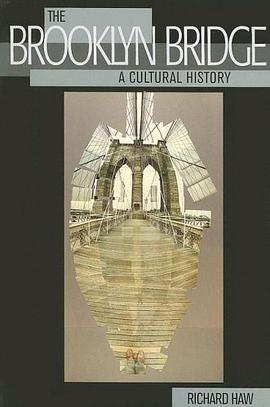

具体描述
Hailed by some as the Eighth Wonder of the World when it opened in 1883, the Brooklyn Bridge is one of the world's most recognizable and beloved icons. For over one hundred years it has excited and fascinated with stories of ingenuity and heroism and it has been endorsed as a flawless symbol of municipal improvement and a prime emblem of American technological progress. Despite its impressive physical presence, however, Brooklyn's grand old bridge is much more than a testament of engineering and architectural achievement. As Richard Haw shows in this first-of-its-kind cultural history, the Brooklyn Bridge owes as much to the imagination of the public as it does to the historical events and technical prowess that were integral to its construction. Bringing together more than sixty images of the bridge that, over the years, have graced postcards, magazine covers and book jackets and appeared in advertisements, cartoons, films and photographs, Haw traces the diverse and sometimes jarring ways in which this majestic structure has been received, adopted and interpreted as an American idea. Haw's account is not a history of how the bridge was made, but rather of what people have made of the Brooklyn Bridge--in film, music, literature, art and politics--from its opening ceremonies to the blackout of 2003. Classic accounts from such writers and artists as H. G. Wells, Charles Reznikoff, Hart Crane, Lewis Mumford, Joseph Pennell, Walker Evans and Georgia O'Keeffe, among many others, present the bridge as a deserted, purely aestheticized romantic ideal, while others, including Henry James, Joseph Stella, Yun Gee, Ernest Poole, Alfred Kazin, Paul Auster and Don DeLillo, offer a counter-narrativeas they question not only the role of the bridge in American society, but its function as a profoundly public, communal place. Also included are never-before-published photographs by William Gedney and a discussion of Alexis Rockman's provocative new mural "Manifest Destiny. Drawing on hundreds of cultural artifacts, from the poignant, to the intellectual, to the downright quirky, "The Brooklyn Bridge sheds new light on topics such as ethnic and foreign responses to America, nationalism, memory, parade culture, commemoration, popular culture, and post-9/11 America icons. In the end, we realize that this impressive span is as culturally remarkable today as it was technologically and physically astounding in the nineteenth century.
作者简介
目录信息
读后感
评分
评分
评分
评分
用户评价
坦率地说,这本书的哲学思辨深度远超我最初的预期。它并非仅仅是工程学的教科书,更像是一部关于“连接”的形而上学探讨。作者巧妙地将布鲁克林大桥——这个物理上的通道——转化成了一面镜子,映射出纽约这座城市在不同族裔、不同阶层之间无形的张力与融合。每当描述到大桥落成时人们的情绪波动,我都能感受到那种跨越地域隔阂后,集体的身份认同的微妙变化。其中有一段关于“阴影的几何学”的论述,非常精妙,它探讨了光线穿过缆索时在桥面上投下的复杂阴影,如何象征着历史的厚重与现代的空灵之间的永恒对话。这种将具体事物抽象化的笔法,使得阅读体验充满了智力上的愉悦感,每一次翻页都像是在解开一个新的谜团,关于人类的雄心与局限。
评分这本书的叙事节奏把握得如同纽约的潮汐,时而汹涌澎湃,时而低回婉转。我必须承认,在阅读过程中,我好几次被作者对于细节的考究所震撼。他描绘的不仅仅是一座钢筋水泥的巨物,更是一种精神图腾在历史长河中的挣扎与辉煌。作者似乎对十九世纪末到二十世纪初那段工业革命的喧嚣有着近乎偏执的热爱,每一个关于铆钉、钢缆和石材的描述,都带着一种老式蓝图的精确感和浪漫主义的憧憬。我尤其喜欢其中对于早期工程师们那种近乎狂热的信念的刻画,他们仿佛站在时代的风口浪尖,用汗水和智慧挑战着重力的极限。那种探索未知、挑战不可能的勇气,隔着一百多年的时光,依然能清晰地扑面而来,让人不由自主地屏住呼吸,仿佛自己也成了那个在东河边仰望天空的工人,心中充满了对宏伟工程的敬畏。这种沉浸感,是很多历史类书籍难以企及的。
评分最让我感到惊喜的是作者在社会生态描绘上的细腻入微。他没有将焦点仅仅集中在那些站在聚光灯下的设计师和富豪身上,而是深入到了那些默默无闻的移民工人的生活侧面。通过收集大量的口述历史和私人信件,作者勾勒出了一幅生动的十九世纪末纽约移民社区的浮世绘。从意大利裔石匠的家庭晚餐,到爱尔兰裔电焊工在寒冷夜晚的简陋住所,这些碎片化的生活场景,极大地丰富了对“大桥建设”这一宏大叙事的理解。它们提醒我们,任何伟大的工程背后,都凝聚着无数普通人的血汗与梦想。这种兼具历史学家的人文关怀和小说家洞察力的叙事角度,让整本书的温度瞬间提升,不再是冰冷的纪念碑,而是活生生的历史肌理。
评分这本书的语言风格极其鲜明,带着一种古老的、略显繁复的文学腔调,读起来就像是在品尝一坛陈年的波尔多红酒,需要慢下来,细细品味每一个词藻的质感。作者似乎毫不吝惜他那丰富的词汇库,句子往往绵长而富有韵律,充满了排比和拟人化的手法。这使得即便是描述材料采购和预算控制这样枯燥的环节,也被赋予了一种史诗般的庄严感。对我个人而言,这种阅读体验是一种挑战,尤其是在通勤的嘈杂环境中,我不得不反复回读某些长句才能完全捕捉其精髓。然而,一旦适应了这种节奏,那种扑面而来的古典美感,那种对“伟大”一词的庄重诠释,便让人心甘情愿地沉溺其中,感觉自己像是回到了那个对“进步”怀有无限信仰的年代。
评分从装帧和排版的角度来看,这本书无疑是一件艺术品。纸张的选择有着恰到好处的厚重感,触摸起来有一种怀旧的质地。内页的插图和照片选择极其考究,尤其是那些早期工程图的扫描件,线条清晰,细节毕现,它们本身就构成了对文本的有力佐证。我注意到,作者在处理图注时,也保持着高度的克制与优雅,没有过多渲染,只是冷静地提供信息,让图像自己说话。这种对媒介本身的尊重,使得阅读过程变成了一种多感官的享受。这不仅仅是一本“阅读”的书,它更像是一件可以“珍藏”的物件,值得在光线下反复摩挲,去体会那种印刷术鼎盛时期的严谨与美学追求。
评分 评分 评分 评分 评分相关图书












本站所有内容均为互联网搜索引擎提供的公开搜索信息,本站不存储任何数据与内容,任何内容与数据均与本站无关,如有需要请联系相关搜索引擎包括但不限于百度,google,bing,sogou 等
© 2026 book.quotespace.org All Rights Reserved. 小美书屋 版权所有