

具体描述
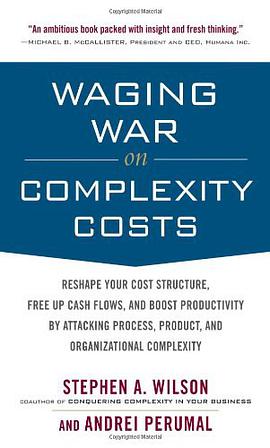
Shed Revenue-Draining Complexity Costs by Thirty Percent! "This is an ambitious book packed with insight and fresh thinking. Separating good from badcomplexity costs is a critical task facing companies today, and the authors provide a compellingroadmap for solving the problem." Michael B. McCallister, President and CEO, Humana Inc. "Waging War on Complexity Costs examines an incredibly important and often overlooked aspectof business and organizations in general-regulators and government officials should read thisbook and take notice. Complexity dramatically increases costs and risk of failure. It is like acancer that eats away at efficiency and profitability." Andy Beal, Chairman and CEO, Beal Bank "This is by far the best and most useful explanation of how to address complexity in a business.Waging War on Complexity Costs frames the issue in a way that companies can finally tackle theproblem-this book delivers." Ahmad R. Chatila, CEO, MEMC Electronic Materials Inc. "This is the first book that really targets organizational complexity in a compelling way, makingthis a must-read for any organization that is looking to distance itself from the competition. Afteryears of cost-cutting, many companies are realizing that they still don't have a discernable costadvantage. This book provides the platform to achieve just that, by attacking the complexity thatbogs them down." Tom DiDonato, EVP Human Resources, American Eagle Outfitters, Inc. About the Book: Complexity costs are the single biggestdeterminant of your company's costcompetitiveness. For the past two decades thepursuit of growth has created massive complexityin processes, product portfolios, andorganizations, adding costs that companiescan ill afford. The only good news is that yourcompetitors may be carrying as much complexityas you are. Learn how to eliminate thiscomplexity, and you can create a tremendouscost advantage over your competition. In Waging War on Complexity Costs, StephenWilson and Andrei Perumal deliver a powerfuland practical approach for reclaiming yourcost advantage. This executive-level resourcepresents a wealth of insight and new researchto definitively answer key questions such as: How can I quantify the cost of complexitywithout getting lost in a sea of data? Where are the biggest opportunities forreducing product, process, and organizationalcomplexity, and how can I cut through theinterdependencies that trap these costs? How can I see results quickly by takingtargeted actions against key levers? How do I keep complexity costs at bay? It is not enough to attack bloated product portfolios.Substantive cost improvements requireaddressing the complexity in the underlyingprocesses and organizational structures. WagingWar on Complexity Costs provides a wealth ofrelevant case studies with examples from Kraft,Tesco, Fiat, and the U.S. Navy and highlightsspecific strategies for reducing costs by 15-30%in significant portions of your business. Tomorrow's consumers are emerging as wellinformedcustomers who know what theywant and the price they're willing to payfor it. Complexity not only drives costs; itcreates a barrier between you and the customer.Declare a war on complexity costs andprepare for profitable growth.
作者简介
目录信息
读后感
评分
评分
评分
评分
用户评价
我原本以为这又是一本在鼓吹“精益”或者“敏捷”的又一体现,但事实远比我想象的要深刻和具有批判性。这本书的真正价值在于它毫不留情地揭示了“复杂性本身就是一种权力结构”这一残酷现实。那些热衷于构建复杂系统的人,往往是那些从复杂性中获益最多的人,因为复杂性创造了他们存在的必要性——他们成了唯一能理解并驾驭这些迷宫的人。这种对组织政治和信息不对称的剖析,简直是教科书级别的。我记得其中有一章详细分析了“系统层面的蔓延”,即一个部门引入的新工具或流程,如何在不被察觉的情况下,迫使其他部门也必须做出相应的调整,从而导致整个生态系统臃肿不堪。这种连锁反应的描述,让我回忆起过去几年公司内发生的一系列莫名其妙的“升级”和“整合”,事后看来,那些行动的真正目的或许并非提升效率,而是巩固特定部门的控制力。这本书读起来像是一部企业界的侦探小说,充满了对隐藏动机的揭露,读完后,你再看任何商业报告或战略文件时,都会不自觉地去寻找那些潜藏的“复杂性制造者”。
评分这本书的语言风格非常独特,它带着一种老派的、近乎哲学思辨的严谨,同时又夹杂着对现代商业实践的辛辣讽刺。它不像市面上那些流行的管理书籍那样,一味地鼓吹“积极心态”和“快速行动”,而是更关注于结构性缺陷的根源。我特别欣赏作者对“概念的模糊化”所持有的警惕态度。很多时候,我们用一个听起来很高级的词汇(比如“协同效应”、“平台化战略”)来掩盖我们其实并不知道该如何具体执行的窘境。这本书强迫你去定义你所说的每一个词的实际操作意义。它让我对过去签署的无数“谅解备忘录”和“战略合作框架”产生了深深的怀疑——它们究竟是通往成功的桥梁,还是仅仅是为某些人粉饰太平的烟雾弹?这本书的核心观点,即“复杂性是惰性思维的投影”,在我脑海中久久回荡。它不是一本快速阅读的指南,而是一部需要反复咀嚼,并在实践中不断印证的思维工具书。读完它,你对任何看似无懈可击的商业提案都会抱持一种健康的怀疑态度。
评分这本书简直是一剂清醒剂,尤其对于那些在日常工作中被各种流程、技术债务和管理层级压得喘不过气的人来说。我花了很长时间才真正消化完其中的核心思想,它不仅仅是在抱怨“复杂性”这个老生常谈的问题,而是深入剖析了这种复杂性是如何在不知不觉中吞噬掉企业的创新能力和利润的。作者的叙事非常引人入胜,他没有采用那种枯燥的理论堆砌,而是通过一系列生动的案例,比如某个大型软件项目因为过度设计而陷入泥潭,或者某个组织因为层级过多而决策缓慢的“慢动作”效应。我尤其欣赏其中关于“认知负荷”的讨论,很多时候我们以为增加了沟通环节是为了确保万无一失,结果却适得其反,让真正需要做决策的人被信息洪流淹没。这本书促使我开始重新审视自己团队内部的会议结构和文档标准,很多看似必要的“治理”措施,实际上都在为系统增加摩擦力。读完之后,我感觉自己像是一个刚刚发现自己房子里堆满了没用的杂物,准备开始大扫除的房主,那种豁然开朗的感觉,真是太棒了。它提供的不是一套放之四海而皆准的万能公式,而是一套让你学会质疑现有复杂性的思维框架。
评分我必须承认,这本书的阅读体验有些颠簸,因为它要求你对自己的思维习惯进行彻底的自我反思,这并不轻松。它不是那种可以边喝咖啡边轻松翻阅的书籍。它更像是一份严峻的挑战书,特别是当你身处一个以复杂性为傲的环境中时,阅读它需要一定的勇气。我特别喜欢其中关于“反脆弱性”的对比论述,它暗示了过于僵硬和复杂的系统,一旦遇到黑天鹅事件,其崩溃的速度会比任何一个简单系统都要快得多。书中对“标准化”的过度推崇也提出了尖锐的批评,指出当标准化成为一种教条而非工具时,它就成了扼杀灵活性的枷锁。这种对既有商业智慧的解构,让我感到既警醒又兴奋。它不是在主张回到石器时代,而是鼓励我们在每一次决策时,都问自己那个最简单却也最难回答的问题:“我们是否真的需要这个额外的步骤、这个额外的报告、这个额外的接口?” 这种回归本质的追问,是这本书给我最大的收获。
评分对于技术领导者而言,这本书是一剂强效的解毒剂。它清晰地指出了,当我们沉迷于追逐最新的技术栈或架构模式时,往往忽略了最基本的原则:任何增加的抽象层,如果不能带来同等或更高的价值回报,那就是一种净损失。作者对于“过度工程化”的批判,尤其精准。他区分了“必要的复杂性”(由问题的本质决定)和“人为制造的复杂性”(由不成熟的设计或组织惰性产生)。书中关于如何通过“消减边界”和“明确责任域”来降低系统交互成本的实践建议,非常具体且可操作。我尝试将书中的一些“简化测试”应用到我们最近的一个微服务拆分项目中,结果是原本计划用六个月的方案,硬生生被我们压缩到了四个月,而且代码的可维护性反而提升了。这让我深刻认识到,我们过去常常用“专业性”的名义,为自己增加不必要的负担,而真正的专业,应该是让事情变得简单易懂。这本书的价值不在于告诉你“做什么”,而在于让你明白“为什么你现在做的事情是错的”。
评分 评分 评分 评分 评分相关图书














本站所有内容均为互联网搜索引擎提供的公开搜索信息,本站不存储任何数据与内容,任何内容与数据均与本站无关,如有需要请联系相关搜索引擎包括但不限于百度,google,bing,sogou 等
© 2026 book.quotespace.org All Rights Reserved. 小美书屋 版权所有