具体描述
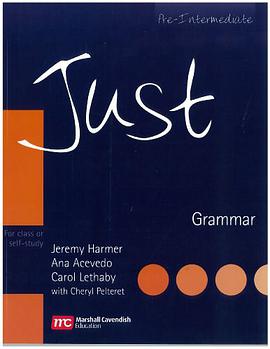
"The Just Skills" series provides a flexible set of teaching materials for use individually or in any combination to form an integrated course. "The Just Skills" series, available at four levels, comprises Grammar, Vocabulary, Listening & Speaking, and Reading & Writing books. The corpus of the "Just Right" course has been used to create this set of skills books. The consistent methodological approach used throughout each book allows for them to be used easily together. These books are ideal for: skills lessons in the classroom; self-study; specialised skills-focused courses; one-to-one lessons; and, supplementing other course books.
Mastering the Fundamentals: Essential English Grammar for Today’s Learner A Comprehensive Guide to Building a Solid Linguistic Foundation This textbook serves as a robust and detailed introduction to the core mechanics of the English language, designed specifically for learners who have a foundational understanding but need to solidify their grasp of essential grammatical structures. Moving beyond the introductory stage, this volume focuses on practical application, clarity, and building the confidence required to communicate effectively in both spoken and written contexts. Target Audience and Approach Intended for students progressing beyond the absolute beginner phase, this book assumes familiarity with basic concepts like subject-verb agreement and simple tenses. It is meticulously structured to bridge the gap between elementary knowledge and intermediate proficiency. Our pedagogical approach emphasizes clarity through concise explanations, reinforced by extensive, context-rich exercises. We prioritize understanding why a structure works, rather than simply memorizing rules, ensuring that learners can adapt their knowledge to novel situations. The tone remains encouraging yet academically rigorous throughout. Core Content Modules This extensive volume is organized into four primary sections, each building upon the preceding one to create a cohesive learning journey. --- Part I: The Anatomy of the Sentence – Core Structures Refined This section dives deep into the building blocks of clear communication, ensuring that the foundation is impeccable before tackling more complex constructions. Module 1: Nouns, Articles, and Determiners in Depth Countable vs. Uncountable Mastery: Detailed exploration of how to correctly use plurals, singular forms, and collective nouns. Specific focus on common tricky uncountable nouns (e.g., advice, furniture, information) and how to quantify them using partitives (e.g., a piece of advice). The Nuances of Articles (A, An, The, and Zero Article): Comprehensive coverage of when and why to use the definite article versus the indefinite article, including specific rules for geographical names, institutions, and abstract concepts. Extensive practice distinguishing between specific and general references. Quantifiers Extended: A thorough examination of many, much, few, little, some, any, and their variations (a few, a little). Practical guidelines for usage in affirmative, negative, and interrogative sentences. Module 2: Pronoun Power and Placement Subject, Object, Possessive, and Reflexive Pronouns: Clarification on correct case usage and common errors, particularly the confusion between subject and object forms (e.g., He saw her and me vs. She saw him and I). Demonstrative and Indefinite Pronouns: Systematic review of this, that, these, those and someone, anybody, nothing, focusing on contextual appropriateness. Relative Pronouns (Who, Whom, Which, That, Whose): Detailed differentiation between restrictive (essential) and non-restrictive (non-essential) clauses and the corresponding punctuation rules. Module 3: Adjectives and Adverbs – Modifying Meaning Comparative and Superlative Forms: Systematic coverage of regular and irregular forms. Crucially, this section addresses common pitfalls like double comparatives (more better) and the correct use of less versus fewer. Adjective Order (The Royal Order): A clear, step-by-step guide to the conventional ordering of adjectives preceding a noun (Opinion – Size – Age – Shape – Color – Origin – Material – Purpose). Adverb Placement and Function: Distinguishing between adverbs of manner, time, place, and frequency, and mastering their flexible placement within a sentence without disrupting clarity. --- Part II: Mastering the Verb System – Tense and Aspect This section forms the bedrock of the intermediate curriculum, providing a deep dive into how English expresses time and duration. Module 4: The Simple and Continuous Aspects Present Simple vs. Present Continuous: Moving beyond rote memorization, this module explores the nuances of habit vs. temporary action, background setting, and the use of the present continuous for near future arrangements. Special attention is given to stative verbs and when they are not typically used in the continuous form. Past Simple vs. Past Continuous: Focus on sequencing past events, using the continuous form to set the scene for an interrupting action, and correctly employing time markers (while, when). Future Forms Revisited: A structured comparison of will, going to, and the present continuous for future reference, highlighting the subtle differences in certainty, intention, and pre-arrangement. Module 5: Perfect Tenses Explained Present Perfect Simple and Continuous: The most challenging area for many learners. This section uses extensive real-life scenarios to clarify the connection between past actions and the present result (Simple) versus the duration or repetition up to the present moment (Continuous). Focus on the contrasting use of for and since. Past Perfect: Detailed instruction on using the Past Perfect to clearly indicate an action that was completed before another past action, essential for complex narrative recounting. Future Perfect and Future Perfect Continuous: Practical examples illustrating projections into the future—what will be finished by a certain time, and how long an action will have been in progress. Module 6: Voice and Conditionals The Passive Voice: A thorough breakdown of when and why the passive voice is preferred (unknown actor, emphasis on the action). Practice transforming active sentences into passive forms across all major tenses. Introduction to Conditionals (Zero, First, and Second): Clear differentiation between factual conditions (Zero), likely future possibilities (First), and hypothetical present/future situations (Second). Emphasis on maintaining correct verb consistency across the if clause and the main clause. --- Part III: Connecting Ideas – Prepositions, Conjunctions, and Modals This section focuses on the linguistic glue that holds complex thoughts together, adding precision and nuance to expression. Module 7: Prepositions in Detail Time, Place, and Direction: Moving beyond simple in, on, at to cover common phrasal uses (e.g., at the end of, in front of). Prepositions Following Verbs and Adjectives: A targeted list and practice set for common verb-preposition pairings (rely on, interested in, apologize for) and adjective-preposition pairings, which are crucial for idiomatic language acquisition. Module 8: Conjunctions and Sentence Structure Coordinating Conjunctions (FANBOYS): Review and advanced usage. Subordinating Conjunctions: Extensive work with conjunctions that introduce dependent clauses (although, because, if, unless, provided that), showing how to create compound-complex sentences that flow logically. Module 9: Modal Verbs for Certainty and Obligation Core Modals (Can, Could, May, Might, Will, Would, Must, Should): Detailed exploration of their primary functions (ability, permission, obligation) and their secondary functions (speculation, deduction, polite requests). Semi-Modals and Modal Perfects: Introduction to expressions like have to, ought to, be able to, and how to express past possibility or criticism using modal perfect structures (should have gone, must have seen). --- Part IV: Practical Application and Review This final section consolidates learning through integrated tasks and focuses on common structural challenges. Module 10: Common Structural Challenges and Review Reported Speech (Direct vs. Indirect): Comprehensive guide to the necessary backshifting of tenses, pronouns, and time/place adverbials when reporting what someone else has said. Inversion for Emphasis (Limited Introduction): A careful, controlled introduction to structures that require subject-verb inversion for stylistic effect (e.g., after negative adverbials like Never before...). Error Analysis Workbook: A dedicated section featuring common mistakes identified across various learner groups, allowing students to diagnose and correct their own habitual errors in syntax, tense choice, and article usage. Key Features of this Edition: Clear, Uncluttered Layout: Each grammatical point is isolated on a dedicated page or spread, minimizing visual distraction. Contextualized Examples: All examples are drawn from modern, authentic scenarios to ensure relevance. Extensive Practice Bank: Over 500 targeted exercises, including gap-fills, sentence transformations, rewriting tasks, and short controlled writing prompts, ensuring immediate reinforcement of every concept covered. Full Answer Key: A comprehensive key is provided at the back for self-study and verification.