

具体描述
内容简介
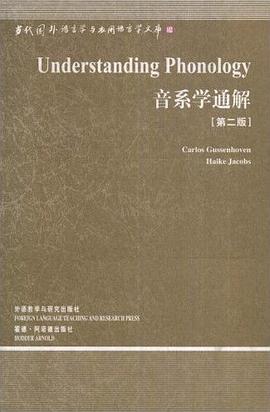
《音系学通解》是一部音系理论的教科书,这部教科介绍了以SPE(Cnomsky & Halle 1968)为代表的经典生成音系学至优选论几乎所有得要的音系学理论,讨论了音系学领域中许多热点问题,全书每一章都附的思考题和练习题,正文和红习题涉及一百多种语言的材料,作者精心安热排,突出重点,精选语言材料,行文简练,从而使一部二百多面的教科书包含了如此之多的内容。
生成音系学是当代音系学的主流,这部教产书介绍的理论,基本概念和分析方法主要取之于生成音系学的研究成果。
-------
目录
Preface
1 The production of speech
1.1 Introduction
1.2 The lungs and the larynx
1.2.1 The vocal folds: the open and vibrating glottis
1.2.2 Devoicing and aspiration
1.2.3 Special types of phonation
1.2.4 Pitch
1.2.5 The glottal stop
1.3 The vocal tract
1.3.1 The pharynx
1.3.2 The nasal cavity
1.3.3 The mouth
1.4 Vowels
1.5 Constrictions
1.5.1 Places of articulation
1.5.2 Types of constriction
1.6 Segmental duration
1.7 Complex consonants
1.7.1 Secondary articulations
1.7.2 Double articulations
1.7.3 Manner-contourconsonants
1.8 Nonpulmonic consonants
1.9 Stress
1.10Conclusion
2 Some typology: sameness and difference
2.1 Introduction
2.2 Morphosyntactic structure
2.2.1 Morphologicalstructure
2.2.2 Syntactic structure
2.3 A world without phonological structure
2.3.l One phonology for all languages?
2.3.2 Two kinds of structure
2.4 There's a difference
2.5 Universals and implicational relations
2.5.1 Plain or special?
2.5.2 Avoiding complexity
2.5.3 A word of caution
2.5.4 Speech ergonomics
2.5.5 System gaps
2.6 Conclusion
3 Making the form fit
3.1 Introduction
3.2 Hawaiian
3.3 Adjustment processes
3.3.1 The process of nativization
3.3.2 Adjustments in the native vocabulary
3.4 Two approaches
3.4.1 Rules
3.4.2 Constraints
3.5 Choosing between rules and constraints
3.5.1 Gradient violation and unranked constraints
3.6 Conclusion
4 Underlying and surface representations
4.1 Introduction
4.2 Allophonic variation
4.3 Two levels of representation
4.4 Neutralization
4.5 Choosing the underlying form
4.6 Conclusion
5 Distinctive features
5.1 Introduction
5.2 Motivating distinctive features
5.3 Feature values
5.4 A set of distinctive features
5.4.1 Major-class features
5.4.2 Laryngeal features
5.4.3 Manner features
5.4.4 Ambiguity and nonspecification
5.5 Place features
5.5.1 Labial
5.5.2. Coronal
5.5.3 Dorsal
5.5.4 Radical
5.6 Some examties
5.7 Redundant vS contrastire features
5.8 Conclusion
6 0rdered rules
6.1 Introduction
6.2 SPE representations
6.3SPE rules
6.3.1 Refefence to the syllable
6.3.2 The brace
6.3.3 Variable feature values
6.3.4 Parentheses
6.3.5 The transformationaI rule format
6.4 Linear order
6.5 Extrinsic and intrinsic ordering
6.6 Feeding,counterfeeding,bleeding,counterbleeding
6.6.1 Feeding order
6.6.2 Counterfeeding order
6.6.3 Bleeding order
6.6.4 Counterbleeding order
6.7 Opacity
6.8 Conclusion
7 A case study:the diminutive suffix i11 Dutch
7.1 Introduction
7.2 General Dutch rules
7.2.1 Final devoicing
7.2.2 Palatalization
7.2.3 Degemination
7.3 Standard Dutch
7.4 The dialect of Sittard
7.5 Conclusion
8 Levels of representation
8.1 Introduction
8.2 Defining an intermediate level of representation
8.3 Lexical Phonology
8.3.1 Reference to morphological labels
8.3.2 Exceptions
8.3.3 Structure preservation
8.3.4 Natire.speaker intuitions
8.3.5 ADplication across WOrd boundaries
8.3.6 Lexical rules apply before postlexical rules
8.4 Phonological information in the lexicon
8.5 Controversial properties of lexical rules
8.6 Beyond the surface representation
8.6.1 Phonetic implementation
8.6.2 Models of implementation
8.6.3 Deciding between phonology andphonetic implementation
8.7 Conclusion
9 Representing tone
9.1 Introduction
9.2 The inadequacy of a linear model
9.3 W.0rd.based tone patterns
9.3.1 Language-specific associations
9.4 Stability
9.5 Postlexical tone
9.6 The Obligatory Contour Principle
9.6.1 Violating the OCP
9.7 Conclusion
10 Between the segment and the syllable
10.1 Introduction
10.2 A skeletaI tier
10.3 Syllabification:the Maximum Onset Principle
10.3.1 The sonority profile
10.4 Arguments for the CV tier
10.4.1 The templatic use of the CV tier
10.4.2 Unfilled and unassociated slots
10.4.3 Compensatory lengthening
10.5 Moras
10.6 svllable-based generalizations
10.7 Post-MOP syllabification rules
10.7.1 Ambisyllabicity in English
10.8 Conclusion
11 Feature geometry
11.1 Introduction
11.2 Tw0 properties ofassimilations
11.3 Natural feature classes
11.4 Buildingatree
11.4.1 The place node
11.4.2 The laryngeal node
11.413 The supralaryngeal node
11.5 Spreading and delinking
11.5.1 Writing rules
11.6 Implications OfundersDecification
11.6.1 Default rules
11.7 Condusion
12 Exploiting the feature tree
13 Stress and feet
14 Further constraining stress
15 Phonology above the word
Epilogue
Key to questions
References
Language index
Subject index
作者简介
目录信息
1 The production of speech
1.1 Introduction
1.2 The lungs and the larynx
1.2.1 The vocal folds: the open and vibrating glottis
1.2.2 Devoicing and aspiration
1.2.3 Special types of phonation
1.2.4 Pitch
1.2.5 The glottal stop
1.3 The vocal tract
1.3.1 The pharynx
1.3.2 The nasal cavity
1.3.3 The mouth
1.4 Vowels
1.5 Constrictions
1.5.1 Places of articulation
1.5.2 Types of constriction
1.6 Segmental duration
1.7 Complex consonants
1.7.1 Secondary articulations
1.7.2 Double articulations
1.7.3 Manner-contourconsonants
1.8 Nonpulmonic consonants
1.9 Stress
1.10Conclusion
2 Some typology: sameness and difference
2.1 Introduction
2.2 Morphosyntactic structure
2.2.1 Morphologicalstructure
2.2.2 Syntactic structure
2.3 A world without phonological structure
2.3.l One phonology for all languages?
2.3.2 Two kinds of structure
2.4 There's a difference
2.5 Universals and implicational relations
2.5.1 Plain or special?
2.5.2 Avoiding complexity
2.5.3 A word of caution
2.5.4 Speech ergonomics
2.5.5 System gaps
2.6 Conclusion
3 Making the form fit
3.1 Introduction
3.2 Hawaiian
3.3 Adjustment processes
3.3.1 The process of nativization
3.3.2 Adjustments in the native vocabulary
3.4 Two approaches
3.4.1 Rules
3.4.2 Constraints
3.5 Choosing between rules and constraints
3.5.1 Gradient violation and unranked constraints
3.6 Conclusion
4 Underlying and surface representations
4.1 Introduction
4.2 Allophonic variation
4.3 Two levels of representation
4.4 Neutralization
4.5 Choosing the underlying form
4.6 Conclusion
5 Distinctive features
5.1 Introduction
5.2 Motivating distinctive features
5.3 Feature values
5.4 A set of distinctive features
5.4.1 Major-class features
5.4.2 Laryngeal features
5.4.3 Manner features
5.4.4 Ambiguity and nonspecification
5.5 Place features
5.5.1 Labial
5.5.2. Coronal
5.5.3 Dorsal
5.5.4 Radical
5.6 Some examties
5.7 Redundant vS contrastire features
5.8 Conclusion
6 0rdered rules
6.1 Introduction
6.2 SPE representations
6.3SPE rules
6.3.1 Refefence to the syllable
6.3.2 The brace
6.3.3 Variable feature values
6.3.4 Parentheses
6.3.5 The transformationaI rule format
6.4 Linear order
6.5 Extrinsic and intrinsic ordering
6.6 Feeding,counterfeeding,bleeding,counterbleeding
6.6.1 Feeding order
6.6.2 Counterfeeding order
6.6.3 Bleeding order
6.6.4 Counterbleeding order
6.7 Opacity
6.8 Conclusion
7 A case study:the diminutive suffix i11 Dutch
7.1 Introduction
7.2 General Dutch rules
7.2.1 Final devoicing
7.2.2 Palatalization
7.2.3 Degemination
7.3 Standard Dutch
7.4 The dialect of Sittard
7.5 Conclusion
8 Levels of representation
8.1 Introduction
8.2 Defining an intermediate level of representation
8.3 Lexical Phonology
8.3.1 Reference to morphological labels
8.3.2 Exceptions
8.3.3 Structure preservation
8.3.4 Natire.speaker intuitions
8.3.5 ADplication across WOrd boundaries
8.3.6 Lexical rules apply before postlexical rules
8.4 Phonological information in the lexicon
8.5 Controversial properties of lexical rules
8.6 Beyond the surface representation
8.6.1 Phonetic implementation
8.6.2 Models of implementation
8.6.3 Deciding between phonology andphonetic implementation
8.7 Conclusion
9 Representing tone
9.1 Introduction
9.2 The inadequacy of a linear model
9.3 W.0rd.based tone patterns
9.3.1 Language-specific associations
9.4 Stability
9.5 Postlexical tone
9.6 The Obligatory Contour Principle
9.6.1 Violating the OCP
9.7 Conclusion
10 Between the segment and the syllable
10.1 Introduction
10.2 A skeletaI tier
10.3 Syllabification:the Maximum Onset Principle
10.3.1 The sonority profile
10.4 Arguments for the CV tier
10.4.1 The templatic use of the CV tier
10.4.2 Unfilled and unassociated slots
10.4.3 Compensatory lengthening
10.5 Moras
10.6 svllable-based generalizations
10.7 Post-MOP syllabification rules
10.7.1 Ambisyllabicity in English
10.8 Conclusion
11 Feature geometry
11.1 Introduction
11.2 Tw0 properties ofassimilations
11.3 Natural feature classes
11.4 Buildingatree
11.4.1 The place node
11.4.2 The laryngeal node
11.413 The supralaryngeal node
11.5 Spreading and delinking
11.5.1 Writing rules
11.6 Implications OfundersDecification
11.6.1 Default rules
11.7 Condusion
12 Exploiting the feature tree
13 Stress and feet
14 Further constraining stress
15 Phonology above the word
Epilogue
Key to questions
References
Language index
Subject index
· · · · · · (收起)
读后感
评分
评分
评分
评分
用户评价
这本书的独特之处在于其对历史脉络的梳理和对未来趋势的预判,展现出一种超越时代的视野。作者没有沉溺于对既有范式的简单复述,而是着力于挖掘现象背后的深层动因和演变轨迹。阅读过程中,我仿佛跟随作者的笔触,穿越了数个关键的历史节点,清晰地看到了某些理论是如何在特定社会文化背景下孕育、发展,最终又如何被新的思潮所挑战和取代。这种时间维度上的纵深感,使得整本书的论述具有了强大的说服力。更难能可贵的是,作者在展望未来时,并没有流于空泛的臆测,而是基于扎实的现状分析,提出了几个极具建设性和可操作性的思考方向。对于那些希望将所学知识应用于实际研究或行业前沿的人来说,这本书无疑提供了一份极富前瞻性的路线图。它不仅是知识的记录者,更是思想的催化剂。
评分这本书拿到手,光是封面设计就让人眼前一亮,那种简约中带着一丝古朴的气质,很对我的胃口。内页的排版也做得相当用心,字体大小和行间距都恰到好处,长时间阅读也不会感到疲劳。我尤其欣赏作者在行文风格上展现出的那种娓娓道来的叙事感,仿佛不是在读一本严肃的学术著作,而是在聆听一位智者对某一领域进行深入浅出的讲解。书中对于理论的阐述逻辑性极强,层层递进,即使是初次接触这个主题的人,也能循着作者的思路,逐步建立起完整的认知框架。那种感觉就像是作者为你搭建了一座坚实的知识阶梯,让你能稳稳当当地登上高处,俯瞰全局。而且,书中的例子选择得非常巧妙,既有宏观的理论支撑,又不乏微观的生动实例,让抽象的概念变得具体可感,极大地提升了阅读的趣味性和理解的深度。总而言之,从装帧到内容呈现,这本书都体现出一种对读者的尊重和对知识的敬畏,让人爱不释手,非常值得细细品味。
评分这本书的实用价值和启发性超乎我的想象。我原本以为它会是一本纯粹的理论大全,但实际上,作者巧妙地将理论框架与实际应用场景紧密结合起来。书中对不同案例的剖析,极其细致入微,不仅展示了“是什么”,更深入挖掘了“为什么会是这样”,并进一步探讨了“我们能从中得到什么”。这种从现象到本质,再回归到实践指导的完整闭环,使得书中的知识不再是空中楼阁,而是可以立刻在脑海中进行“模拟操作”的工具箱。对于我们这些致力于将学术成果转化为实际影响力的学习者而言,这种“知行合一”的写作方式,是最高级的教学范式。它不仅丰富了我的理论储备,更重要的是,它极大地优化了我的问题解决思路,让我看待和分析问题的方式都有了质的飞跃。
评分我必须强调这本书在语言运用上的精妙,这对于一本技术性较强的著作来说,实属难得。作者的文字功力极高,行文流畅自然,即便是一些涉及高度专业化的术语和复杂的结构关系,也能通过精巧的句子结构和恰当的比喻,变得易于理解和记忆。书中不时出现的那些精炼的总结性段落,简直可以作为范本摘录下来,它们如同灯塔一般,在我迷失于繁复的细节时,立刻将我拉回到核心的论点之上。更令人欣赏的是,作者的语气始终保持着一种温和而坚定的学者风范,没有丝毫的傲慢或故作高深,让人在学习知识的同时,也感受到了作者的谦逊和风度。这使得阅读过程变成了一种愉快的“对话”,而不是单向的灌输,极大地提升了阅读的粘性和效率。
评分阅读体验可以用“震撼”来形容,这绝不是一本泛泛而谈的入门读物,它直击核心,展现了作者深厚的学术功底和敏锐的洞察力。作者在梳理复杂概念时,那种干净利落的笔法,让人拍案叫绝。很多我原本认为已经“定论”的概念,在书中被重新审视和剖析,提供了一种全新的、更具批判性的视角。特别是在处理那些跨学科的交叉点时,作者的融会贯通能力令人叹服,他总能精准地找到不同理论之间的共鸣与张力,将原本看似孤立的知识点串联成一张密不透风的知识网。我特别喜欢书中那些充满思辨性的讨论,它不直接给出标准答案,而是引导读者去思考“为什么”和“如何才能更好”,这种开放式的探讨,极大地激发了我主动探索的欲望。读完一部分,我甚至需要停下来,消化一下那种思想的冲击,反复回味那些精辟的论断,感觉自己的思维维度都被拓宽了不少。
评分天啊。。。那年考试居然还得了75分。。。谢谢。。
评分天啊。。。那年考试居然还得了75分。。。谢谢。。
评分虽然说是Understanding,但是并不是入门级的,可能是在中级左右吧。看完以后第一件事就是倒头睡觉。
评分痛苦中
评分要我老命
相关图书










本站所有内容均为互联网搜索引擎提供的公开搜索信息,本站不存储任何数据与内容,任何内容与数据均与本站无关,如有需要请联系相关搜索引擎包括但不限于百度,google,bing,sogou 等
© 2026 book.quotespace.org All Rights Reserved. 小美书屋 版权所有