

具体描述
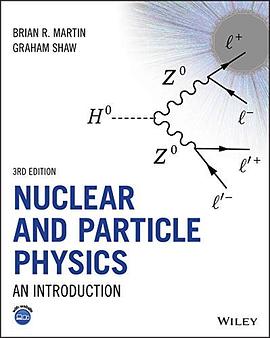
Updated and expanded edition of this well-known Physics textbook provides an excellent Undergraduate introduction to the field This new edition of Nuclear and Particle Physics continues the standards established by its predecessors, offering a comprehensive and highly readable overview of both the theoretical and experimental areas of these fields. The updated and expanded text covers a very wide range of topics in particle and nuclear physics, with an emphasis on the phenomenological approach to understanding experimental data. It is one of the few publications currently available that gives equal treatment to both fields, while remaining accessible to undergraduates. Early chapters cover basic concepts of nuclear and particle physics, before describing their respective phenomenologies and experimental methods. Later chapters interpret data through models and theories, such as the standard model of particle physics, and the liquid drop and shell models of nuclear physics, and also discuss many applications of both fields. The concluding two chapters deal with practical applications and outstanding issues, including extensions to the standard model, implications for particle astrophysics, improvements in medical imaging, and prospects for power production. There are a number of useful appendices. Other notable features include: New or expanded coverage of developments in relevant fields, such as the discovery of the Higgs boson, recent results in neutrino physics, research to test theories beyond the standard model (such as supersymmetry), and important technical advances, such as Penning traps used for high-precision measurements of nuclear masses. Practice problems at the end of chapters (excluding the last chapter) with solutions to selected problems provided in an appendix, as well as an extensive list of references for further reading. Companion website with solutions (odd-numbered problems for students, all problems for instructors), PowerPoint lecture slides, and other resources. As with previous editions, the balanced coverage and additional resources provided, makes Nuclear and Particle Physics an excellent foundation for advanced undergraduate courses, or a valuable general reference text for early graduate studies.
作者简介
BRIAN R. MARTIN and GRAHAM SHAW have researched and taught for many years in the Physics and Astronomy departments at University College London and the University of Manchester, respectively. Prior to that they have held positions at various institutes, including Brookhaven National Laboratory and Niels Bohr Institute (Martin), Columbia University and Rutherford Laboratory (Shaw). They have previously collaborated on other successful textbooks, including Particle Physics (4th edn. 2017) and Mathematics for Physicists (2015), both published by Wiley. Brian has also published books on statistics and a Beginner's Guide to Particle Physics, while Graham is the co-author with Franz Mandl of the well-known postgraduate text, Quantum Field Theory (2nd. edn. 2010), also published by Wiley.
目录信息
读后感
评分
评分
评分
评分
用户评价
对于那些已经有一定基础,但希望能够更系统化地梳理和深化自己对核物理和粒子物理交叉领域理解的读者来说,这本书无疑是上佳的选择。它的难度设置恰到好处,既能满足专业学习的需求,又不会让非专业背景的爱好者望而却步。书中关于核结构模型的介绍,例如壳层模型和集体模型之间的联系与区别,阐述得极其精妙,清晰地勾勒出了不同模型在描述原子核不同行为时的适用范围。更值得称赞的是,作者在讲解中非常注重理论的普适性,很多在粒子物理中使用的工具和概念,如群论的应用,在核结构中也得到了充分体现,这极大地帮助我建立了跨领域的知识联系,打破了学科壁垒。我强烈推荐给研究生阶段需要进行跨学科研究的同仁们。
评分这本书在排版和术语的使用上体现出一种老派的专业和尊重。纸张的质感,字体选择,乃至公式的对齐方式,都透露出一种沉稳可靠的气息。它不像某些现代出版物那样追求花哨的设计,而是将所有精力都投入到了内容的准确性和逻辑的流畅性上。每一个术语的引入都伴随着明确的定义和必要的背景介绍,这对于需要精准理解的物理学文本来说至关重要。我发现,当我需要快速定位某个特定公式或概念时,书后的索引做得非常详尽,查找效率极高。这种对细节的关注,反映了作者和出版方对科学严谨性的不懈追求,使得这本书真正成为了可以被长期参考和依赖的工具书,而不是读完一遍就束之高阁的快餐读物。
评分我特别欣赏作者在处理实验物理部分时的那种平衡感。它没有陷入到对特定实验设备细节的过度描述中,而是着重于介绍“为什么”要进行这些实验,以及如何从实验结果中提炼出新的物理知识。比如,在讲述夸克模型的建立过程中,作者巧妙地将早期的散射实验数据和后来的高能对撞机结果串联起来,清晰地展示了理论是如何被实验不断修正和强化的过程。这对我来说非常受用,因为我一直认为物理学的魅力就在于理论和实验之间那种永无止境的对话。书中的图表质量极高,清晰地标明了能量尺度、粒子截面等关键信息,即使是那些复杂的探测器原理,也被简化到了最核心的功能层面,非常适合在快速阅读和回顾时使用。它成功地避开了“技术手册”的陷阱,始终保持着对核心物理洞察力的关注。
评分这本书简直是一本知识的宝库,尤其是它在讲解理论物理基础时的那种严谨和深入,真的让人印象深刻。我记得有一次我卡在一个关于量子场论的推导上,市面上很多教材要么过于晦涩,要么就一带而过,但这本书却非常耐心地,一步一步地展示了每一步背后的物理图像和数学推导。作者显然非常清楚初学者在面对这些抽象概念时会遇到的难点,所以他们设计了大量的插图和类比,把那些原本抽象得让人摸不着头脑的波函数、拉格朗日量,一下子变得具体可感。读完关于对称性和守恒定律那几章后,我感觉自己对整个粒子物理学的框架都有了一个全新的、更深刻的理解,不再只是死记硬背公式,而是真正领悟了支配微观世界的那些基本法则。对于任何想严肃对待这门学科,并希望未来能进行更深入研究的人来说,这本书提供的坚实基础是无可替代的。
评分这本书的叙事节奏感把握得非常好,读起来一点都不枯燥,反而有一种史诗般的展开感。从卢瑟福的原子核发现,到标准模型的建立,再到对中微子质量的探索,作者仿佛带着我们进行了一场穿越时空的科学探险。我尤其喜欢它在介绍那些“未解之谜”时的笔触,那种既肯定现有成就又充满对未知敬畏的态度,非常能激发读者的好奇心。它没有把标准模型描绘成一个终极真理,而是把它放在一个动态发展的历史背景下审视。这种处理方式,让读者在学习具体知识点的同时,也能感受到物理学作为一门不断进步的科学的活力。我常常在读完一章后,会停下来思考:“下一个重大突破会是什么?”这种强烈的代入感,是很多教科书所欠缺的。
评分有量子力学基础的看这个入门粒子物理正合适
评分有量子力学基础的看这个入门粒子物理正合适
评分有量子力学基础的看这个入门粒子物理正合适
评分有量子力学基础的看这个入门粒子物理正合适
评分有量子力学基础的看这个入门粒子物理正合适
相关图书








本站所有内容均为互联网搜索引擎提供的公开搜索信息,本站不存储任何数据与内容,任何内容与数据均与本站无关,如有需要请联系相关搜索引擎包括但不限于百度,google,bing,sogou 等
© 2026 book.quotespace.org All Rights Reserved. 小美书屋 版权所有