
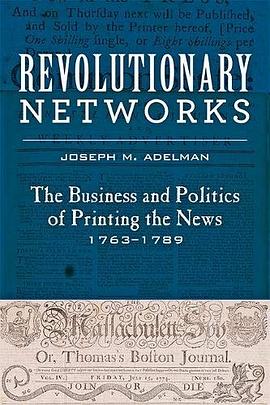

具体描述
During the American Revolution, printed material, including newspapers, pamphlets, almanacs, and broadsides, played a crucial role as a forum for public debate. In Revolutionary Networks, Joseph M. Adelman argues that printers—artisans who mingled with the elite but labored in a manual trade—used their commercial and political connections to directly shape Revolutionary political ideology and mass mobilization. Going into the printing offices of colonial America to explore how these documents were produced, Adelman shows how printers balanced their own political beliefs and interests alongside the commercial interests of their businesses, the customs of the printing trade, and the prevailing mood of their communities.
Adelman describes how these laborers repackaged oral and manuscript compositions into printed works through which political news and opinion circulated. Drawing on a database of 756 printers active during the Revolutionary era, along with a rich collection of archival and printed sources, Adelman surveys printers' editorial strategies. Moving chronologically through the era of the American Revolution and to the war's aftermath, he details the development of the networks of printers and explains how they contributed to the process of creating first a revolution and then the new nation.
By underscoring the important and intertwined roles of commercial and political interests in the development of revolutionary rhetoric, this book essentially reframes our understanding of the American Revolution. Printers, Adelman argues, played a major role as mediators who determined what rhetoric to amplify and where to circulate it. Offering a unique perspective on the American Revolution and early American print culture, Revolutionary Networks reveals how these men and women managed political upheaval through a commercial lens.
作者简介
Joseph M. Adelman is an assistant professor of history at Framingham State University.
目录信息
1. The Business and Economic World of the Late Colonial Printing Trade
2. A Trade under Threat: Printers and the Stamp Act Crisis
3. The Business of Protest: Printing against Empire
4. The Collision of Business and Politics, 1774-1775
5. Patriots, Loyalists, and the Perils of Wartime Printing
6. Rebuilding Print Networks for the New Nation
Conclusion
Notes
Essay on Sources
Index
· · · · · · (收起)
读后感
评分
评分
评分
评分
用户评价
这本书的语言风格,用“华丽”来形容或许有些平庸,它更像是一种精心打磨过的、带有古典韵味的现代白话,充满了对精确措辞的执着。我注意到作者在描述宏大场景时,会不自觉地运用一种近乎诗歌化的排比句式,这使得原本可能枯燥的论述变得赏心悦目。更令人称奇的是,作者在构建人物对话时,那种对不同阶层、不同地域口音的模仿与提炼,达到了出神入化的地步,使得每一个角色的声音都独树一帜,栩栩如生。我甚至可以想象出他们说话时的神态和微表情。这种对语言细节的极致追求,让阅读过程变成了一种对美学享受的不断捕捉,仿佛在欣赏一部由文字构建的立体声交响乐,层次分明,错落有致。
评分这本书的作者对于细节的考据功力,绝对是令人叹服的。我特别关注到书中对于特定历史场景中物质文化的描绘,比如某一时期特有的服饰面料、室内陈设的摆放习惯,甚至是一顿寻常饭菜的配料细节,都处理得无可挑剔。这种对“真实感”的执着,不仅仅停留在宏大的政治事件上,而是深入到了微观的、日常生活的层面。这种扎实的基石确保了即便在叙事走向最超现实或最具争议性的部分时,读者仍然能牢牢地抓住脚下的土地,不会感到文本飘忽不定。这种对底层细节的敬畏,最终铸就了整部作品无可辩驳的权威性和说服力,让人对作者的研究投入感到由衷的钦佩。
评分我读这本书时,最直观的感受是它强烈的思辨色彩。它不像是一本平铺直叙的作品,更像是一场与作者跨越时空的哲学辩论会。作者似乎并不满足于提供标准答案,而是热衷于抛出那些让人夜不能寐的悖论和困境,迫使读者亲自去寻找证据,去构建自己的逻辑链条。尤其是关于“集体意志”如何被少数精英操纵的章节,其论证过程之严密,逻辑推演之环环相扣,让人在感到被说服的同时,又生出几分深刻的怀疑与反思。这种鼓励读者主动参与构建意义的写作手法,极大地提升了阅读的深度和持久性,读完之后,它留下的不是一个结论,而是一系列需要持续探索的开放性问题。
评分这本书的叙事结构简直是一场智力上的探险,作者似乎深谙如何将晦涩的理论包裹在引人入胜的故事线中。我特别欣赏作者对于历史节点把握的精准度,那种对关键转折点细腻入微的描摹,让人仿佛亲身经历了那些风云变幻的时代。书中对人际关系复杂性的探讨,尤其是那些在权力斗争中微妙平衡的刻画,展现了作者超越一般历史记述者的洞察力。它不仅仅是在记录事件,更是在解剖驱动事件背后那些深藏不露的动机和冲突。阅读过程中,我时常需要停下来,回味那些精妙的隐喻,它们像散落在文本各处的宝石,需要细心甄别才能体会其真正光芒。文字的张力把握得极好,时而如涓涓细流般沉静,时而又陡然爆发,形成强烈的阅读冲击感,这种节奏变化极大地增强了文本的沉浸体验。
评分这本书在叙事上的创新性,体现在它对时间线的处理上,简直可以称得上是颠覆性的。作者似乎故意打乱了传统的时间顺序,通过碎片化的闪回、交叉叙事,以及插入的伪档案资料,构建了一个非线性的信息迷宫。起初,这种叙事方式确实带来了一定的阅读障碍,需要读者不断地在不同的时间点之间进行跳跃和重组。然而,一旦适应了这种节奏,那种“拼图完成”的满足感是无与伦比的。它迫使我们跳出线性的因果思维,去观察事件之间那些看似无关却又暗藏关联的共振点,这种阅读体验更接近于我们大脑处理真实记忆和信息的方式——复杂、多维、充满跳跃。
评分 评分 评分 评分 评分相关图书















本站所有内容均为互联网搜索引擎提供的公开搜索信息,本站不存储任何数据与内容,任何内容与数据均与本站无关,如有需要请联系相关搜索引擎包括但不限于百度,google,bing,sogou 等
© 2026 book.quotespace.org All Rights Reserved. 小美书屋 版权所有