
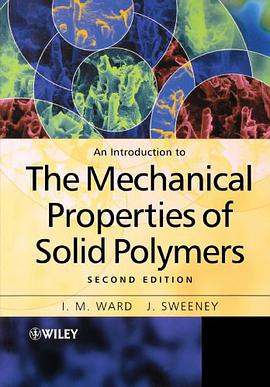
An Introduction to the Mechanical Properties of Solid Polymers pdf epub mobi txt 电子书 下载 2026
- Polymer Mechanics
- Solid State Physics
- Materials Science
- Polymer Science
- Mechanical Properties
- Engineering Materials
- Rheology
- Polymer Characterization
- Solid Mechanics
- Macromolecular Chemistry

具体描述
Provides a comprehensive introduction to the mechanical behaviour of solid polymers. Extensively revised and updated throughout, the second edition now includes new material on mechanical relaxations and anisotropy, composites modelling, non-linear viscoelasticity, yield behaviour and fracture of tough polymers. The accessible approach of the book has been retained with each chapter designed to be self contained and the theory and applications of the subject carefully introduced where appropriate. The latest developments in the field are included alongside worked examples, mathematical appendices and an extensive reference.* Fully revised and updated throughout to include all the latest developments in the field* Worked examples at the end of the chapter* An invaluable resource for students of materials science, chemistry, physics or engineering studying polymer science
作者简介
目录信息
1 Structure of Polymers 1
1.1 Chemical compostion 1
1.2 Physical structure 9
2 The Deformation of an Elastic Solid 19
2.1 The state of stress 19
2.2 The state of strain 20
2.3 The generalized Hooke’s law 24
2.4 Finite strain elasticity: the behaviour of polymers in the rubber-like state 25
3 Rubber-Like Elasticity 31
3.1 General features of rubber-like behaviour 31
3.2 The thermodynamics of deformation 33
3.3 The statistical theory 35
3.4 Modifications of the simple molecular network 43
3.5 Recent developments in the molecular theory of rubber elasticity 46
4 Principles of Linear Viscoelasticity 53
4.1 Viscoelasticity as a phenomenon 53
4.2 Mathematical representation of linear viscoelasticity 59
4.3 Dynamic mechanical measurements: the complex modulus and complex compliance 70
5 The Measurement of Viscoelastic Behaviour 79
5.1 Creep and stress relaxation 80
5.2 Dynamic mechanical measurements 83
5.3 Wave-propagation methods 88
6 Experimental Studies of Linear Viscoelastic Behaviour as a Function of Frequency and Temperature: Time-Temperature Equivalence 95
6.1 General introduction 95
6.2 Time-temperature equivalence and superpostion 101
6.3 Molecular interpretations of time-temperature equivalence 104
6.4 Flexible molecular chain models 113
7 Anisotropic Mechanical Behaviour 121
7.1 Elastic constants and polymer symmetry 121
7.2 Measuring elastic constants 125
7.3 Experimental studies of mechanical anisotropy in oriented polymers 131
7.4 Interpretation of mechanical anisotropy: general considerations 139
7.5 Experimental studies of anisotropic mechanical behaviour and their interpretation 142
7.6 The aggregate model for chain-extended polyethylene and liquid crystalline polymers 152
7.7 Auxetic materials: negative Poisson’s ratio 157
8 Polymer Composites: Macroscale and Microscale 163
8.1 Composites: a general introduction 163
8.2 Mechanical anisotropy of polymer composites 164
8.3 Short fibre composites 170
8.4 Takayanagi models for semicrystalline polymers 174
8.5 Ultrahigh-modulus polyethylene 184
8.6 Conclusions 190
9 Relaxation Transitions: Experimental Behaviour and Molecular Interpretation 193
9.1 Amorphous polymers: an introduction 193
9.2 Factors affecting the glass transition in amorphous polymers 194
9.3 Relaxation transitions in crystalline polymers 202
9.4 Conclusions 216
10 Creep, Stress Relaxation and Non-linear Viscoelasticity 219
10.1 The engineering approach 220
10.2 The rheological approach 220
10.3 Creep and stress relaxations as thermally activated processes 231
11 Yielding and Instability in Polymers 241
11.1 Discussion of load–elongation curves in tensile testing 242
11.2 Ideal plastic behaviour 250
11.3 Historical development of understanding of the yield process 258
11.4 Experimental evidence for yield criteria in polymers 261
11.5 The molecular interpretations of yield and cold-drawing 266
11.6 Cold-drawing 268
12 Breaking Phenomena 273
12.1 Definition of tough and brittle behaviour in polymers 273
12.2 Principles of brittle fracture of polymers 274
12.3 Controlled fracture in brittle polymers 280
12.4 Crazing in glassy polymers 281
12.5 The structure and formation of crazes 286
12.6 Controlled fracture in tough polymers 296
12.7 The molecular approach 307
12.8 Factors influencing brittle–ductile behaviour: brittle–ductile transitions 310
12.9 The impact strength of polymers 315
12.10 The tensile strength and tearing of polymers in the rubbery state 325
12.11 Effect of strain rate and temperature 328
12.12 Fatigue in polymers 331
Appendix 1 341
A1.1 Scalars, vectors and tensors 341
A1.2 Tensor components of stress 341
A1.3 Tensor components of strain 342
A1.4 Generalized Hooke’s law 342
A1.5 Engineering strains and matrix notation 343
A1.6 The elastic moduli of isotropic materials 345
A1.7 Transformation of tensors from one set of coordinate axes to another 347
A1.8 The Mohr circle construction 350
References 351
Appendix 2 353
A2.1 Rivlin, Mooney, Ogden 353
References 356
Answers to Problems 357
Index 377
· · · · · · (收起)
读后感
评分
评分
评分
评分
用户评价
相关图书












本站所有内容均为互联网搜索引擎提供的公开搜索信息,本站不存储任何数据与内容,任何内容与数据均与本站无关,如有需要请联系相关搜索引擎包括但不限于百度,google,bing,sogou 等
© 2026 book.quotespace.org All Rights Reserved. 小美书屋 版权所有