
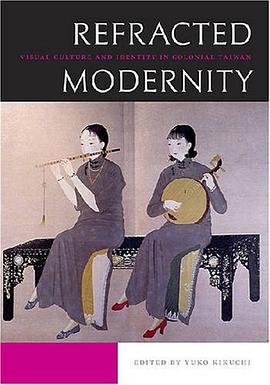

具体描述
Since the mid-1990s Taiwanese artists have been responsible for shaping much of the international contemporary art scene, yet studies on modern Taiwanese art published outside of Taiwan are scarce. The nine essays collected here present different perspectives on Taiwanese visual culture and landscape during the Japanese colonial period (1895-1945), focusing variously on travel writings, Western and Japanese/Oriental-style paintings, architecture, aboriginal material culture, and crafts. Issues addressed include the imagined Taiwan and the "discovery" of the Taiwanese landscape, which developed into the imperial ideology of nangoku (southern country); the problematic idea of "local color," which was imposed by Japanese, and its relation to the "nativism" that was embraced by Taiwanese; the gendered modernity exemplified in the representation of Chinese/Taiwanese women; and the development of Taiwanese artifacts and crafts from colonial to postcolonial times, from their discovery, estheticization, and industrialization to their commodification by both the colonizers and the colonized.The central theme of this volume is "refracted modernity"--the recursive and transferable nature of modernity--in the context of colonialism. Modernity and identity in Taiwanese visual culture emerged in the cross-cultural complexity engendered by Japanese colonization. Their formation involves a range of interdependent cultural transfers and appropriations between Europe, Japan, and Taiwan. Viewed in terms of refracted modernity, the state and product of localization/appropriation appears in an eclectic manner and is often characterized by the term "hybrid." The notion of hybridity describes the complex state that results from the continuous dissemination and translation of cultures in colonial situations, thus revising the one-dimensional historical analytical models of colonialism. The model presented in this volume instead stresses original and creative aspects and renounces the notion of imitation, a judgment often imposed by the Eurocentric view. Offering many examples of hybrid expressions that render Taiwanese visual culture unique and attractive, the case studies collectively make a strong argument for revising the traditional positioning of colonialism while offering a thought-provoking perspective on Taiwan's surge forward as a major force in contemporary art today.Refracted Modernity: Visual Culture and Identity in Colonial Taiwan will be of substantial interest to historians of Taiwan, China, and Japan; art historians of Chinese and Japanese art; and scholars of colonialism, decolonization, modernism, and modernity in general. Readers in the fields of anthropology, cultural studies, visual culture, and women's studies will find its essays timely and highly informative.
作者简介
Yuko Kikuchi is a Research Fellow in Art and Design History at the London Institute, Chelsea College of Art and Design.
目录信息
IntroductionbyYukoKikuchi 1
Part 1: Images of Taiwan and the Discovery of the Taiwanese Landscape
Naoko shimazu
Colonial Encounters: JapaneseTravelWritingonColonialTaiwan 21
Hsin-tien [xintian] liao
The Beauty of the Untamed: Exploration and Travel in Colonial Taiwanese Landscape Painting 39
Toshio Watanabe
Japanese Landscape Painting and Taiwan: Modernity,Colonialism,andNationalIdentity 67
Chuan-ying [juanying] Yen
The Demise of Oriental-style Painting inTaiwan 83
Part 2:Images by and about Women
Kaoru Kojima
The Changing Representation of Women in Modern Japanese Paintings 111
Ming-chu [mingzhu] Lai
Modernity, Power, and Gender: Images of Women by Taiwanese Female Artists under Japanese Rule 133
Part 3 : Construction of Taiwan’s Vernacular Landscape
Chao-ching [chaoqing] Fu
Taiwaneseness in Japanese Period ArchitectureinTaiwan 169
Chia-yu [jiayu] Hu
Taiwanese Aboriginal Art and Artifacts: Entangled Images of Colonization and Modernization 193
Yuko Kikuchi
Refracted Colonial Modernity: Vernacularism in the Development of Modern Taiwanese Crafts 217
Bibliography 249
Contributors 273
Index 277
· · · · · · (收起)
读后感
评分
评分
评分
评分
用户评价
这本书的封面设计真是引人注目,那种深邃的蓝色调配上抽象的几何图形,立刻抓住我的眼球。我是在一家独立书店偶然翻到它的,当时并没有对内容抱有太高的期望,只是单纯被它的视觉冲击力所吸引。翻开扉页,排版简洁而又不失艺术感,每一个章节的过渡都设计得颇具匠心。我通常比较注重书籍的阅读体验,而这本在触感和视觉上都给了我极大的满足。纸张的质感很棒,墨水的气味也恰到好处,让人有一种想要沉浸其中的冲动。虽然我还没来得及深入研读,但从装帧和设计来看,作者和出版方显然在细节上花费了大量心血。它给我的第一印象是:这是一本值得收藏的艺术品,而不仅仅是一本普通的读物。我期待着在接下来的阅读中,内容能够与这精美的外壳相匹配,带来同样深刻的体验。
评分说实话,我买这本书是有点冲动的,主要原因是我被朋友的强烈推荐所说服。他用了非常夸张的词语来形容这本书的“颠覆性”,这让我很好奇。拿到书后,我立刻去看了目录,发现主题跨度很大,涵盖了从技术伦理到文化变迁的多个领域。我对其中探讨的“碎片化生存”那一章节尤其感兴趣。我感觉现代人的生活就是被各种信息流切割得支离破碎,而这本书似乎试图去梳理这些混乱的线索。尽管阅读过程需要一定的专注度,因为作者的论证链条比较长,但我发现一旦跟上他的思路,就会有一种豁然开朗的感觉。它不是那种可以轻松读完的书,更像是一场智力上的马拉松,需要投入精力去啃食那些硬核的观点。
评分从文学性的角度来看,这本书的语言运用达到了极高的水准。尽管它处理的是相对严肃的话题,但作者的文字功底深厚,充满了精准的隐喻和极富画面感的描述。我时常会因为某一个措辞的精妙而感到惊艳,作者似乎总能找到那个最恰当的词语来捕捉一种难以言喻的现代情绪。它让我想起一些经典作家的作品,那种对语言的近乎偏执的打磨。阅读过程中,我经常会摘录一些句子,不是为了引用,而是纯粹为了欣赏其语言本身的美感。这本书不仅仅是在传递信息,更像是在进行一场关于“如何恰当地表达复杂性”的语言实验。这种对文字的尊重和深度挖掘,使得即便在理解稍有滞涩的地方,阅读的愉悦感也从未消减。
评分这本书最让我印象深刻的是它对叙事结构的创新运用。我注意到作者并没有采用传统的线性叙事或纯粹的论证结构,而是将多种文本形式巧妙地编织在一起——时而像是学术论文的严谨论述,时而又穿插着一些类似散文的感性片段,甚至还有一些看似随意的脚注,每一个都可能隐藏着重要的线索。这种多层次的文本编排,使得阅读本身也变成了一种“解码”的过程。我常常需要停下来,回溯前文,思考这些看似不连贯的部分是如何在一个更大的框架下相互呼应的。这种对阅读体验的挑战性,反而成了吸引我的一个重要因素。它迫使读者放下被动接受信息的习惯,转而积极地参与到意义的构建之中。
评分我最近对非虚构类作品特别感兴趣,尤其是那些探讨社会现象与哲学思辨的著作。这本书的标题虽然有些晦涩,但其内在的引人入胜之处在于它似乎触及了一些当代社会中被忽视的、微妙的张力。我注意到书中的论述风格非常冷静且富有逻辑性,它不像某些流行的社科读物那样急于给出结论,而是更倾向于引导读者去观察、去质疑。我特别喜欢那种抽丝剥茧的分析方法,作者似乎总能从一个看似无关紧要的细节入手,最终揭示出宏大的结构性问题。尽管我还没有读完,但它已经成功地在我脑海中种下了一些关于“既有模式”的反思种子。这种缓慢而深刻的启迪过程,正是我阅读这类书籍所追求的——不是被告知答案,而是学会如何提问。
评分 评分 评分 评分 评分相关图书







本站所有内容均为互联网搜索引擎提供的公开搜索信息,本站不存储任何数据与内容,任何内容与数据均与本站无关,如有需要请联系相关搜索引擎包括但不限于百度,google,bing,sogou 等
© 2026 book.quotespace.org All Rights Reserved. 小美书屋 版权所有