
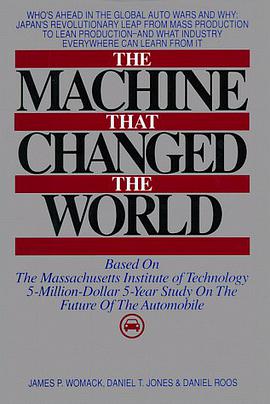

具體描述
Today, the industrial world is experiencing the most revolutionary change since Henry Ford's assembly line -- which forever changed the way things are made. Japanese companies are sweeping the world, as Western companies and governments struggle to find ways to emulate them. The Machine That Changed the World points for the first time to a positive way out of this dilemma. It shows that being defeatist about the Japanese threat, and tougher protectionism, are not the answers. This book outlines the enormous tasks facing Western companies in the 1990s and has cogent messages for Japanese firms as well, as they move abroad. The Machine That Changed the World is based on the largest and most thorough study ever undertaken in any industry: the Massachusetts Institute of Technology five-million-dollar, five-year, fourteen-country International Motor Vehicle Program's study of the worldwide auto industry. Twice in this century the auto industry has changed our most fundamental ideas about how to make things. Now it is doing it again. Just as mass production swept away craft production, so a new way of making things, called lean production, is now rapidly making mass production obsolete. Lean production is the Japanese secret weapon in the industrial wars and is spreading throughout the world. If Western companies and their managers and workers are to survive in the 1990s, they must learn and adapt to lean production. Some of the smartest already have begun to do so. Lean production welds the activities of everyone from top management to line workers, to suppliers, into a tightly integrated whole that can respond almost instantly to marketing demands from consumers. It can also double production and quality, while keeping costs down. Its adoption, as it inevitably spreads beyond the auto industry, will change almost every industry and consequently how we work, how we live, and the fate of companies and nations as they respond to its impact. In clear and compelling terms, this book explains what lean production is, and its global implications for all of us.
著者簡介
詹姆斯 P. 沃麥剋
James P. Womack
曾為美國麻省理工學院資深教授,為企業提供精益谘詢,也嚮小型製造廠投資。他創辦瞭精益企業研究所(LEI)並擔任所長,這傢研究所是一個非營利教育和研究機構,緻力於精益思想的傳播和應用。
丹尼爾 T. 瓊斯
Daniel T. Jones
創辦瞭英國精益企業研究院(LEA)並擔任院長。這傢研究院分擔瞭精益企業研究所在提升精益意識方麵的任務,並將精益知識應用於一係列的行業。
丹尼爾·魯斯
Daniel Roos
美國麻省理工學院機械係係統分部創始人,日本鋼鐵工業工程教授。
圖書目錄
讀後感
仔细读了这本书,太赞了!! 1. 研究分析方法值得学习:这是一个学术研究的交付物,整个研究过程中方向选择,落实方法都值得学习; 2. 观点到现在也不落后:说到底,大规模生产和精益的核心差别之一在于共生集团内部各方如何对待其他共生集团内部的成员,是建立在互不信任,...
評分仔细读了这本书,太赞了!! 1. 研究分析方法值得学习:这是一个学术研究的交付物,整个研究过程中方向选择,落实方法都值得学习; 2. 观点到现在也不落后:说到底,大规模生产和精益的核心差别之一在于共生集团内部各方如何对待其他共生集团内部的成员,是建立在互不信任,...
評分 評分1984年秋,詹姆斯·P·沃麦克和丹尼尔·琼斯等人在结束一次国际会议后宣布他们出版了一本新书《汽车的未来》,该书讨论了世界汽车工业所面临的诸多问题,他们认为,在经济衰退的情况下,日本的丰田生产方式对欧美国家的大批量生产方式必然有所冲击,为了防止这一事态的发生,...
評分穷则变,变则通。当年日本穷的只剩下人了。于是发明了精益制造,发挥了人的最大潜力。精益制造,其实是日本精神放在了制造里面。同样大量制造是很美国的模式。 有两点想记下来,一是反省的力量,五个为什么,也是精益的核心之一 二是,我觉得制造的过程和烧菜是一样的 丰田是...
用戶評價
相關圖書









本站所有內容均為互聯網搜索引擎提供的公開搜索信息,本站不存儲任何數據與內容,任何內容與數據均與本站無關,如有需要請聯繫相關搜索引擎包括但不限於百度,google,bing,sogou 等
© 2025 book.quotespace.org All Rights Reserved. 小美書屋 版权所有