
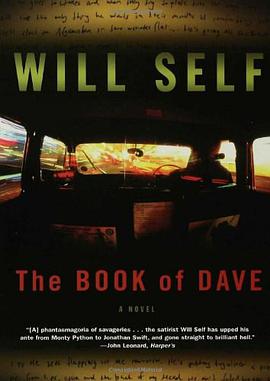

具体描述
When East End cabdriver Dave Rudman's wife takes from him his only son, Dave pens a gripping text--a compilation about everything from the environment, Arabs, and American tourists to sex, Prozac, and cabby lore--that captures all of his frustrations and anxieties about his contemporary world. Dave buries the book in his ex-wife's Hampstead backyard, intending it for his son, Carl, when he comes of age. Five hundred years later, Dave's book is found by the inhabitants of Ham, a primitive archipelago in post-apocalyptic London, where it becomes a sacred text of biblical proportions and the template for a new civilization. Only one islander, Symum, remains incredulous. But, after he is imprisoned for heresy, his son Carl must journey through the Forbidden Zone and into the terrifying heart of New London to find the only thing that will reveal the truth once and for all: a second Book of Dave that repudiates the first. "The Book of Dave" is a profound meditation upon the nature of religion and a caustic satire of contemporary life. Will Self is the acclaimed author of such books as "The Quantity Theory of Insanity," "Great Apes, "and "How the Dead Live. "He won the Geoffrey Faber Memorial Prize and was shortlisted for the Whitbread Book of the Year. Will Self lives in London. When cabdriver Dave Rudman's wife of five years deserts him for another man, taking their only child with her, he is thrown into a tailspin of doubt and discontent. Fearing his son will never know his father, Dave pens a gripping text--part memoir, part deranged philosophical treatise, and part handbook of "the Knowledge" learned by all London cab drivers. Meant for the boy when he comes of age, the book captures the frustration and anxiety of modern life. Five hundred years later, the "Book of Dave "is discovered by the inhabitants on the island of Ham, where it becomes a sacred text of biblical proportion, and its author is revered as a mighty prophet. "The first 90 pages of this book read like a cross between 'Jabberwocky' and "A Clockwork Orange." It's a devilishly catchy argot and once readers sink into it, they will find themselves wondering if the characters are traveling norf or souf . . . Like Martin Amis, with whom he's often compared, Self marries his verbal acrobatics to social critique, gamely taking on corporate culture, family law, London urban sprawl, religion, racial division and the received wisdom of women's magazines and the pub . . . You're left with the intoxication of Self's wordplay and the clarity of his visions."--Regina Marler, "Los Angeles Times""" "Fans of Self's previous edgy satires won't be disappointed with "The Book of Dave," his latest riff on the strange complexities of the modern world. Balancing stories of pained intimacies between fathers and sons, it also brilliantly caricatures the fervor of literal-minded religious fundamentalism . . . Blisteringly astute."--Geoffrey Bateman, "Rocky Mountain News ""In this tale of an embittered taxi-driver whose psychotic rantings become the creed of a blighted people hundreds of years after his death, Self unleashes his apparently boundless misanthropy on modern London, the origins of religion, and the postapocalyptic future. Dave Rudman, driven mad by divorce and ill-prescribed antidepressants, thinks he is God and writes a vitriolic screed, which he has printed on metal plates and buries in a garden. Discovered by the survivors of a catastrophic flood and adopted as a gospel, it demands the complete separation of mothers and fathers (children to spend exactly half the week with each). Switching between a narrative of Dave's unlucky life and the phonetically rendered 'Mokni' speech of his wretched followers, Self achieves an elaborate vision of vicious superstition and hopeless struggle, but his insights never quite repay the effort of engaging with his stylistic pyrotechnics."--"The New Yorker" "In "The Book of Dave," his satiric masterpiece thus far, Self proves again that with talent like his, it's never the what, but the how . . . Though his invention (often via inversion) of a future language owes an obvious debt to Russell Hoban's "Riddley Walker," Anthony Burgess's "A Clockwork Orange," and Orwell, Self spins his own brilliantly macaronic web between Now and Later . . . Self's inventiveness and control are dazzling . . . Self's novel achieves depth not by skewering organized religion, though it does so quite adroitly, but by exploring the many grids of modern despair, how we find ourselves cast adrift, and how, much like Dave, whose loneliness is unabated by the 'hateful company of his own kind, ' we fester unseen . . . A gripping, funny, and pleasurably intricate novel."--Sam Lipsyte, "Bookforum ""This searing satire maps the unraveling of London cabbie Dave Rudman's life--and the resulting "Book of Dave" he prints on metal pages and buries in his former backyard after his ex-wife cuts off visitations with his son. Meanwhile, sometime in the twenty-sixth century or beyond (dating of the period is pegged to 'the purported discovery of "The Book of Dave'"), England has entered a second Dark Age; the country, now called Ing, is broken apart by rising seas and spiritually bankrupted by the twisted teachings of Dave, which mix mad misogynistic dictates with the legendary knowledge of London streets ('the runs and the points') that the city's cabdrivers must internalize. On the former heights of Hampstead, now known as the isle of Ham, villagers live side by side with the gentle motos--walruslike creatures who talk like lisping human children, products of twenty-first-century genetic engineering. As present-day Rudman slowly reclaims his life, the future sons of Ham seek out Dave's rumored second book--the one recanting his earlier ravings and giving mummies and daddies permission to love each other again. But as Dave's ex prophetically muses, 'everyday life was made up of a series of small botched actions, which, althou
作者简介
目录信息
读后感
评分
评分
评分
评分
用户评价
我必须承认,这本书的开篇处理得相当大胆,它没有采用传统的“钩子”手法来迅速抓住读者的注意力,而是以一种近乎散文诗的笔调,缓慢地引入这个世界,甚至在前几十页里,事件的推进速度可以说是极其缓慢的。这对于追求即时爽感的读者来说,或许是一种挑战。但正是这种慢,为后续的爆发蓄积了足够的力量。作者似乎在用时间换取深度,他耐心地铺陈人物的日常、他们的习惯、他们面对世界的惯性反应,使得当我们真正面对冲突时,一切显得如此真实可信。书中对于某些特定职业或社会现象的描摹,细节翔实到令人惊叹,我猜想作者一定做了极其深入的田野调查,这使得那些非虚构的片段穿插进来时,毫无违和感,反而增强了故事的“质感”。这种扎实的功底,让整本书的骨架异常强健。我特别留意到作者是如何处理情绪的宣泄点的,它们总是被安排在最意想不到的时刻,不是通过大喊大叫,而是通过一个微小的动作——比如颤抖的手指,或者不自觉的重复某个习惯性的小动作——将巨大的情感张力瞬间释放出来,这种“克制之美”,是这本书最引人入胜之处之一。
评分说实话,我一开始拿到这本书时,对它的期待值并不算太高,毕竟市场上同类题材的作品太多了,总觉得难有出新意。然而,这本书彻底颠覆了我的固有印象。它的叙事视角非常灵活,时而宏大叙事,展现出一幅波澜壮阔的时代画卷,将个体命运置于历史洪流之中进行审视;时而又陡然拉近,聚焦于某一个角色最微不足道的日常琐事,那种对“小”的关注,反而折射出“大”的无奈与真实。作者在构建世界观方面展现了惊人的想象力和严谨的逻辑性。虽然背景设定可能偏离现实,但其内部规则的自洽性无可挑剔,让你完全信服于它所创造的那个世界。我特别欣赏作者对待道德模糊性的处理方式,没有简单地将角色划分为绝对的善与恶,每个人都有其存在的合理性与不可告人的阴影面,这种复杂性极大地提升了故事的深度和可信度。读到后半段,我甚至开始反思自己以往对某些事件的简单判断,这本书像一面镜子,映照出人性中那些难以言喻的灰色地带。那些对话片段,简直可以单独摘录出来,成为哲理箴言,它们不刻意说教,只是在人物的你来我往中自然流淌出来,自然而然地引发读者去思索人生的本质难题。这本书的阅读过程,与其说是读故事,不如说是在进行一场深刻的自我审视。
评分这本书的文字像一场流动的盛宴,每一次翻页都像被卷入一个精心编织的梦境。作者的笔触细腻入微,对于人物内心世界的刻画简直达到了令人心悸的程度。我仿佛能透过文字的缝隙,窥见那些角色灵魂深处的挣扎与渴望。故事的节奏把握得炉火纯青,时而如山涧溪水般潺潺流淌,温柔地铺陈细节;时而又猛地加速,如同遭遇了突如其来的暴风雨,让人屏息凝神,手心微微出汗。尤其是一些关键的转折点,处理得极其高明,它们并非是生硬的突变,而是水到渠成的必然,回味起来,才惊觉早有无数的伏笔如蛛网般散落在前文之中,只是当时未曾察觉。这种层层递进的叙事技巧,极大地满足了一个沉浸式阅读爱好者的胃口。我常常在深夜里,被某个场景或某句对白深深触动,不得不放下书本,凝视黑暗,让情绪慢慢沉淀。它不是那种读完就忘的快餐文学,更像是与一位老友进行了一次漫长而深刻的对话,结束后,你感到自己似乎又多活了一段不同的人生。书中的意象运用更是独到,那些看似寻常的物件,在作者的描摹下,瞬间被赋予了某种神秘的象征意义,使得整个阅读体验充满了探索的乐趣。这本书的结构如同一个复杂的钟表,每一个齿轮都咬合得严丝合缝,驱动着故事精准而有力地前行。
评分这本小说的语言风格有一种奇特的“疏离美学”,读起来有一种冷峻的、近乎诗意的距离感。作者似乎并不急于将所有情绪一股脑地倾泻而出,而是通过精准、克制的词汇,构建出一层薄薄的冰晶,让你必须仔细靠近,才能感受到下面蕴藏的巨大能量。我尤其喜欢它对环境氛围的描绘,那种环境描写不仅仅是背景板,它几乎成为了一个沉默的、具有生命力的角色。无论是阴冷的雾气、干燥的尘土,还是某栋建筑上斑驳的苔藓,都与故事的基调和人物的心境形成了奇妙的共振。这种对细节的偏执,让阅读体验变得异常丰满和立体。阅读过程中,我的脑海里不断地浮现出电影般的画面,场景切换流畅且富有冲击力,这无疑是作者卓越的画面感带来的功劳。不过,对于习惯了直白叙事的读者来说,初期可能需要稍微适应一下这种略带晦涩的文风,但一旦度过了那个适应期,你就会发现自己被带入了一个全新的文学维度。它要求读者付出注意力,但回报是远远超乎预期的。这本书就像一壶需要时间温热的老茶,初尝可能平淡,细品之下,回甘悠长,层次丰富,令人久久不忘。
评分这本书的结构设计堪称精巧的迷宫,每一次自以为找到了出口,都会发现自己不过是转入了另一条同样曲折的回廊。我尤其欣赏作者在叙事中对“信息碎片”的巧妙运用。许多重要的背景信息、人物关系的关键点,都不是直接告诉你,而是通过不同角色的回忆、遗失的信件、甚至是错误的传闻中被拼凑出来。这就要求读者必须保持高度的警惕和参与感,去扮演一个侦探的角色,将这些散落的线索串联起来。这种阅读体验是极其主动和富有创造性的,我感觉自己不是在被动接受故事,而是在与作者共同构建故事的真相。这种互动性,是很多线性叙事作品难以比拟的优势。而且,这本书的留白处理得非常艺术化,许多核心问题的答案被有意地悬置在那里,没有给出明确的结论。这并非是作者能力不足,恰恰相反,这是一种对读者智识的尊重——它邀请我们带着自己的经验和理解,去为故事的结局填补最后的色彩。读完后,我发现自己脑海中依然在回荡着那些未解的疑问,而这些疑问,比任何一个明确的答案都更有价值,因为它们会持续地激发你的思考,让你在接下来的日子里,仍然时不时地想起书中的某个场景,并尝试去赋予它新的意义。
评分 评分 评分 评分 评分相关图书
















本站所有内容均为互联网搜索引擎提供的公开搜索信息,本站不存储任何数据与内容,任何内容与数据均与本站无关,如有需要请联系相关搜索引擎包括但不限于百度,google,bing,sogou 等
© 2026 book.quotespace.org All Rights Reserved. 小美书屋 版权所有