

具体描述
People complain about our system of justice and how it deals with villains. If it is not the government complaining about how lenient judges are, it is the Press whining about inadequately punished rapists or the premature release of prisoners. There are also frequent calls for more criminals to be committed to prison and predictions of an apocalypse if the law continues to strive for balanced solutions.
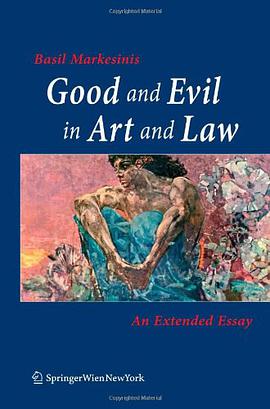
This is an interdisciplinary essay. It looks at art and especially literature in juxtaposition with law and speculates how the two disciplines approach, in their separate but inter-related ways, the notions of "good" and "evil". Full of detail, it examines how the two disciplines deal with these notions, why the evil-doer is often agrandicized in literature but is base in real life and how good and evil change with time. Though one discipline cannot influence the reasoning process of the other, this book, addressed to the general educated reader, is a plea for a broader humanistic education.
作者简介
Sir Basil Markesinis is an honorary QC and holds doctorates or honorary doctorates from (in alphabetical order) Athens, Cambridge, Ghent, Munich, Oxford, and Paris I (Panthéon-Sorbonne). After holding successively the Chairs of European Law and then Comparative Law at the University of Oxford, where he founded the Oxford Institute of European and Comparative Law, he moved to University College London to the Chair of Common and Civil Law, which he holds simultaneously with the (part-time but tenured) Jamail Regents Chair at the University of Texas at Austin.
He has authored or co-authored twenty-nine books and over one hundred twenty legal articles, which have been published in leading law journals in America, Belgium, England, France, Germany, Greece, Italy, and the Netherlands. He has lectured extensively in twenty-five different law faculties including Cornell, Ghent, Leiden, Michigan, Munich, Paris I, Paris II, Rome, and Siena, where he has held Visiting Professorships. He is a Fellow of the British Academy, a Corresponding Fellow of the French Academy, a Foreign Fellow of the Italian Academy (Accademia Nazionale dei Lincei), the Royal Belgian and the Royal Netherlands Academies, a Corresponding Fellow of the Academy of Athens, and a Member of the American Law Institute. In 2002 he was appointed Conseiller Scientifique du Premier Président de la Cour de Cassation (France) on matters of European law. Besides his academic work, Sir Basil has advised many Government Ministers on both sides of the Channel on matters concerning Europe and, between 1997 and 2001, he also served as Special Advisor on Eurpean matters to the multi-national firm of Clifford Chance. For his academic work and other services Sir Basil has received high decorations from the Presidents of France (three times), Germany (three times), Greece, and Italy (three times). Most recently (2002) he was promoted by the President of Italy to the highest rank of the Italian Order of Merit, Knight Grand Cross, while the President of Germany awarded him the insignia of Knight Commander of the Order of Merit, in May 2003. He was made Knight Bachelor by Her Majesty Queen Elizabeth II in the New Year of 2005 for "Distinguished Services to International Legal Relations"
目录信息
读后感
评分
评分
评分
评分
用户评价
我原本以为这会是一本偏向理论思辨的沉重之作,但作者的叙事策略非常高明,充满了活力和争议性。它没有回避艺术史上那些令人不安的角落,反而直面了艺术与权力、审美与压迫之间的复杂纠葛。书中对表现主义艺术作品在威权政权下被定性为“堕落艺术”的分析,与当时针对特定社会群体的立法歧视,两者之间的因果链条被揭示得淋漓尽致。作者的笔锋犀利而不失洞察力,总能在看似对立的两者之间找到张力的平衡点。它挑战了我们对“进步”的线性历史观,展示了文化和法律的“善恶观”是如何在历史的起伏中反复摆动的。这本书读起来有一种酣畅淋漓的感觉,因为它敢于撕开那些精致的文化表象,直达权力运作的底层逻辑。对于希望理解艺术如何被“政治化”以及法律如何“审美化”的读者来说,这本书无疑是一份宝贵的指南,它教会我们如何警惕那些披着合法或高雅外衣的偏见。
评分这本书给我最大的感受是其结构的精巧和逻辑的严密,读起来简直是一种享受。它不像许多跨学科著作那样显得松散或牵强附会,而是像一个技艺高超的钟表匠,将“美学判断”和“司法裁决”这两个看似不相关的齿轮,完美地啮合在一起,使其运作流畅而富有节奏感。作者在论证过程中大量运用了比较分析法,比如将古典理想主义对“完美形式”的追求,与早期罗马法中对“形式正义”的执着进行对比,揭示出人类对秩序和纯粹性的共同渴望。这种对比不仅开阔了视野,更重要的是,它让读者对“什么是好”和“什么是对”的追问,从抽象概念落回到了具体的人类行为和社会结构之中。整本书的论证脉络清晰可见,层次分明,即便是涉及复杂的法律史细节,也处理得毫不费力,文字简练有力,没有丝毫拖沓。强烈推荐给所有对西方文明的深层结构感到好奇的人,它提供了一个全新的、具有穿透力的视角。
评分这本书的阅读体验是渐进式的,它不是一次性的知识灌输,而是一场缓慢而深入的思维“浸泡”。随着阅读的深入,我发现自己对许多既有观念产生了动摇,尤其是关于“客观性”在艺术批评和司法裁决中的作用。作者似乎在暗示,无论是对一件雕塑的“和谐之美”的判断,还是一项判决的“公平无私”的宣称,其背后都蕴含着难以完全剥离的主观滤镜和文化预设。书中对不同时代法律文本的语言风格分析,与对特定流派艺术宣言的文本解读形成了奇妙的互文关系。这种细致入微的文本分析能力,使得全书的论据扎实可靠,即便是最激进的观点,也有坚实的文献支撑。这本书的价值在于,它提供了一种“怀疑的审美”和“审美的怀疑”,鼓励我们永远不要停止追问:谁来定义“善”?谁来执行“法”?这种深层的反思,远超出了艺术或法律领域的范畴,触及了人类社会构建意义的根本方式。
评分老实说,当我拿到这本书时,我有点担心它会变成枯燥的术语堆砌,毕竟艺术与法律的结合听起来就容易显得生硬。然而,这本书的叙事节奏和案例选择简直是教科书级别的精彩。它没有停留在对宏大理论的空泛讨论上,而是聚焦于那些极具戏剧张力的历史瞬间。比如,书中对中世纪猎巫审判中“证据”的构建过程的剖析,与同期哥特式教堂中光影对“神圣”与“污秽”的视觉界定,形成了惊心动魄的对比。作者的语言极具画面感,仿佛能让人亲眼目睹那些法庭上的嘶吼与画室里的沉思。更让我震撼的是,它迫使读者直面现代性带来的困境:当艺术作品挑战社会禁忌时,法律的边界应该如何划定?这种对灰色地带的勇敢探索,使得全书充满了持续的智力挑战。它不提供简单的答案,而是提供了一套强有力的分析工具,让你自己去解构那些我们习以为常的道德假设。这本书绝对不是那种读完后就束之高阁的“摆设”,它更像是一个常驻的思维伙伴,不断地激发新的思考火花。
评分这本书的深度和广度实在令人惊叹,它不仅仅是一本关于艺术史或法学理论的教科书,更像是一场穿梭于人类文明核心矛盾的哲学之旅。作者以极其细腻的笔触,探讨了“善”与“恶”这两个看似简单实则复杂到令人眩晕的概念,是如何在不同的历史时期、不同的文化语境下,被艺术家和立法者所构建、解构和重塑的。我特别欣赏它在处理跨学科议题时的游刃有余,比如,当它分析文艺复兴时期宗教画中对原罪的描绘时,如何与同时期关于契约精神和自然法的早期法律思想形成对话,那种洞察力让人拍案叫绝。读完后,我发现自己看任何一部经典艺术作品或法律条文时,都会不由自主地去追问其背后潜藏的道德基石。它成功地揭示了艺术作为社会良心的反映镜,以及法律作为社会秩序的道德契约,两者之间那种微妙的、充满张力的共生关系。这本书的行文风格兼具学术的严谨与散文的抒情性,使得即便是初次接触此类复杂议题的读者,也能被其强大的逻辑链条所吸引,沉浸其中,难以自拔。
评分 评分 评分 评分 评分相关图书








本站所有内容均为互联网搜索引擎提供的公开搜索信息,本站不存储任何数据与内容,任何内容与数据均与本站无关,如有需要请联系相关搜索引擎包括但不限于百度,google,bing,sogou 等
© 2026 book.quotespace.org All Rights Reserved. 小美书屋 版权所有