
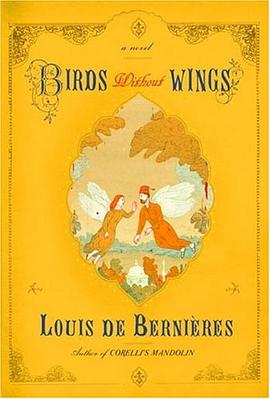

具体描述
Louis de Bernières’s last novel, Corelli’s Mandolin, was met with the highest praise: “Behind every page,” said Richard Russo, “we sense its author’s intelligence, wit, heart, imagination, and wisdom. This is a great book.” A. S. Byatt placed the author in “the direct line that runs through Dickens and Evelyn Waugh.” Now, de Bernières gives us his long-awaited new novel. Huge, resonant, lyrical, filled with humor and pathos, a novel about the political and personal costs of war, and of love–between men and women, between friends, between those who are driven to be enemies.
It is the story of a small coastal town in South West Anatolia in the dying days of the Ottoman Empire told in the richly varied voices of the people–Christians and Muslims of Turkish and Greek and Armenian descent–whose lives are rooted there, intertwined for untold years. There is Iskander, the potter and local font of proverbial wisdom; Karatavuk–Iskander’s son–and Mehmetçik, childhood friends whose playground stretches across the hills above the town, where Mehmetçik teaches the illiterate Karatavuk to write Turkish in Greek letters. There are Father Kristoforos and Abdulhamid Hodja, holy men of different faiths who greet each other as “Infidel Efendi”; Rustem Bey, the landlord and protector of the town, whose wife is stoned for the sin of adultery. There is a man known as “the Dog” because of his hideous aspect, who lives among the Lycian tombs; and another known as “the Blasphemer,” who wanders the town cursing God and all of his representatives of all faiths. And there is Philothei, the Christian girl of legendary beauty, courted from infancy by Ibrahim the goatherd–a great love that culminates in tragedy and madness. But Birds Without Wings is also the story of Mustafa Kemal, whose military genius will lead him to victory against the invading Western European forces of the Great War and a reshaping of the whole region.
When the young men of the town are conscripted, we follow Karatavuk to Gallipoli, where the intimate brutality of battle robs him of all innocence. And in the town he left behind, we see how the twin scourges of fanatical religion and nationalism unleashed by the war quickly, and irreversibly, destroy the fabric of centuries-old peace.
Epic in its narrative sweep–steeped in historical fact–yet profoundly humane and dazzlingly evocative in its emotional and sensual detail, Birds Without Wings is a triumph.
作者简介
Novelist Louis de Bernières was born in London in 1954. He joined the army at 18 but left after spending four months at Sandhurst. After graduating from the Victoria University of Manchester, he took a postgraduate certificate in Education at Leicester Polytechnic and obtained his MA at the University of London.
Before writing full-time, he held many varied jobs including landscape gardener, motorcycle messenger and car mechanic. He also taught English in Colombia, an experience which determined the style and setting of his first three novels, The War of Don Emmanuel's Nether Parts (1990), Señor Vivo and the Coca Lord (1991) and The Troublesome Offspring of Cardinal Guzman (1992), each of which was heavily influenced by South American literature, particularly 'magic realism'.
In 1993, he was selected as one of the 20 'Best of Young British Novelists 2' promotion in Granta magazine. His fourth novel, Corelli's Mandolin, was published in the following year, winning the Commonwealth Writers Prize (Best Book). It was also shortlisted for the Sunday Express Book of the Year. Set on the Greek island of Cephalonia during the Second World War, the novel tells the story of a love affair between the daughter of a local doctor and an Italian soldier. It has become a worldwide bestseller and has now been translated into over 30 languages. A film adaptation of the novel was released in 2001, and the novel has also been adapted for the stage. In 2001, Red Dog was published - a collection of stories inspired by a statue of a dog encountered on a trip to a writers' festival in Australia in 1998.
Prizes and awards
1991 Commonwealth Writers Prize (Eurasia Region, Best First Book) The War of Don Emmanuel's Nether Parts
1992 Commonwealth Writers Prize (Eurasia Region, Best Book) Señor Vivo and the Coca Lord
1994 Sunday Express Book of the Year (shortlist) Corelli's Mandolin
1995 Commonwealth Writers Prize (Overall Winner, Best Book) Corelli's Mandolin
1995 Lannan Literary Award (Fiction)
1997 British Book Awards Author of the Year
2004 Whitbread Novel Award (shortlist) Birds Without Wings
2005 Commonwealth Writers Prize (Eurasia Region, Best Book) (shortlist) Birds Without Wings
目录信息
读后感
When the legendary beauty Philothei died, her ugly childhood friend Drosoula said griefly What is the use of being beautiful Here, in the story, the author tends to believe that all the beautiful things in our life are to be killed or destroyed, which is ...
评分When the legendary beauty Philothei died, her ugly childhood friend Drosoula said griefly What is the use of being beautiful Here, in the story, the author tends to believe that all the beautiful things in our life are to be killed or destroyed, which is ...
评分When the legendary beauty Philothei died, her ugly childhood friend Drosoula said griefly What is the use of being beautiful Here, in the story, the author tends to believe that all the beautiful things in our life are to be killed or destroyed, which is ...
评分When the legendary beauty Philothei died, her ugly childhood friend Drosoula said griefly What is the use of being beautiful Here, in the story, the author tends to believe that all the beautiful things in our life are to be killed or destroyed, which is ...
评分When the legendary beauty Philothei died, her ugly childhood friend Drosoula said griefly What is the use of being beautiful Here, in the story, the author tends to believe that all the beautiful things in our life are to be killed or destroyed, which is ...
用户评价
我很少读到一部作品能够如此深刻地探讨“身份重塑”这一宏大主题,并将其处理得如此内敛而富有张力。本书并未将焦点集中于某一两个主角身上,而是通过一个庞大的群像,展示了社会结构对个体认同的蚕食与重塑。给我留下最深印象的是作者处理视角转换的方式,它极其流畅,却又带着一种诡秘感,仿佛叙述者本身也在不断地变化,观察着一切,却又不完全属于任何一方。这种多重视角,极大地丰富了故事的层次,避免了任何单一视角的偏颇。阅读过程中,我不断地在思考,究竟是环境塑造了他们,还是他们选择了这种被环境塑造的方式?小说将这种哲学上的困境,通过一个个鲜活的、充满缺陷的角色,具象化了。书中对于“希望”的描绘也十分高明,它并非那种乌托邦式的承诺,而是一种在承认所有残酷现实之后,依然选择坚持下去的微弱的、近乎固执的信念。这种对生命力的肯定,即使在最黑暗的篇章中也从未缺席。总结来说,这是一部文学价值极高,思想深度远超一般叙事作品的作品,它值得被认真对待,反复品味,并推荐给所有不满足于表面故事的深度阅读者。
评分坦白说,我对这类探讨社会边缘人物群像的作品一向抱有很高的期待,而《无翼之鸟》成功地超越了我的预期。它描绘的不是高高在上的英雄史诗,而是扎根于泥土,挣扎求生的普通人的困境。这里的“困境”是多维度的,不仅有物质上的匮乏,更有精神上的迷惘和身份认同的危机。作者的观察力达到了近乎偏执的程度,无论是对特定地域文化的细致描摹,还是对特定职业群体生存状态的精准捕捉,都显示出作者下了大量的案头功夫。书中有一段关于集体记忆消散的描写,简直是神来之笔,它精准地捕捉到了现代社会中个体与历史疏离的普遍焦虑。阅读体验是起伏跌宕的,有好几次,我不得不放下书本,去理清思绪,因为作者似乎故意打乱了时间线,将过去和现在不断地交错,迫使读者像修复破碎的文物一样,拼凑出完整的真相。这种叙事上的大胆尝试,虽然初期会增加阅读的难度,但最终带来的收获是巨大的——它让读者意识到,现实本身就是由无数个碎片化的瞬间构成的。这部作品不迎合大众口味,它要求读者付出耐心和思考,而最终的回报,是一种对人性更深层次的理解和共情。
评分这部小说的文字功力令人叹为观止,它有一种返璞归真的力量,每一句话都像是经过千锤百炼,没有一个多余的词。它的魅力不在于情节的曲折离奇,而在于对日常生活中那些微妙的情绪波动的精准捕捉。我个人对那种细腻的情感描摹非常敏感,而这本书几乎将所有隐藏在表面平静之下的暗流都挖掘了出来。角色之间的对话尤其精彩,很多时候,真正重要的信息并不是通过直白的陈述传达出来的,而是隐藏在停顿、沉默和那些欲言又止的回应之中。这要求读者必须保持高度的专注,去解读那些“未说出口的话语”。书中构建的世界观,虽然基于现实,却又被笼罩上了一层淡淡的荒诞色彩,这种“似真非真”的质感,让故事的主题——关于顺从与抗争——得到了更强有力的表达。它没有给出简单的对错判断,而是清晰地展示了环境如何塑造人,以及人如何在被塑造的过程中,试图重新定义自我。这就像观看一场慢镜头回放,你清楚地看到每一个选择如何一步步将角色导向必然的结局,却又为他们在绝境中展现出的那一丝微光而动容。它是一部需要用“心”而非仅仅用“眼”去阅读的书。
评分翻开这本厚重的书,我立刻被卷入了一种强烈的情感漩涡。作者对于人性复杂性的把握简直出神入化,那些表面上看起来坚不可摧的角色,私底下却布满了裂痕和恐惧。我常常在阅读的过程中停下来,深深地呼吸一口气,因为那些文字带来的冲击力实在太强了。它不是那种用华丽辞藻堆砌起来的精致文学,反而带着一种粗砺的真实感,仿佛是用砂纸打磨过的木头,虽然不光滑,但纹理清晰可见,能感受到时间留下的每一道痕迹。最令我震撼的是,小说对“失去”这一主题的处理。它没有将失去描绘成一个戏剧性的高潮点,而是将其融入到日常生活的每一个角落,变成了一种慢性中毒般的存在。角色们看似在继续生活,但灵魂深处早已被掏空。这种潜移默化的腐蚀力量,比突发的灾难更令人不寒而栗。我喜欢作者在叙事中偶尔插入的、近乎诗歌般的内心独白,它们像是在混沌中突然亮起的探照灯,瞬间照亮了角色最隐秘的角落。整本书的结构就像一个精密的钟表,每一个齿轮——每一个角色、每一个场景——都严丝合缝地咬合在一起,推动着故事向着那个不可避免的终点前进,而这个终点本身,也充满了令人深思的开放性。这是一部需要全神贯注去阅读,并且值得反复咀嚼的佳作。
评分这部作品,名为《无翼之鸟》,初读时便被它那仿佛带着某种宿命般沉重的基调所吸引。作者以一种近乎冷峻的笔触,勾勒出了一幅幅在时代洪流中挣扎的众生相。我尤其欣赏它对人物内心世界的细腻刻画,那种在无声的压抑中爆发出的微小反抗,如同夜空中转瞬即逝的流星,虽然短暂,却足以照亮漫长而幽暗的旅程。故事的叙事节奏并非一气呵成,它更像是一首由错综复杂的支线交织而成的交响乐,时而低沉哀婉,时而激昂澎湃。初读时可能会感到有些迷失,那些散落在字里行间的隐喻和象征,需要读者付出额外的精力去解读。但正是这种需要主动构建意义的过程,让阅读本身变成了一种深度参与的体验,而非被动的接受。书中的环境描写,无论是北方小镇那永恒的灰白,还是都市边缘那灯火阑珊的虚假繁荣,都构建得极其真实且富有张力,让人仿佛能闻到空气中弥漫的尘土和汗水的味道。它不提供廉价的慰藉或明确的答案,更多的是将你抛入一个充满灰色地带的世界,让你自己去寻找属于自己的那一片微弱的光亮。读完之后,心中留下的不是简单的感动或震撼,而是一种深刻的反思——关于自由、关于选择、关于个体在庞大结构面前的无力与坚持。这种回味无穷的复杂感,是真正优秀文学作品的标志。
评分土耳其不止帕慕克(甚至比唧唧歪歪碎碎念的帕慕克好太多)
评分土耳其不止帕慕克(甚至比唧唧歪歪碎碎念的帕慕克好太多)
评分土耳其不止帕慕克(甚至比唧唧歪歪碎碎念的帕慕克好太多)
评分"Man is a bird without wings, and a bird is a man without sorrows."
评分"Man is a bird without wings, and a bird is a man without sorrows."
相关图书







本站所有内容均为互联网搜索引擎提供的公开搜索信息,本站不存储任何数据与内容,任何内容与数据均与本站无关,如有需要请联系相关搜索引擎包括但不限于百度,google,bing,sogou 等
© 2026 book.quotespace.org All Rights Reserved. 小美书屋 版权所有