
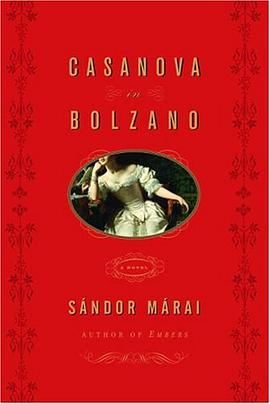

具体描述
From Publishers Weekly
October 31, 1756: the incorrigible playboy and roving gambler Giacomo Casanova escapes from a pestilent Venetian prison. Aiming for Munich, he stops near the Austrian border at an inn in Bolzano. The imperious septuagenarian duke of Parma, Casanova's victorious former rival for the hand of Francesca—then a teenager, now the duchess of Parma, and still in love with Casanova—just happens to live nearby. To prevent another duel, the duke blackmails the legendary womanizer: either he seduces Francesca, breaks her heart and leaves, thereby curing her of the "infection" that is Casanova, or he risks being killed or turned in to the authorities. The fervent colloquy echoes the centerpiece tête-à-tête that structures Embers, Márai's only other novel to be translated into English. Unlike Embers, however, this book fizzles out; an austere and poignant exposition on the inexorability of fate that has been building for over 200 pages collapses into an intolerably tedious, long-winded rant by Francesca as she tries to persuade Casanova to run away with her. The harangue makes it hard to believe that anyone would fight over her and makes the reader wonder why another Márai (1900–1989) work was not translated before this one.
Copyright © Reed Business Information, a division of Reed Elsevier Inc. All rights reserved.
From The Washington Post's Book World/washingtonpost.com
This entertaining and profound novel validates a nagging suspicion that I have had since reading Embers, Sandor Marai's only other novel available in translation: that Sandor Marai (1900-89) is one of the great modern novelists, in the same league as Gabriel García Márquez (with whom he shares many qualities). The delay in acknowledging this comes from the tragic happenstance, at least for English readers, that Marai wrote in Hungarian, a language not widely translated. The confinement of a writer of Marai's talent, at once dramatic and witty, to a language of so few readers seems almost criminal. Of course, Marai wouldn't have felt this way. He was passionately devoted to Hungarian, and, in exile in California after leaving Hungary for political reasons, he referred to his language as "his only homeland."
Casanova in Bolzano is the fictional account of Casanova after an escape from jail in Venice, and the means by which Marai holds forth on just about everything important in human activity: love, honor, how to live, how to die, the importance of style and dignity, and, of course, the never-ending difficulties between men and women. And, as in any good novel, it is successful because its intriguing characters are in the midst of confronting one another.
The first of these is Casanova himself. When he arrives in Bolzano, he excites the citizens, who "understood, in short, that a genuine man was as unusual a phenomenon as a genuine woman. A man who is not trying to prove anything by raising his voice or rattling his sword, who does not crow, who asks no favors except those he himself can grant . . . because every nerve, every spark of his spirit and every muscle of his body, is devoted to the power that is life: that kind of man is indeed the rarest of creatures."
Casanova's first antagonist is the Duke of Parma, with whom he fought and lost a duel over a woman. Marai's great gift is his ability to demonstrate his characters' qualities rather than merely describe them. For instance, the duke's dignity is obvious in every aspect of his life, such as his style, how easy he is to anger, and in his devotion to his sense of right and wrong. With Marai's characters, the experience for the reader is almost extra-literary, or just plain real, in that you have the sense of being in the presence of someone you wouldn't want to offend.
After the Duke of Parma wounds Casanova, he takes the bleeding man to a surgeon. There, in front of the surgeon's door, the duke says: "You will have everything you need. Once you are well you will leave the region. Nor will you ever come back. Should you ever return . . . I will either kill you myself, or have you killed, make no mistake about it." With Marai such episodes are not the end but the beginning, since as he says, "You cannot, after all, settle things with a duel and a little bloodshed."
Casanova's other antagonist is Francesca, the woman over whom he fought the duel. At the time of the duel she was just a girl of 15, but even then it was "as if she were saturated with light, so intensely did that sweet yet disturbing energy flow from her. . . . There was light in her, and when a man looked into her eyes . . . everything around him was brighter, more real, more substantially true." When Casanova returns, she is older, married to the Duke of Parma. She has learned to write and has been thinking about her feelings. When she hears that her lover is in town again, she sends him a note: "I must see you." Now Marai portrays Francesca as a woman, not a girl, furious at being in love and unable to do anything about it. This, and her vitality, make her a very dangerous woman indeed. The climax of the novel is the confrontation between Francesca and Casanova, in which it is unclear if she will dedicate her life to him or kill him. Marai presents this scene with a keen sense for drama, which he handles with a quality that verges on delight. You can almost see his wink at the reader, as though acknowledging the fun he is having.
This sounds like the description of an opera, but the book saves itself by its drama, its language and its observations about being alive. In Casanova in Bolzano Marai has a voice similar to Márquez's, with descriptions that are lush and filled with unexpected details. In fact, it is hard to imagine that Márquez hasn't read Marai, although the path of a book being translated from Hungarian into Spanish seems just as improbable as from Hungarian to English.
In addition to the description, Marai's characters have a vitality that recalls those of Márquez in One Hundred Years of Solitude. For instance, here Casanova describes people who had him arrested: "These are the people who judged me! Patricides, murderers of their own sons, usurers, gluttons, parasites, living off orphans' tears and sucking the blood of widows with their taxes -- and these are the people who dared pass judgment on me!" It could be a speech by Márquez's Colonel Buendia.
Marai includes such observations as this: There is a "moment of silence at a vital turn in a man's life." Or "we love them simply because there is in the world a kind of purpose whose true working lies beyond our wit, which desires to articulate itself much as an idea does."
Casanova in Bolzano is at once erotic in its texture and sense of longing, witty in its observation about the human condition and, on top of everything else, great fun to read. There are another 40 Marai books still imprisoned in Hungarian, but with any luck they will be liberated after all. I can hardly wait.
Reviewed by Craig Nova
Copyright 2004, The Washington Post Co. All Rights Reserved.
作者简介
目录信息
读后感
评分
评分
评分
评分
用户评价
坦白说,我最初是被这本书的书名所吸引,带着一丝猎奇的心态购入的。但随着阅读的深入,我发现自己完全被书中描绘的世界深深地吸引住了。卡萨诺瓦,这个名字本身就自带一种危险而迷人的光环,而作者并没有仅仅将他塑造成一个脸谱化的浪子,而是赋予了他更丰富的内心世界。他在博尔扎诺的经历,仿佛是一面镜子,照出了他内心深处那些不为人知的脆弱与渴望。书中的情节发展出乎我的意料,它并非是那种一蹴而就的浪漫故事,而是充满了曲折和转折,每一次的意外都让故事更加引人入胜。我尤其欣赏作者在处理情感戏时的克制与张力,那些欲言又止的眼神,那些若即若离的距离,都比直白的告白更能触动人心。博尔扎诺这个城市,在作者的笔下,也焕发出了别样的生机。它不再是单纯的背景板,而是成为了人物情感的承载者,城市的风光与人物的心境,彼此呼应,共同构建了一个令人沉醉的艺术品。这本书让我思考了很多关于爱情、关于人生、关于自由的问题,它不仅仅是一部消遣读物,更是一次精神的洗礼。
评分这本书的封面设计真的非常吸引人,一看就充满了异国情调和浪漫的遐想。淡雅的色彩搭配,以及上面那个模糊却又精致的画像,让人忍不住想要探究画中人究竟是谁,又会带来怎样的故事。书名“Casanova in Bolzano”更是直接点明了核心,仿佛带着一种复古的优雅和一丝丝的神秘感。意大利的博尔扎诺,这个名字本身就自带一种阿尔卑斯山脉下小镇的宁静与风情,不知道在这样一个背景下,那位声名显赫的卡萨诺瓦会遇到怎样的际遇?他会延续他一贯的魅力与风流,还是会在这个相对保守的地域遭遇意想不到的挑战?仅仅是想象,就足够让人心潮澎湃。我尤其好奇作者是如何描绘博尔扎诺这个地方的,它不仅仅是故事发生的背景,更是故事的灵魂所在。是那种阳光明媚,充满鲜花和咖啡香气的街道,还是隐藏着古老城堡和深邃传说的神秘之地?卡萨诺瓦的出现,又会如何打破这里的宁静,或是为这片土地增添别样的色彩?我对书中人物的塑造也充满了期待,尤其是卡萨诺瓦,他是否依然是那个玩世不恭、情场高手,还是会展现出更深层次的情感和思考?而博尔扎诺的当地居民,又会以怎样的姿态迎接这位远道而来的“传奇”?这本书,在我看来,是一场视觉与心灵的双重盛宴的开端,它承诺着一段跨越时空的情感之旅,一段关于魅力、欲望与人性的深刻探索,我迫不及待想要翻开它,去感受那股扑面而来的故事力量。
评分这是一本真正能触动灵魂的书。当我拿起它的时候,我并没有预设任何期待,只是被它独有的气质所吸引。然而,当我沉浸在其中时,我发现自己被深深地打动了。卡萨诺瓦,这个名字本身就带着一种诱惑,但作者笔下的他,却展现出了更多元的魅力。他不仅仅是一个情场高手,更是一个对生活有着深刻理解和独特感悟的人。博尔扎诺这个城市,在作者的笔下,也拥有了独特的生命力。它不是一个冰冷的背景,而是与卡萨诺瓦的命运紧密相连,共同演绎着一段跌宕起伏的故事。我尤其喜欢作者对人物情感的细腻描绘,那些细微的表情变化,那些欲说还休的眼神,都充满了力量,能够直击人心。书中对情节的把控也十分老练,张弛有度,总能在不经意间制造出惊喜,让读者欲罢不能。更重要的是,这本书引发了我很多关于爱情、关于人生意义的思考。它让我看到了一个男人在经历世事之后,对生活更加深沉的理解和对真挚情感的渴望。这本书,给我带来的不仅仅是阅读的乐趣,更是一种心灵的启迪。
评分这本书给我的感觉,就像是品尝一杯年份悠久的波特酒,初入口时醇厚而微甜,细细回味时,则能品出复杂的层次和深邃的余韵。卡萨诺瓦的形象在我的脑海中变得鲜活起来,他不再是教科书上那个模糊的标签,而是一个有血有肉、有情感、有挣扎的鲜活个体。博尔扎诺的地理环境,尤其是那种阿尔卑斯山脉下的独特风情,被作者描绘得淋漓尽致。我仿佛能够看到那些古老的石板路,听到潺潺的溪流声,感受到清冽的山风。书中对于那个时代社会风貌的展现也十分到位,那些细腻的服饰描写,那些贵族的生活细节,都仿佛将我带回了那个遥远的年代。然而,这本书最让我着迷的,并非是华丽的外表,而是卡萨诺瓦内心深处的探寻。他在这个似乎与他过往生活截然不同的地方,究竟在寻找什么?是真实的爱情,还是对自我的一种救赎?书中的许多情节都充满了象征意义,留下了不少让读者回味的空间。它让我感受到了历史的厚重,也体验了人性中那些永恒的追求,是一部值得反复品读的佳作。
评分读完这本书,我感觉自己像是刚刚从一场华丽的梦境中醒来,空气中还弥漫着淡淡的酒香和迷迭香的气息。作者的文字有一种魔力,能够将读者毫不费力地带入到那个时代的博尔扎诺,仿佛能够听见远处教堂的钟声,闻到路边糕点店飘出的甜腻香味,甚至能够感受到微风拂过脸颊的温柔。卡萨诺瓦这个名字本身就充满了传奇色彩,而作者对他的描绘,更是将这份传奇推向了新的高度。他不仅仅是一个征服女性的浪子,更是一个对生活充满热情、对艺术有着深刻理解的灵魂。他在博尔扎诺的经历,并非仅仅是简单的情感纠葛,而是更深层次的自我认知和对人生的反思。书中对博尔扎诺这个城市的描绘也令人印象深刻,它不再只是一个地理名词,而是一个有生命、有温度的存在,与卡萨诺瓦的情感起伏巧妙地交织在一起。我特别喜欢作者对于细节的刻画,无论是精致的服饰,还是华丽的舞会,亦或是那些不易察觉的面部表情,都展现了作者扎实的功底和对那个时代的深刻洞察。这本书让我感受到了历史的厚重感,也体验了人性的复杂与细腻。它不仅仅是一个故事,更是一种情感的传递,一种对美好与自由的向往。
评分 评分 评分 评分 评分相关图书












本站所有内容均为互联网搜索引擎提供的公开搜索信息,本站不存储任何数据与内容,任何内容与数据均与本站无关,如有需要请联系相关搜索引擎包括但不限于百度,google,bing,sogou 等
© 2026 book.quotespace.org All Rights Reserved. 小美书屋 版权所有