

具体描述
Book Description
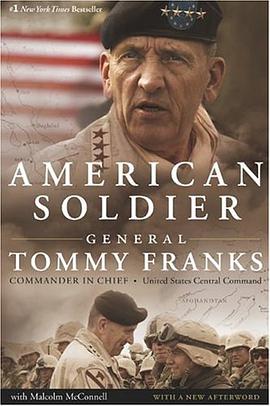
The Commander in Chief of the United States Central Command from July 2000 through July 2003, General Tommy Franks made history by leading American and Coalition forces to victory in Afghanistan and Iraq — the decisive battles that launched the war on terrorism.
In this bestselling memoir, General Franks retraces his journey from a small-town boyhood through a lifetime of military service, recounting his experiences as an Artillery officer in Vietnam, a reform-minded Cold War commander, a shrewd tactician during Operation Desert Storm, and the senior American military officer at CENTCOM. Drawing on his own recollections and military records declassified for this book, Franks offers a rare window into sessions with President Bush, Donald Rumsfeld, Colin Powell, and other major players, giving readers the first true insider's account of the war on terrorism.
Now in paperback--the extraordinary memoir of General Tommy Franks, who traces his journey from a boyhood in Oklahoma and Texas through his heroic tour of duty as Commander-in-Chief of the United States Central Command.
Amazon.com
As Commander in Chief of the United States Central Command from July 2000 through July 2003, Tommy Franks led the American and Coalition forces to victory in both Afghanistan and Iraq. Unsurprisingly, the portions of American Soldier covering these wars are the most interesting because they combine military maneuvers, political wrangling, and lots of action and commentary. This does not mean, however, that the rest of his autobiography is dull. General Franks's writing is clear and engaging and his insider's perspective is informative and interesting, particularly when he explains how the military moved into the 21st century by emphasizing speed, agility, and better cooperation among the various branches--a significant shift from the first Persian Gulf war just a decade earlier.
In addition to his years as a war general, his memoir also covers his childhood, his early years in the Army, his tours of Vietnam, and how he contemplated retirement before being called up as commander of Central Command, "the most diverse, strategically vital—and unstable—region of the planet." Ever the diplomat, General Franks offers insights, but little criticism of individuals. Other than expressing admiration for his own staff and for President Bush and Defense Secretary Donald Rumsfeld in particular, he is tight-lipped about any conflict within the administration that may have occurred regarding policy issues. (The one exception is counterterrorism specialist Richard Clarke. "I never received a single operational recommendation, or a single page of actionable intelligence, from Richard Clarke," he writes). He also writes that he was surprised by the absence of weapons of mass destruction in Iraq and that no WMDs were used against American troops. Still, the invasion of Iraq was justified in his eyes: "While we may not have found actual WMD stockpiles, what the Coalition discovered was the equivalent of a disassembled pistol, lying on a table beside neatly arranged trays of bullets." American Soldier is a compelling look at the war on terrorism from one who served on the frontlines as both a warrior and a diplomat.
--Shawn Carkonen
From The Washington Post's Book World /washingtonpost.com
The Romans let victorious generals keep slaves and other spoils of war. The British showered them with noble titles and country estates. In free-market America, we've outsourced the job of rewarding our war heroes to the private sector, where they get cushy corporate board seats, lucrative speaking engagements and fat contracts for their memoirs.
Gen. Tommy Franks, who as head of U.S. Central Command presided over the wars in Afghanistan and Iraq, has duly produced the expected autobiography. It is a good read, thanks to the work of veteran ghostwriter Malcolm McConnell; the early sections on Franks's blue-collar upbringing and Vietnam service are particularly affecting. But it has not made as much of a media splash as some other accounts of the administration, because it is not hostile to George W. Bush.
To the contrary, American Soldier rebuts some criticisms directed against the president. Bush has been accused, for instance, of taking his eye off Afghanistan by ordering the plan for a possible war with Iraq in the fall of 2001. Franks writes that, given the threat posed by Saddam Hussein, this was a sensible request, and that "our mission in Afghanistan never suffered" as a result.
Scores of pundits have accused the administration of lying, or at least distorting the evidence, about Iraq's weapons of mass destruction. But Franks reveals that the leaders of Egypt and Jordan told him that Saddam Hussein had chemical and biological weapons. Though no weapon of mass destruction was ever found, he writes, "I do not regret my role in disarming Iraq and removing its Baathist regime."
Another charge made against the administration is that political appointees failed to give the generals enough troops in either Afghanistan or Iraq. In fact, Franks writes, it was his own choice to employ limited forces in order to avoid getting bogged down. Instead of relying on sheer size, he thought surprise and speed were the keys to victory -- a judgment largely vindicated by events.
In general (so to speak), Franks is complimentary about his bosses. Vice President Dick Cheney is praised for asking questions that "consistently cut to the core of the issue at hand." Bush comes across as a "confident" and "decisive" leader who refused to let politics intrude into his decision-making. When White House chief of staff Andrew Card brought up the issue of the 2002 elections as a factor in planning for war with Iraq, Bush reportedly snapped, "That is no consideration at all . . . Timing will have nothing to do with congressional elections or polls." Franks did become exasperated at times with the "genetically impatient" Donald Rumsfeld, but ultimately decided that he and the defense secretary made an effective team.
Not all is sweetness and light in American Soldier. Franks comes off as a bit tetchy. He complains in particular when the Joint Chiefs of Staff get involved in any operational issues that lie outside their jurisdiction. He accuses the chiefs of being focused only on their "parochial" service concerns, of leaking secrets to the press, wasting his time and offering "gratuitous" advice. In one extraordinary episode, he cusses out the Navy and Marine chiefs, Adm. Vern Clark and Gen. James Jones, in language that can't be reprinted here.
A particular target of his ire is Undersecretary of Defense Douglas Feith, whom he denounces as the "dumbest [expletive] guy on the planet" and "a theorist whose ideas were often impractical," without offering any examples. He adds, however, that "Rumsfeld never allowed Feith to interfere in my business." This -- along with the fact that Deputy Secretary of Defense Paul Wolfowitz barely rates a mention in this book -- should help dispel the popular myth that a cabal of neoconservatives led by Wolfowitz and Feith has been running the war on terrorism. Actually Franks was the one in operational control until July 2003, and he offers not a single instance where Rumsfeld, Feith or any other politico forced him to do anything he didn't want to do.
Perhaps they should have. American Soldier reveals numerous blind spots: Franks never discusses why he didn't send more U.S. soldiers to cut off al Qaeda fighters escaping Tora Bora in December 2003 or Ba'athists fleeing to the Sunni Triangle in April 2004. Nor does he seriously ponder what more he could have done to foster a secure postwar environment in Iraq and Afghanistan. One of the "impractical" suggestions from Feith that he disregarded, we now know, was to rally Iraqis to assist in their country's liberation. More than a year later, the United States continues to pay a heavy price for not having mobilized sufficient Iraqi security forces early on.
Reviewed by Max Boot
From AudioFile
Retired General Tommy Franks, architect of the spring 2003 campaign in Iraq, as well as the fall 2001 campaign in Afghanistan, recaps his life. He is straightforward in telling his life's odyssey from humble beginnings in Oklahoma and Texas, through his first (failed) attempt at college, eventual enlistment in the Army, and his experiences with officer candidate's school, Vietnam, marriage, and, finally, the Iraq campaign. The author's comments and observations give great insight into the campaign of 2003 and the present situation in Iraq. While Franks does not endorse every action of the Bush administration regarding the war on terrorism, the general appears to be in agreement with the administration's broad policy direction. Though not a polished reader, he speaks well and exudes comfort in telling his story of a Texas boy done good. M.T.F.
About Author
General Tommy Franks retired from the Army on August 1, 2003. Commissioned a Second Lieutenant in 1967 as a distinguished graduate of the Artillery Officer Candidate School, Fort Sill, Oklahoma, he was assigned to the 9th Infantry Division, Republic of Vietnam. He also served as an Assistant Division Commander during Operations Desert Shield/Desert Storm. General Franks has been awarded three Defense Distinguished Service Medals, two Distinguished Service Medals, and four Legion of Merit awards. His other decorations include three Purple Hearts, three Bronze Stars, an Air Medal, and an Army Commendation Medal -- all with "V" for valor. In 2004 he was named a Knight Commander of the Order of the British Empire. General Franks lives with his wife, Cathy, in Tampa, Florida.
Book Dimension :
length: (cm)23.3 width:(cm)16
作者简介
目录信息
读后感
评分
评分
评分
评分
用户评价
我一直对历史题材的书籍情有独钟,尤其是那些能够触及人性深处的作品。这本书,它给了我一种前所未有的震撼。作者在文字中展现的,不仅仅是事件本身,更是事件背后的人物命运和时代洪流。我发现自己会不自觉地去代入书中角色,去感受他们的挣扎、他们的痛苦、他们的希望。有时,我会因为书中某个情节而感到心潮澎湃,眼眶湿润;有时,我又会因为人物的坚韧而获得力量。这本书让我看到了,在时代的巨浪面前,个体是如何渺小却又如何不屈的。作者的叙述方式非常冷静客观,但他字里行间流露出的对人性的深刻洞察,却又带着一种温暖的力量。我喜欢这种不煽情却能直击人心的表达方式。它迫使我去思考,去反思,去重新审视一些我习以为常的观念。这本书带给我的,不仅仅是知识,更是一种精神上的洗礼。
评分我是一个特别注重故事节奏的人,有时候看书,如果情节进展太慢,很容易就失去了耐心。这本书,虽然看起来厚实,但意外地读起来非常流畅。它不是那种急于抛出各种悬念的类型,而是娓娓道来,像一条缓缓流淌的河流,一点一点地铺陈开来。你会在不经意间发现,自己已经被深深地吸引进去,跟着书中的人物一起经历他们的喜怒哀乐。我尤其喜欢作者在描绘一些场景时,那种细腻的笔触,仿佛能身临其境一般。比如,书中对某个季节的描写,那种光影的变化,空气中的味道,都刻画得活灵活现。这种写实的手法,让整个故事更加有血有肉,让读者更容易产生共鸣。而且,作者并没有刻意去制造戏剧冲突,很多情感的爆发都是自然而然发生的,这种“润物细无声”的处理方式,反而更显功力。我常常在读完一章后,会停下来回味一下,思考人物内心的变化,以及作者想要传达的那份情感。
评分说实话,我是一个对细节要求很高的人,尤其是在阅读书籍的时候。这本书,它的细节处理得真的让我非常满意。作者在构建情节的时候,逻辑非常严谨,几乎找不到任何的漏洞。而且,他对人物的刻画也十分生动,每一个角色都有自己的性格特点和成长轨迹,不会让人觉得脸谱化。我尤其欣赏作者在描写一些重要场景时的铺垫,那些看似不经意的细节,在后面都会起到至关重要的作用。这种“草蛇灰线,伏笔千里”的写作手法,让整个故事充满了惊喜和回味。读完之后,我还会忍不住去回顾前面的一些章节,去寻找那些被我忽略的线索,然后恍然大悟。我觉得,作者在创作这本书的时候,一定付出了巨大的心血,他不仅仅是在讲一个故事,更是在编织一个精密而又引人入胜的世界。这样的书,真的值得反复品读。
评分对于我这样平常喜欢看一些轻松读物的人来说,一开始拿到这本书,确实有些担心会不会太晦涩或者太沉重。但出乎意料的是,这本书的语言风格其实挺朴实的,没有那些过于复杂的词汇或者晦涩的句子。读起来感觉很接地气,像是邻家大哥在给你讲故事一样。而且,作者在叙述过程中,会时不时地穿插一些幽默的元素,让我在阅读过程中也不会觉得过于压抑。我喜欢这种张弛有度的表达方式,既能深刻地探讨问题,又不失轻松的阅读体验。有时候,我会因为一句有趣的对话而忍不住笑出声来,然后又因为接下来的情节而陷入沉思。这种情绪的起伏,让阅读的过程变得更加丰富多彩。我觉得,一本好的书,应该能够满足不同读者的需求,既有深度,又不失可读性,而这本书,无疑做到了这一点。
评分这本书,嗯,怎么说呢,我拿到它的时候,封面就挺吸引人的,有一种沉甸甸的历史感。拿到手里翻开,纸张的质感也很好,不是那种很廉价的纸,读起来感觉挺舒服的。我平时喜欢读一些需要沉下心来品味的书,这本书在我床头已经放了好几天了,每天晚上都会翻几页,感受那种文字的力量。有时候,我会特别留意作者的遣词造句,有些句子真是写得太有韵味了,会让人反复咀嚼。而且,这本书的排版也很不错,字号大小适中,行间距也刚刚好,长时间阅读也不会觉得眼睛疲劳。我觉得,一本好的书,从封面设计到纸张印刷,再到排版,每一个细节都蕴含着创作者的心意,而这本书,无疑在这方面做得相当出色。它不仅仅是一堆文字的堆砌,更像是一件精心打磨的艺术品,让人在阅读的同时,也能享受到视觉和触觉上的愉悦。我喜欢这种有温度的书,感觉像是和作者隔着文字在对话,能感受到他传递过来的情绪和思考。
评分 评分 评分 评分 评分相关图书










本站所有内容均为互联网搜索引擎提供的公开搜索信息,本站不存储任何数据与内容,任何内容与数据均与本站无关,如有需要请联系相关搜索引擎包括但不限于百度,google,bing,sogou 等
© 2026 book.quotespace.org All Rights Reserved. 小美书屋 版权所有