
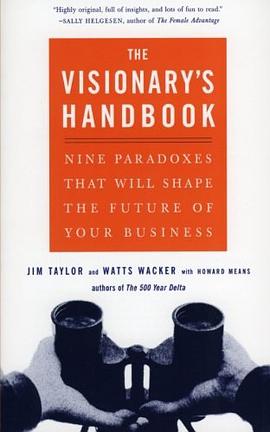

具体描述
在线阅读本书
Publisher Comments:
Chapter OneThe Paradox of the Visionary
"The more you are right,
the more wrong you will be
Welcome to the Age of Possibility.
Welcome to the first time in the history of the planet when you truly can choose what you want to be, what you want to do, what you want to know, and where you want to go.
Welcome to a world in which reality is whatever we make it, a world in which you both can and must immerse yourself in your own possibilities, a world in which you — you the person, you the business, you the organization, you the government, and you the society — can write your own story and walk into it and become whatever it is you imagine yourself becoming. Life has never been easier, and because it has never been easier, life has never been more hard.
Emancipated from group-think and collective fate, people have the capacity today as never before to claim their own futures and to shape those futures to suit completely idiosyncratic wants and needs. You really are free, and as all truly free people are, you really are responsible. Fail to build your own future, and someone is going to build one for you, whether you want it or not. Fail to bind all the disparately emerging futures within your organization — be it company, school, government, or family — to a shared set of goals, and its future will be forfeit, too.
Our job as consultants is to help top executives look into the future and prepare themselves for the paradoxical nature of the world they must learn to operate in — the world that lies just around the corner and the world that is waiting decades down the road. Far more than that, though, our job is to introduce CEOs and their companies to the tools we use asvisionaries so that they can become the custodians of their own destiny. No one can predict the future, but no one afford to be unprepared to meet whatever does arrive.
We can do the same thing for you and for your business. We can give you the same tools and show you the same frames of mind you'll need to master, and instead of charging you the tens of thousands of dollars consultants charge the corporate top brass, you will have had to pony up only the price of this book. But to become your own visionary, you will need to help yourself along the way. You can begin that process right now by taking the pretest below, and you can enhance the value immensely by being utterly honest with yourself, on this test and on all the tests and "Future Exercises" that follow. It's your destiny, not ours, that you are pursuing, and the only person you finally have to please is yourself.
Pretest
Total Test Time: 4 Minutes
This test consists of four sections. In the chapters ahead, you'll have time to ponder all four sections in for greater depth. For now, go with your gut and take no more than sixty seconds to complete each one.
On a clean sheet of paper, freeze your reality at this precise moment in time and list all the things you are-not yesterday or tomorrow, but right now. This is your benchmark against which to measure future change.
On a second sheet of paper, declare a major in your future by listing all the things you will be. This is the reality you hope to invent.
For Section 3, start another list, your postulates about the future: "Things that have to be true in order for me to be what I will be." Fill the list out.
Finally, write at the top of a fresh sheet of paper"The following things mark me as a radical among my peers." Take no more than sixty seconds to list them all.
When you're through with the pretest, store your answers somewhere handy. We're going to ask you to complete a similar exercise at the end of this book, and comparing those answers to these should give you a good road map of the trip you've taken through these pages. For now, though, give yourself a good pat on the back because you've just attacked the four critical issues in becoming your own futurist:
1.You have to know who you are.
2.You have to know where you want to go.
3.You need to recognize your own seminal moments.
4.And you must have an attitude of insurgency.
For a visionary, these four principles are the beginning of knowledge. You might not get where you want to go by following them, but you can't control your destiny without them.
A New Grammar
In this book, we also explore what it means to live not in the past or the present or even in the future, but to live in a new grammar: the future expressed in the present tense, because this is where and how we must live today, with a foot in both tenses.
Just as important, we invite you to be our colleagues on this exploration, to find yourself and the story of your business in the stories we have to tell, and to write your own story as we tell ours. There are times we ask you to do that literally, as we have just done: times when we encourage you to take out a pencil and pad and work an exercise. We hope you also jot notes in the margins as you read along and that you constantly inject yourself and your company into the anecdotes we tell and the situations we describe. The more you choose toparticipate as you read along, the more you are likely to have produced an accidental diary of your own future by the time you come to our final page...
Synopsis:
In The 500 Year Delta, Watts Wacker and Jim Taylor astounded readers with their sweeping vision of time and change. Now they proclaim the Age of the Individual - a world where life has never been more difficult, because it has never been easier.
Today, individuals have far more power to claim their own futures than ever before, which means they have to follow four major rules to chart their courses: know who you are: know where you want to go; recognise your own seminal moments; and adopt an attitude of insurgency. As these rules are applied to organisations, they too can master the nine paradoxes that abound in everyday life and watch productivity go through the roof.
Synopsis:
In The Visionary's Handbook, Watts Wacker and Jim Taylor refuse to paint a simplistic picture of the future; instead, they show where to look for the insight needed to compete and grow in the years ahead. Authors of the prophetic The 500 Year Delta, they now proclaim the Age of the Individual — a world where life has never been more difficult, because it has never been easier. Today, individuals have far more power to claim their own futures than ever before, which means they have to follow four major rules to chart their courses:
1.Know who you are.
2.Know where you want to go.
3.Recognize your own seminal moments.
4.Adopt an attitude of insurgency.
A bold, incisive book, The Visionary's Handbook captures the interlocking web of paradoxes that abound in everyday business life, and provides an essential map to help make the future work for every individual and every company in the challenging and uncertain times ahead.
About the Author
Watts Wacker FirstMatter LLC, a company bringing the future to corporations, and is the futurist at one of the nation's foremost think tanks.
From Amazon.com
At a time when business bestsellers such as Six Sigma are touting scientific management, The Visionary's Handbook desires to be different. Authors Watts Wacker, Jim Taylor, and Howard Means forgo the nuts-and-bolts approach for a philosophical look at management, examining nine broad trends, or "paradoxes," they say are shaping business today.
At the heart of these paradoxes lies change--change that is occurring at an increasing rate. The more certain we are of the future, say the authors, the more likely we are to be wrong. To support their argument, they cite both online and real-world examples, including Xerox, eBay, Kodak, and Cisco. Their observations, if not groundbreaking, are certainly accurate. For instance, the Paradox of Size--the bigger your company, the smaller it needs to appear--has been explored at length in Customers.com. Similarly, the need for continual innovation--even to the detriment of your core business--is a paradox that merits attention and one that readers of The Innovator's Dilemma will recognize.
The Visionary's Handbook is about more than just paradoxes, though. Interspersed throughout its pages are exercises challenging readers to pencil in the future they want to see, to visualize and outline their success. Some may find these exercises a valuable and practical addition to the text. Broadly conceived and thought-provoking, The Visionary's Handbook will be an eye opener for many readers.
--Demian McLean
Book Dimension
Height (mm) 204 Width (mm) 136
作者简介
目录信息
读后感
评分
评分
评分
评分
用户评价
总而言之,这本书的阅读体验是一次非常宝贵的经历。它不仅为我提供了丰富的知识和深刻的见解,更重要的是,它启发了我去思考,去探索,去成长。我相信,这本书会对任何渴望提升自己、拓展思维的读者都产生深远的影响。我非常推荐这本书,并期待着未来能够再次翻阅,从中汲取更多的智慧。
评分这本书的语言风格给我留下了深刻的印象。作者的文字功底非常扎实,行文流畅,用词精准,没有丝毫的冗余和拖沓。即使在讨论一些非常专业和复杂的议题时,也能做到条理清晰,易于理解。我尤其喜欢作者在某些段落中使用的那种富有哲理的表达方式,它们常常能触动我内心深处的一些思考,让我对事物有了更深层次的理解。总的来说,这本书的阅读体验非常愉悦,就像是在与一位博学且善于表达的智者进行一场深入的对话。
评分在内容的深度上,这本书绝对是超出我的预期的。它并没有泛泛而谈,而是深入到了一些非常具体且实用的层面,让我对很多曾经模糊的概念有了更清晰的认识。我尝试着将书中的一些理念应用到我最近正在进行的一个个人项目中,惊喜地发现那些看似抽象的原则,在实践中竟然有着如此强大的指导意义。作者的论述逻辑非常清晰,层层递进,让你能够一步步地理解其核心思想。而且,我非常欣赏它在解释复杂概念时所使用的类比和例子,这些都极大地降低了理解的门槛,让我在阅读过程中充满了“原来如此”的顿悟时刻。
评分阅读这本书的过程,对我来说就像是在进行一场思想的探险。它不仅仅是在灌输知识,更是在激发思考。很多时候,我会在读完一章后停下来,反复咀嚼其中的观点,并将其与我自己的经验和认知进行对照。书中的一些观点甚至挑战了我过去的某些固有认知,迫使我去审视和反思,这正是高质量书籍的价值所在。我发现,这本书并非那种可以快速浏览一遍就丢下的书,它值得反复品读,每一次阅读都会有新的发现和体会,就像是一坛陈年的老酒,越品越有味道。
评分我一直对某些特定领域有着浓厚的兴趣,而这本书恰好触及了我关注的多个焦点。作者在对这些领域进行剖析时,展现出了非凡的洞察力,并且能够将不同领域之间的联系和相互影响梳理得井井有条。更难得的是,这本书并没有局限于理论的层面,它还探讨了许多实践性的挑战以及应对策略。我在阅读过程中,也在积极思考如何将这些知识转化为具体的行动,并且已经开始付诸实践,效果非常显著。
评分我一直认为,一本好的书应该能够引导读者去思考,而不是仅仅提供答案。这本书完美地做到了这一点。它提出了许多值得探讨的问题,并且鼓励读者去寻找属于自己的答案。在阅读的过程中,我常常会主动去查阅一些相关的资料,进一步拓展我的知识边界,这种主动学习的乐趣是在其他地方很难获得的。这本书就像是给我打开了一扇新的窗户,让我看到了更广阔的世界,也激发了我不断探索的动力。
评分从这本书中,我学到了很多关于如何更有效地进行思考和学习的方法。作者分享了一些非常实用的技巧和工具,我尝试着在我的日常工作中运用它们,结果让我非常惊喜。这些方法不仅提高了我的工作效率,更重要的是,它们帮助我建立了一种更系统、更深入的思考模式。我发现,很多曾经让我感到棘手的任务,在应用了书中的方法之后,变得迎刃而解。
评分这本书的结构安排也十分出色。每一章节都围绕着一个核心主题展开,并且与其他章节之间有着紧密的逻辑联系。这种清晰的结构使得整个阅读过程非常顺畅,不会出现逻辑上的断层或者理解上的困难。我尤其喜欢书中对一些复杂概念的梳理和总结,它们帮助我快速地掌握了关键信息,并且能够融会贯通。
评分我非常欣赏作者在书中展现出的那种严谨的学术态度和深厚的知识积累。每一个观点都经过了充分的论证,并且有大量的证据和案例来支撑。这使得这本书不仅具有启发性,更具有说服力。在阅读的过程中,我能够感受到作者对知识的敬畏之心,以及他希望将真正有价值的内容传递给读者的真诚愿望。
评分这本书我拿到手已经有一段时间了,期间我利用了各种碎片化的时间来阅读它,包括通勤路上、午休时间,甚至是夜晚睡前。这本书给我的整体感觉是非常深刻且具有启发性的。首先,它在装帧上就显得非常用心,厚实的书脊,纸张的触感也十分温润,拿在手里就有一种沉甸甸的知识感。我尤其喜欢它的排版设计,字体大小适中,行距也恰到好处,阅读起来一点都不费眼,即便长时间阅读也不会感到疲惫。而且,书中穿插的一些插图,虽然不是那种华丽的,但却恰如其分地起到了辅助理解的作用,为枯燥的理论知识增添了几分趣味性和生动性。
评分 评分 评分 评分 评分相关图书














本站所有内容均为互联网搜索引擎提供的公开搜索信息,本站不存储任何数据与内容,任何内容与数据均与本站无关,如有需要请联系相关搜索引擎包括但不限于百度,google,bing,sogou 等
© 2026 book.quotespace.org All Rights Reserved. 小美书屋 版权所有