
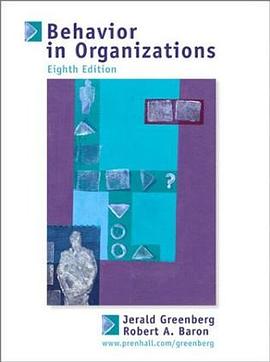

具体描述
ORGANIZATIONAL BEHAVIOR: THE ULTIMATE REALITY SHOW Three years ago, when the previous edition of this book was published, Enron and WorldCom were successful and highly acclaimed companies; involvement in a dot-com was an assured path to riches, and September 11 was just a date on the calendar. Today, that's all changed. In a very short time, it's become a different world, especially the business world. Companies that once moved "from bricks to clicks" today are returning to bricks, but are keeping the clicks as well. Many organizations that downsized in a sagging economy subsequently rehired employees, only to downsize once more. And, workplaces that used to be considered safe havens from the uncertainties of a sometimes evil world, today are considered far more vulnerable than ever. To be sure, in preparing the eighth edition of Behavior in Organizations, we have taken careful notice of today's ethical scandals, the always shifting and sometimes troubled economy, and underlying concerns about terrorism that reside in our consciousness. Then again, doing otherwise would be impossible. As chroniclers of the world of work and organizations, we cannot help but come across these themes. These issues, and many others, are on the minds of the students we teach in the classroom (undergraduates, MBA candidates, and doctoral students), the workers we train on the job (ranging from minimum-wage laborers to top CEOs), and the officials from the companies to whom we provide consulting services (from start-ups to Fortune 500 firms). Whatever is on their minds also is on ours. And, these concerns get translated into coverage in this book. For the most part, what everyone wants is relevance. "Theories and research are important," our students acknowledge, so long as they offer insight into what's happening in individual's heads, what's going on in work teams, and how people are interacting with their organizations. "Tell me something I need to know," they clamor; so we listen, and we deliver. And, if those plaques acknowledging our teaching and scholarship that line the walls of our offices mean anything, we have been delivering precisely what's deeded in an effective manner for more than 60 years combined. In preparing this book, our mission was to capture this relevance in a form that could enlighten our target audience college students who desire to learn about the complexities ,of human behavior in organizations. Fortunately, we are in a good position to appreciate these complexities. When not plying our trade in the classroom or the executive suite, we can be found conducting research that contributes to the scholarly contributions that are the foundation of our field. Indeed, this is our fundamental task as professors who work in universities at which scholarship is not only valued, but demanded. And, we are proud of the body of knowledge our field's research has generated not just our own work, but also the research of our many colleagues in the field. After all, without such scholarly contributions, we would have no basis for knowing let alone, teaching anything about behavior in organizations that went beyond mere speculation based on personal experience. Of course, as a field, organizational behavior (OB) is firmly grounded in science and these scientific underpinnings also are highlighted in this book. Indeed, this has been a hallmark of Behavior in Organizations throughout the quarter-century of its life. The hundreds of professors who have adopted earlier editions of this book throughout the years, and the thousands of students who have read it, have valued our research-based approach. These individuals, our core constituency, surely will be pleased to find that this orientation has been retained in this edition of the text. Thus far, we have referred to this book as practical in orientation and also research-based. Indeed, we have taken extensive steps to ensure that it is the best of these seemingly disparate worlds. This is not a contradiction. Rather, this duality echoes the fundamental orientation of the field of OB. It is based on theory and research, but it is not pure, "ivory tower" research. It is work that offers key insights into the world of work. Because the field of OB is a blend of research, theory, and practical application, so too, quite deliberately, is this book. We think of organizational behavior as an ever shifting terrain-and, our job is to map that terrain for current travelers. It is a scientific field that chronicles the ongoing nature of real organizations and the behavior of those individuals and teams that work within them. As economic, technological and social conditions change, so too does the field. Some topics grow in popularity as others wane. Issues and problems that at one time may have seemed so important now may seem outdated. And of course, as advances in research and theory occur, new insight is provided about phenomena that shape the course of managerial practice. Because the field of OB is constantly adjusting to reality, we think of it and this book as "the ultimate reality show" As in the TV show, Survivor, only the most adaptable individuals and teams in the workplace can be expected to make it to tomorrow. And, as in the TV show, Big Brother, relationships with other people also hold the key to success at work. Finally, just as winners in these television programs stand to receive large sums of money and are likely to enjoy the experience of playing the game, so too do employers and employees benefit financially and personally when they have mastered OB. Unlike these so-called "reality" shows, with their carefully scripted scenarios and meticulously chosen casts, however, behavior in organizations is reality. Its effects are ongoing and profound. And this is why we consider it to be "the ultimate" in reality, and why we put so much care into preparing this book. A CAREFULLY BALANCED APPROACH TO THE FIELD We think of this book's coverage as offering a carefully balanced approach to OB. Some competing textbooks focus a great deal on one topic or another. Others invest all their intellectual capital in a particular conceptual or pedagogical approach. These presentations are then justified as selling points. We do not do take this approach. Although such books are unique, their uniqueness comes at a cost: Skewed approaches do not reflect what today's field of OB is really like. To us, characterizing the field as it is, is crucial and, a responsibility we don't take lightly. For this reason, we focus on representing OB as the balanced, integrated field it is. To illustrate this point, let's consider how our balanced approach comes across in three major respects topic coverage, mix of theory and practice, and pedagogical focus. Topic Coverage: Old and New You would not have a serious OB book without paying attention to Weber's concept of bureaucracy, Maslow's need hierarchy theory, and dozens of other classic theories and studies. Such works are to be found on these pages. Competing for space are an equal number of more contemporary approaches to OB that also have received our attention. Consider, for example, just a few of the many new topics covered in this book. Ethics audits (Chapter 1) Corporate social responsibility (Chapter 1) E-training (Chapter 2) Chief Knowledge Officer (Chapter 2) Successful intelligence (Chapter 3) Emoticons (Chapter 4) Organizational compassion (Chapter 4) Religious intolerance (Chapter 5) Cyber-venting (Chapter 5) Incentive stock option plans (Chapter 6) Online networking (Chapter 7) Business incubators (Chapter 7) High performance teams (Chapter 8) Law of telecosm (Chapter 8) Cross-cultural communication (Chapter 9) Computer-mediated communication (Chapter 9) Adaptive agents (Chapter 10) Person sensitivity bias (Chapter 10) Workplace bullying (Chapter 11) Cyberloafing (Chapter 11) Download time (Chapter 12) Executive coaching (Chapter 13) Action learning (Chapter 13) Entrepreneurial creativity (Chapter 14) Spinoffs (Chapter 15) Networked incubators (Chapter 15) Action labs (Chapter 16) Appreciative inquiry (Chapter 16) Online surveys (Appendix I) Theory? Research? Practice? Yes, Yes, and Yes! In an old TV commercial, two people are found arguing whether the product in question is a candy mint or a breath mint. Shortly into the debate (albeit not quick enough for our tastes), we are spared by someone who proposes a resolution: "Stop," she says, "You're both right." We are reminded of this drama whenever we hear similar discussions about OB. To those who wish to argue that "OB is a theoretical field" or that "OB is an applied field," we issue the same admonishment: "Stop, you're both right." Indeed, our image of the field of OB is that it is an applied science that is, science undertaken with practical applications in mind. Those of us who are involved in OB think of ourselves as scientist-practitioners. We conduct "pure" scientific research for purposes of understanding fundamental individual, group, and organizational processes. We then put this knowledge to use in organizations. And, based on what we learn, we then go back to the drawing board, revising our underlying theories as dictated, and conduct more research. This leads to more application, and so the cycle continues. This, we believe makes the field of OB so special, so unique, and so important. We have gone out of our way in this book to capture this process of moving from theory, to research, to application, back to theory. This is a broad and dynamic approach, making it difficult to capture, but we believe we have done so at least, wherever the various pieces of the puzzle are identifiable. For example, in Chapter 2 we cover both theories of learning and how these theories are involved in such organizational practices as training and organizational behavior modification. We designed parallels between theory and practice in Chapter 5, where we consider theories of job satisfaction and organizational commitment, as well as ways these approaches may be applied to improving these important orga...
作者简介
目录信息
读后感
评分
评分
评分
评分
用户评价
老实说,很多关于“绩效管理”的书籍都过于偏重目标设定和量化指标,忽略了绩效反馈过程中的人性弱点。但这本巨著的视角非常独特,它把绩效管理视为一个持续的“对话过程”,而不是一年一度的“审判日”。作者对“建设性批评的艺术”的剖析细致入微,详细解释了如何利用SBI(情境-行为-影响)框架来提供反馈,同时最大限度地保护下属的自尊心。更重要的是,它探讨了绩效评估中的“归因偏差”和“晕轮效应”等认知陷阱,这对于确保评估的公平性和准确性至关重要。通过阅读,我明白了为什么过去一些高压的绩效系统反而扼杀了员工的长期潜力。这本书教会我如何将绩效管理从一个“控制工具”转化为一个“人才发展引擎”。对于任何想要建立真正高绩效、高信任度团队的领导者来说,这本书提供了实现这一目标的路线图,它的实操价值,远远超过了其理论深度。
评分这本书简直是组织行为学的宝典!我最近在研究企业内部的动态变化和员工激励机制,这本书为我提供了极其丰富且深入的视角。它没有停留在那些陈词滥调的理论上,而是真正深入挖掘了“人”在组织结构中的复杂作用。我尤其欣赏它对领导力模型演变的梳理,从传统的层级权威到现在的分布式协作,作者的分析细致入微,并且结合了大量的现实案例,让人读起来不枯燥,而是充满了启发性。比如,书中对“心理安全感”如何影响创新绩效的论述,简直是醍醐灌顶。在当前这个快速变化的商业环境中,理解团队成员的内在驱动力和他们如何与既定流程互动,是管理者成功的关键,这本书恰恰提供了这套完整的工具箱。我感觉自己不再是单纯地“管理任务”,而是开始真正地“引导和赋能”团队成员,这是一种质的飞跃。对于任何希望提升团队凝聚力、优化跨部门沟通效率的人来说,这本书的价值无可估量。它不仅仅是教科书,更像是一本高级管理者的实战手册。
评分这本书在处理“变革管理”这个棘手问题上,展现了令人惊叹的成熟度。变革总是伴随着阻力,而这本书没有将员工的抵触简单归咎于“不愿改变”,而是深入分析了变革对员工身份认同、角色清晰度和未来不确定性的心理冲击。作者花了大量的篇幅来论述透明沟通的重要性,以及如何通过“赋权式参与”来降低变革的感知风险。我特别欣赏其中关于“变革的非线性”的观点——即变革不是一条直线,而是充满反复和需要持续校准的过程。它强调了领导者在危机时刻的“情绪锚定”作用,而非仅仅是项目经理的角色。这对于我这种需要经常推动流程优化的管理者来说,极具指导意义。它让我意识到,再好的战略,如果不能有效地在情感层面和认知层面被员工接纳,最终都会功亏一篑。这本书提供了坚实的理论基础,来支撑我们在艰难的转型期做出更具人文关怀的决策。
评分翻开这本书的时候,我原本预期会是一本枯燥的学术著作,充满着各种统计模型和晦涩难懂的术语。但出乎意料的是,作者的叙事风格非常引人入胜,仿佛在讲述一个关于人类社会缩影的宏大故事。我最欣赏的是它对“权力与冲突”的探讨。在处理组织内部的资源分配和目标冲突时,以往的教材总是提供一些理想化的解决方案,但这本书则非常现实地剖析了权力网络的形成、非正式沟通的威力,以及如何识别和管理那些潜在的、常常被忽视的微观政治斗争。阅读过程中,我不断地将书中的理论映射到我自己的工作环境中,猛然间发现许多困扰我已久的人际难题,都有了清晰的解释路径。它没有直接告诉我“该怎么做”,而是教会了我“为什么会这样发生”,这种深层次的理解远比肤浅的操作指南更有价值。这本书的深度和广度,确保了它能够服务于初学者,同时也能让资深HR或高管从中汲取新的智慧。
评分我花了很长时间寻找一本能够全面覆盖“组织文化”构建与维护的著作,市面上大多数书籍要么只谈愿景,要么只谈仪式,缺乏系统性。然而,这本作品成功地将文化塑造成一个动态的、可量化的实体进行分析。作者没有把文化当作一个抽象的概念来歌颂,而是将其拆解成具体的符号、故事和实践。特别是关于如何通过“招募、入职和解雇”流程来强化或弱化现有文化的部分,逻辑严密,论据充分。我个人觉得最实用的是关于跨国公司中“文化整合”的案例分析。面对不同地域、不同背景的团队,如何找到既能保持公司核心价值观,又能尊重地方差异的平衡点,这本书给出了非常具有操作性的框架,避免了文化同质化带来的僵硬和抵触。读完之后,我对于如何设计更有效的内部沟通策略,以及如何识别和应对文化冲突的“冰山水下部分”,都有了全新的认识。这本书的洞察力,确实超越了一般管理书籍的水平。
评分 评分 评分 评分 评分相关图书












本站所有内容均为互联网搜索引擎提供的公开搜索信息,本站不存储任何数据与内容,任何内容与数据均与本站无关,如有需要请联系相关搜索引擎包括但不限于百度,google,bing,sogou 等
© 2026 book.quotespace.org All Rights Reserved. 小美书屋 版权所有