

具体描述
Publisher Comments:
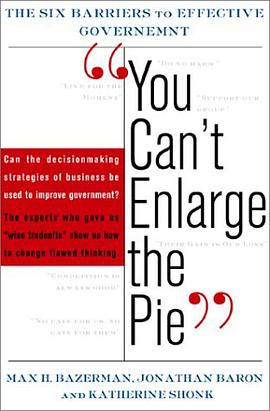
Why do our government leaders continually make decisions and craft policies that everybody knows are foolish? Because they, like the rest of us, remain trapped in foolish and unproductive habits of thinking. "You Can't Enlarge the Pie" analyzes the unspoken assumptions that lead to bad policy, wasted resources, and lost lives, and shows exactly why they're wrong. With fascinating case studies and clear, compelling analysis, it dissects six psychological barriers to ineffective government:
1. Do no harm.
2. Their gain is our loss.
3. Competition is always good.
4. Support our group.
5. Live for the moment.
6. No pain for us, no gain for them.
By freeing ourselves from the narrow way we evaluate our government leaders, we can learn to judge their performance more as that of business leaders is judged: by the overall health of their organizations.
Book Description
When they learn how to negotiate and solve problems, students in management schools are taught two things. First, they are to look for and recognize any cognitive biases that may be affecting their own decisions about possible solutions. Second, in any disagreement, they are to seek out "wise tradeoffs": resolutions that minimize the costs and maximize the gains for all parties. Current and future executives are trained to craft agreements that create value by enlarging the pie of resources available, and to avoid the pitfalls that reduce organizational effectiveness.
But if pragmatic business leaders have adopted such non-adversarial techniques, why has government grown increasingly combative? Why do our government leaders continually make decisions and craft policies that everyone knows are imprudent? It's not because they're ignorant or corrupt, but because our leaders, like the rest of us, are trapped in careless and unproductive habits of thinking. With case studies and clear, compelling analysis based on the latest decision-making and negotiation research findings, Bazerman, Baron and Shonk dissect six flawed ways of thinking that serve as psychological barriers to effective governments.
Two of the country's leading experts in business negotiation and decision-making show how their methods can be used to solve the problems of government.. everybody knows are foolish? It's not because they're stupid or corrupt, say the authors, but because our leaders, like the rest of us, are trapped in foolish and unproductive habits of thinking. "You Can't Enlarge the Pie" analyzes the unspoken assumptions that lead to bad policy, wasted resources, and lost lives, and shows exactly why they're wrong. With fascinating case studies and clear, compelling analysis, they dissect six beliefs that serve as psychological barriers to effective government:1. Do no harm2. Their gain is our loss3. Competition is always good4. Support our group5. Live for the moment6. No pain for us, no gain for themBy freeing ourselves from the narrow way we evaluate our government leaders, say the authors, we can learn to judge their performance just as we judge that of business leaders: by the overall health of their organizations.
Synopsis
Two of the country's leading experts in business negotiation and decision-making show how their methods can be used to solve the problems of government.. everybody knows are foolish? It's not because they're stupid or corrupt, say the authors, but because our leaders, like the rest of us, are trapped in foolish and unproductive habits of thinking. "You Can't Enlarge the Pie" analyzes the unspoken assumptions that lead to bad policy, wasted resources, and lost lives, and shows exactly why they're wrong. With fascinating case studies and clear, compelling analysis, they dissect six beliefs that serve as psychological barriers to effective government:1. Do no harm2. Their gain is our loss3. Competition is always good4. Support our group5. Live for the moment6. No pain for us, no gain for themBy freeing ourselves from the narrow way we evaluate our government leaders, say the authors, we can learn to judge their performance just as we judge that of business leaders: by the overall health of their organizations.
From Publishers Weekly
Bazerman (a Harvard professor of business administration), Baron (a University of Pennsylvania professor of psychology) and Shonk (a Harvard research associate) have a promising idea for improving government. Drawing on "an approach that now dominates the curriculum of business schools," they declare, "Our core argument is that large gains can often only be achieved when citizens learn to accept small losses in return" as with vaccines, which save far more lives than they cost in fatal side effects. The authors devote separate chapters to each of six cognitive barriers they claim prevent us from making such wise trade-offs. Some are clearly related to their main theme "do no harm" describes the rationale opposing vaccination; but others notably "competition is always good" require more elaboration, which is generally lacking. Furthermore, they sometimes criticize behavior in one chapter and praise or simply overlook it in another indicating a schematized approach that ignores crucial sources of policy-making difficulty. One chapter touts free trade between countries while another decries cities' ruinous competitive spending on sports arenas, without acknowledging a similar dynamic when labor, consumer and environmental laws are construed as "trade barriers." The authors' cognitive focus obscures genuine objective dilemmas, while their psychologizing is often implausible. They say campaign finance reform has low priority as an ill-defined "process issue" that people can't grasp because like most business negotiators they don't think ahead. But most citizens grasp political corruption, which seems similarly to be a "process issue." Despite some obviously promising ideas, the relentless reductionism oversimplifies and psychologizes problems that have complex, historical, real-world roots.
Book Dimension
Height (mm) 235 Width (mm) 156
作者简介
目录信息
读后感
评分
评分
评分
评分
用户评价
我是一个非常注重实际效果的读者,我喜欢那些能给我带来实际改变的书。起初,我以为这本书可能更多地偏向理论探讨,但读下去才发现,它其实蕴含着非常深刻的实践指导意义。作者并没有直接告诉你“应该怎么做”,而是通过一种“启发式”的教育方式,让你自己去发现“应该怎么做”。他提出的很多观点,都能够巧妙地应用到我所处的现实环境中,解决我工作中遇到的各种挑战。我尝试着将书中的一些理念融入到我的日常决策中,令人惊喜的是,效果非常显著。我发现,很多曾经让我头疼不已的问题,在新的视角下,变得迎刃而解。这本书就像一位经验丰富的导师,用最恰当的方式,引导我走出迷茫,找到前进的方向。
评分这本书给我的感觉,远不止于一本“书”。它更像是一次“心灵的旅行”,一次“认知的升级”。作者的文字充满了智慧的光芒,每一句话都仿佛经过了千锤百炼,蕴含着深刻的哲理。我惊叹于作者能够将如此宏大的主题,用如此通俗易懂、引人入胜的方式呈现出来。在阅读的过程中,我仿佛置身于一个更加广阔的思维空间,原本固有的认知被不断地挑战和重塑。我曾经对某些事物抱有的固有看法,在这本书的引导下,发生了巨大的转变。这是一种非常愉悦的“痛苦”,痛苦在于打破旧有的思维模式,愉悦在于获得新生般的认知体验。我越来越期待,在这趟心灵旅程的终点,我又能发现怎样的风景。
评分坦白说,当我刚拿到这本书的时候,并没有抱太大的期望,市面上类似的“如何解决问题”的书籍太多了,我担心它会落入俗套。然而,这本书从一开始就展现出了与众不同的气质。作者并没有一开始就抛出各种“解决方案”,而是花了相当大的篇幅去“诊断”问题的根源,就像一位经验丰富的外科医生,在手术前仔细检查病灶。这种深入剖析的方式,让我耳目一新。我发现,很多时候我们之所以陷入困境,并非是因为缺乏解决办法,而是我们根本没有看清楚问题的本质。作者用了一种非常巧妙的方式,将复杂的社会现象和个人困境进行解构,然后一一展示在我们面前。这期间,我不禁多次停下来,思考自己曾经遇到过的一些难题,并惊讶地发现,书中提出的视角,竟然能如此精准地解释我当时的处境,甚至揭示出我自己都没有意识到的深层原因。这种“顿悟”的感觉,正是阅读的魅力所在。
评分这本书给我的感觉,就像是在经历一场精神的“洗礼”。它不是那种能让你立刻获得某种技能的书,也不是那种能让你瞬间致富的书,而是那种需要你静下心来,慢慢品味,并在脑海中反复咀嚼的书。作者的写作风格非常独特,有时候像是诗歌,充满了哲学的韵味;有时候又像是在讲一个古老的故事,引人入胜,发人深省。我特别欣赏作者在处理一些敏感或者争议性话题时的态度,他既不回避,也不偏激,而是以一种非常平和、理性的方式,引导读者去思考,去理解。读这本书的过程中,我发现自己的情绪也在发生微妙的变化,原本的焦躁和困惑,似乎在慢慢被一种平静和豁达所取代。这是一种非常奇妙的体验,仿佛心智被一种更加广阔的视野所拓展,看待世界的方式也变得更加开阔。
评分这本书的封面设计就深深吸引了我,一种简洁但又不失力量的视觉冲击力。没有花哨的插图,只有沉稳的字体和恰到好处的留白,仿佛在用一种无声的语言预示着书中内容的深刻性。翻开第一页,作者的语言风格便如同一股清流,没有晦涩难懂的术语,也没有故弄玄虚的议论,而是直接切入主题,用一种非常真诚且充满智慧的方式与读者对话。我尤其喜欢作者在叙述某个观点时,会引用一些生活中的小故事或者普遍存在的现象来佐证,这让原本可能抽象的道理变得触手可及。读到这里,我便有种预感,这本书绝非泛泛之辈,它所探讨的议题,很可能是我们在日常生活中常常忽略却又至关重要的。每一次阅读,都像是与一位睿智的朋友进行一场深入的灵魂交流,让我不断反思自己的认知和行为模式。我迫不及待地想要深入了解书中更深层次的论述,感受作者所构建的那个引人深思的逻辑世界。
评分 评分 评分 评分 评分相关图书











本站所有内容均为互联网搜索引擎提供的公开搜索信息,本站不存储任何数据与内容,任何内容与数据均与本站无关,如有需要请联系相关搜索引擎包括但不限于百度,google,bing,sogou 等
© 2026 book.quotespace.org All Rights Reserved. 小美书屋 版权所有