具体描述
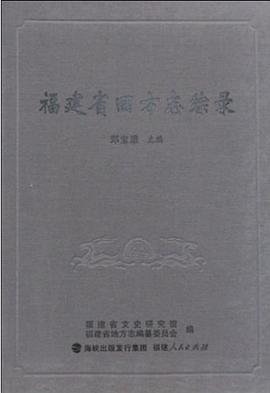
《福建省旧方志综录》将民国以前(含民国)修纂的福建省各级政区(省、府、县、乡)的通志,分存、佚两个部分,编成综录,供读者检索。
《福建省旧方志综录》是一部 meticulously compiled and comprehensive catalog of historical gazetteers pertaining to Fujian Province. It serves as an indispensable resource for researchers, historians, genealogists, and anyone interested in the rich and multifaceted history of Fujian. The compilation meticulously identifies, describes, and categorizes a vast array of gazetteers, spanning centuries of regional documentation. The scope of this work is extensive, encompassing official governmental records, local chronicles compiled by scholars and gentry, and even private compilations that offer unique insights into specific communities or historical periods within Fujian. It does not present new historical narratives or interpretations of Fujian's past. Instead, its primary function is to act as a meta-level guide, pointing researchers towards the primary source materials that form the bedrock of Fujianese history. Each entry within the "综录" (Zōnglù - Comprehensive Record/Catalog) is designed to be informative and user-friendly. While the exact format may vary slightly to accommodate the diverse nature of the source materials, a typical entry might include: Title of the Gazetteer: The full and accurate title of the original gazetteer. Author(s)/Compiler(s): Where known, the individuals or groups responsible for its creation. Publication Date/Period: The approximate or exact year of publication or the historical period it covers. Extent/Volume: Information regarding the number of juan (卷 - traditional scroll units) or volumes. Provenance/Location: Details about where the gazetteer is held in archives, libraries, or private collections, aiding in its physical retrieval or study. This could include mentions of major national libraries, provincial archives, university collections, and potentially even rare private holdings where access might be facilitated through scholarly inquiry. Brief Description of Content: A concise overview of the thematic content of the gazetteer. This is crucial for guiding researchers. Typical content areas found in Fujianese gazetteers include: Geography and Topography: Descriptions of mountains, rivers, lakes, plains, coastlines, and other natural features. This section would often detail geological formations, soil types, and significant landforms that have shaped the region's development and human settlement. Climate and Meteorology: Records of weather patterns, agricultural seasons, and notable climatic events such as droughts, floods, and typhoons. Administrative Divisions and Governance: Information on the historical evolution of prefectures, counties, townships, and their administrative structures, including officials, laws, and governmental policies. This would delve into the bureaucratic frameworks that governed the province over time. Population and Demographics: Data on population figures, ethnic groups, migration patterns, and social stratification. This could include information on population censuses, taxation records, and records of different social classes. Economy and Agriculture: Details on agricultural practices, crop production, livestock, irrigation systems, and land ownership. It would also cover other economic activities such as fishing, mining, handicrafts, and trade. Industry and Commerce: Information on manufacturing, crafts, and trade routes, including the types of goods produced and traded, market dynamics, and key commercial centers. Education and Culture: Records of schools, academies, Confucian temples, literary societies, notable scholars, examinations, and intellectual movements. This would highlight the intellectual and cultural landscape of Fujian. Arts and Literature: Mentions of poets, writers, artists, calligraphers, and their works, as well as descriptions of literary trends and artistic styles prevalent in different periods. Religion and Philosophy: Information on local religious beliefs, temples, monasteries, shamanism, Taoism, Buddhism, and the influence of Confucianism and other philosophical schools. Social Customs and Folklore: Descriptions of local traditions, festivals, rituals, marriage customs, burial practices, dietary habits, and oral traditions. This section offers a glimpse into the daily lives and cultural practices of the people. Biographies (Liezhuan 列传): Accounts of prominent individuals, including officials, scholars, military figures, philanthropists, filial paragons, and virtuous women. These biographies provide insights into the lives and achievements of influential individuals. Local Products and Resources: Information on indigenous flora and fauna, minerals, medicinal herbs, and other natural resources that are unique to or abundant in specific regions of Fujian. Historical Events and Anecdotes: Records of significant historical occurrences, rebellions, wars, famines, natural disasters, and notable legends or local stories that have shaped the collective memory of the region. Architecture and Urban Planning: Descriptions of cities, towns, villages, fortifications, temples, ancestral halls, residences, and other significant structures. This could include details on building materials, architectural styles, and urban layout. Transportation and Infrastructure: Information on roads, bridges, canals, ports, and other infrastructure that facilitated movement and trade within and beyond the province. This "综录" is not an encyclopedic work that synthesizes this information into a cohesive historical account. Rather, it is a critical inventory. Its value lies in its systematic approach to identifying the surviving "old gazetteers" (旧方志 Jiù Fāngzhì). Many of these older documents are rare, scattered, or even unique, making their systematic documentation a monumental task. The compilation process likely involved extensive research in archives, libraries, and private collections across China and potentially internationally. It would have necessitated meticulous comparison of different editions, identification of lacunae, and verification of bibliographic data. The "综录" acts as a roadmap, allowing scholars to understand the available documentary landscape of Fujian's history. For instance, a researcher interested in the economic history of Zhangzhou during the Ming Dynasty might consult the "综录" to find references to specific gazetteers from that period and region. The entry for each gazetteer would then provide the necessary details to locate and consult the primary source itself, enabling the researcher to directly engage with contemporary accounts of trade, agriculture, and local markets. Furthermore, the "福建省旧方志综录" acknowledges the diverse textual traditions and evolving standards of gazetteer compilation over time. It recognizes that older gazetteers might differ significantly in their structure, content emphasis, and stylistic conventions from those compiled in later periods. The "综录" aims to present these variations neutrally, allowing users to appreciate the historical context of each document. In essence, this "综录" is a scholarly tool designed to empower historical research on Fujian. It meticulously catalogs the primary documentary heritage, facilitating access to the raw material of history. It is a testament to the importance of preserving and organizing regional historical records, offering a gateway to the intricate tapestry of Fujian's past. It does not offer its own historical analysis, nor does it claim to be a definitive history of Fujian. Its strength lies in its comprehensive and organized enumeration of the existing historical records, making it an indispensable starting point for any serious study of the province.